

Basic information and model differentiation
1. Core model
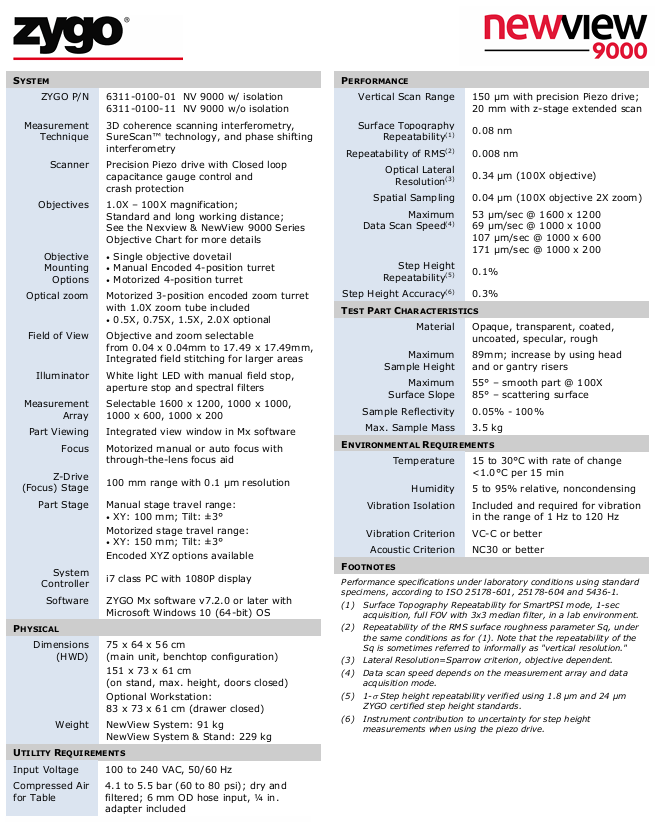
The NewView 9000 system offers two basic configurations, with the core difference being whether it includes vibration isolation components:
Model (ZYGO P/N) Configuration Description Applicable Scenarios
6311-0100-01 Vibration sensitive environment with isolation system (such as laboratory multi equipment area, precision manufacturing workshop)
6311-0100-11 scenarios without isolation system (w/o isolation) equipped with external isolation platform (such as dedicated optical laboratory)
2. Principles of Measurement Technology
Adopting 3D Coherence Scanning Interferometer technology combined with Zygo’s patented SureScan ™ Technology and Phase Shifting Interferometry enable non-contact surface height data acquisition:
Advantages: Balancing “large scanning range” and “high vertical resolution”, it can measure various surfaces such as transparent/opaque, smooth/rough, etc., without the need for sample pretreatment.
Core hardware configuration
The hardware of NewView 9000 is designed around “high-precision optical imaging+flexible motion control”, and the key component parameters are as follows:
1. Optical system
(1) Objective lens and zoom component
Specific parameter characteristics of components
Objective magnification: 1.0X -100X;
Type: Standard working distance, long working distance (optional);
Adaptability: Please refer to the “Nexview&NewView 9000 Series Objective Lens Chart” to cover requirements ranging from “low magnification for large field of view” to “high magnification for small field of view”. Long working distance objective lenses are suitable for thick samples/complex fixtures
There are three options for installing the objective lens:
1. Single objective dovetail groove;
2. Manual Encoded 4-position Turret;
3. Motorized 4-position turret: The motorized turret supports automated objective lens switching and is suitable for batch sample measurement; Manual turntable has lower cost and is suitable for fixed scenarios
Optical zoom standard configuration: electric 3-digit coded zoom turntable (including 1.0X zoom tube);
Optional: 0.5X, 0.75X, 1.5X, 2.0X zoom components with zoom and objective lens to expand the field of view, coding design ensures repeatability of zoom position
(2) Field of view and lighting
Field of View Range: 0.04 × 0.04mm (high magnification objective+high zoom)~17.49 × 17.49mm (low magnification objective+low zoom), supports integrated field stitching, and can measure large-sized samples beyond the field of view;
Lighting system: White LED light source, equipped with manual field stop, aperture stop, and spectral filter, adjustable lighting intensity and spectral range, suitable for different reflectivity samples.
(3) Image acquisition
Measurement array (pixels): 4 options -1600 × 1200 (high-resolution), 1000 × 1000, 1000 × 600, 1000 × 200 (high-speed acquisition);
Sample observation: The Mx software has an integrated view window built-in, which displays sample images in real-time and assists in focusing and area positioning.
2. Motion control system
(1) Z-axis drive (focusing and scanning)
Component parameter function
Precision piezoelectric drive vertical scanning range: 150 μ m;
Control method: Closed loop capacitance gauge;
Safety design: including crash protection for high-precision vertical scanning, obtaining surface height data, and capacitance gauge to ensure scanning accuracy
Z-axis focusing stage stroke: 100mm;
Resolution: 0.1 μ m;
Focusing method: Electric manual/automatic focusing (with bandpass mirror focusing assistance) used for rough focusing and large height range adjustment of samples, with automatic focusing function improving operational efficiency
(2) Sample stage
Provide two configurations of “manual” and “electric” to meet different automation needs:
Stage type XY axis stroke tilt range (Tilt) Additional functions
Manual stage 100mm ± 3 ° foundation positioning, low cost
Electric stage 150mm ± 3 ° supports automated multi position measurement, with optional “coded XYZ” configuration to improve positioning repeatability
3. System control and software
Control computer: i7 processor, 1080P monitor;
Operating System: Microsoft Windows 10 (64 bit);
Software: ZYGO Mx v7.2.0 and above versions, supporting data acquisition, 3D/2D visualization, roughness analysis (such as Sq, Ra), step height calculation, and other functions.
Key performance indicators (under laboratory conditions)
The performance parameters are based on ISO standards (25178-601, 25178-604, 5436-1) and validated using standard samples. The core indicators are as follows:
Performance category specific parameter notes
Vertical scanning range of 150 μ m (piezoelectric drive); 20mm (Z-axis extended scan) extended scan suitable for large step height samples (such as 20mm thick samples)
Surface morphology repeatability (1) 0.08nm SmartPSI mode, 1-second acquisition, full field of view+3 × 3 median filtering
RMS roughness (Sq) repeatability (2) 0.008nm, also known as “vertical resolution”, reflects the accuracy of surface detail measurement under the same measurement conditions as described above
Optical lateral resolution (3) 0.34 μ m (100X objective) Based on the Sparrow criterion, the higher the objective magnification, the higher the lateral resolution
Data scanning speed (4) 171 μ m/s (1000 × 200 array) The speed varies with the “measurement array size” and “acquisition mode”, and the small array is suitable for high-speed measurement
Step height repeatability (5) 0.1% (1 σ) verified with Zygo certified step standard parts at 1.8 μ m and 24 μ m
Step height accuracy (6) 0.3% with instrument contribution only uncertainty, based on piezoelectric drive measurement
Sample adaptation range
NewView 9000 supports multiple types of samples and adapts parameters covering key dimensions such as material, size, and surface characteristics
Description of sample characteristic adaptation parameters
Material: opaque (metal, silicon wafer), transparent (glass, polymer), coated/uncoated, smooth/rough surface. White LED and filter are compatible with low reflectivity samples (minimum reflectivity of 0.05%)
The maximum height of the sample is 89mm; it can be expanded through the “lens holder/gantry risers”. Attention should be paid to the working distance of the objective lens to avoid collision between the sample and the objective lens
Smooth surface slope: maximum 55 ° (100X objective lens);
Scattering surface: Suitable objective lens should be selected for high slope samples with a maximum angle of 85 ° to avoid data loss
The maximum sample weight is 3.5kg to protect the accuracy of the stage movement. For overweight samples, customized load-bearing components are required
Environmental requirements
To ensure measurement accuracy, the following environmental conditions must be met, with core control of “temperature, vibration, acoustics” interference:
Purpose of environmental category requirements
Temperature 15-30 ° C; temperature change rate<1.0 ° C/15 minutes to avoid material thermal deformation affecting the optical system and sample
Humidity 5% -95% relative humidity, non condensing to prevent condensation of optical components and rusting of metal parts
Vibration isolation comes standard with a vibration isolation system (model 6311-0100-01);
Vibration range: 1Hz-120Hz;
Vibration standard: It is required to meet the requirement that vibration of VC-C level or above will cause interference fringes to blur, affecting the accuracy of height data
Acoustic environment NC30 level or above (noise ≤ 30 decibels) to avoid the transmission of sound wave vibrations to equipment and interference with precision moving components
Core notes and applicable scenarios
Timeliness of specifications: Technical parameters may change without prior notice, and actual configuration should be based on the latest official Zygo documentation;
Applicable scenarios:
Research field: Surface roughness of MEMS devices, microstructure step height, and surface morphology analysis of biomaterials;
Industrial field: semiconductor wafer flatness, optical component surface shape error, precision mold surface quality inspection;
Calibration requirements: Zygo certified standard parts (such as step height standard parts, reference planes) need to be calibrated regularly to ensure stable performance indicators.
Leave a comment
Your email address will not be published. Required fields are marked *