
Call us 24/7uaedcs@163.com
Welcome to the official website of CNIACS Automation Technology Co., Ltd!
Call us 24/7uaedcs@163.com

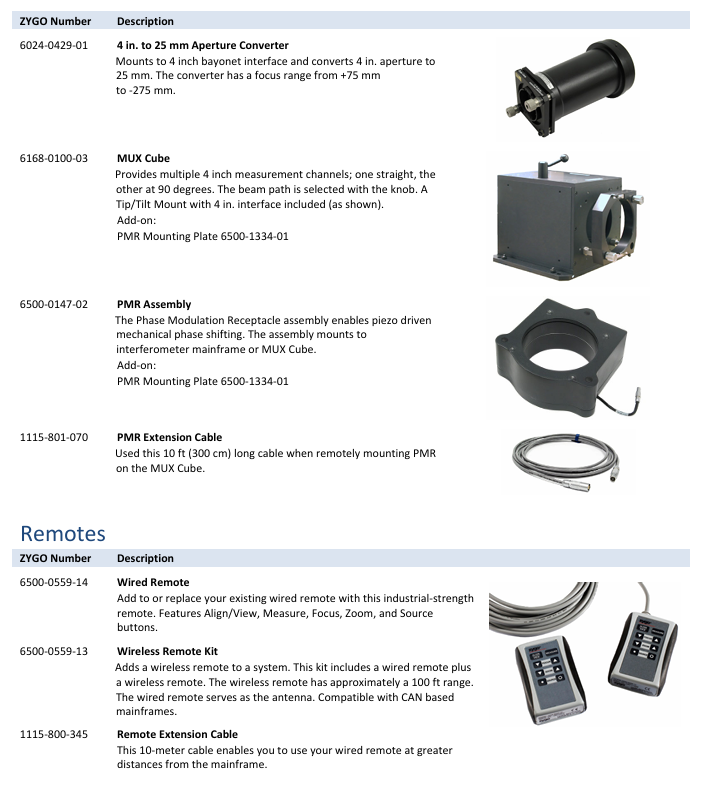
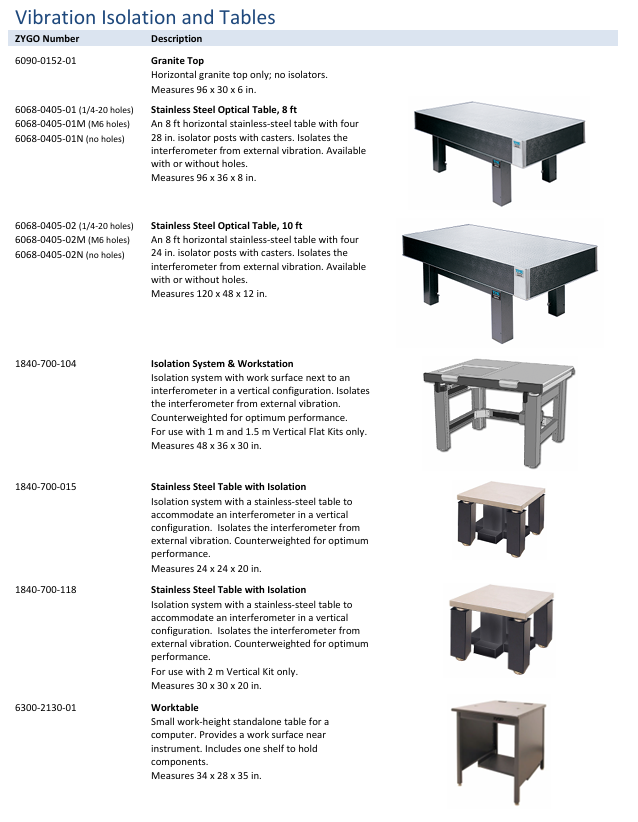
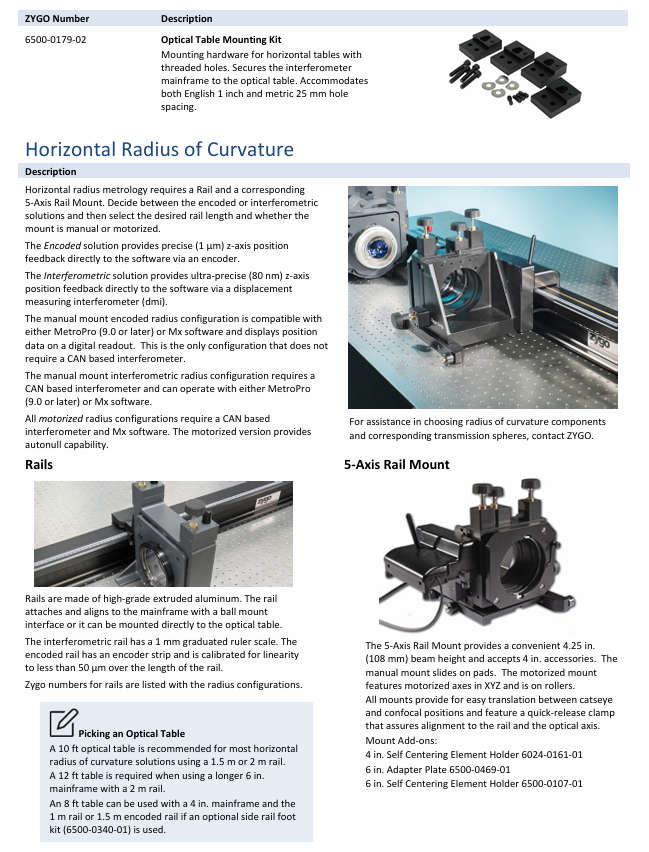
ZYGO Laser Interferometer  Accessory Guide OMP-0463AM 

Core positioning and scope of application

1. Positioning and Value

This manual should be an authoritative guide for the accessories of Zygo laser interferometers, with the core goal of helping users:

Clarify the accessory requirements for different measurement scenarios (such as transmission through the plane for planar measurement and transmission through the sphere for spherical measurement);

Correct selection (such as matching accessory specifications based on interferometer model and measuring aperture), installation and debugging (such as optical alignment, mechanical fixation);

Maximizing accessory functionality (such as improving measurement accuracy through isolation tables and achieving automated measurement through programmable stages).

2. Applicable product scope

Based on the Zygo laser interferometer product line, the core host models covered in the manual are speculated as follows:

Key accessories for core application scenarios of interferometer series

GPI series (such as GPI XP, GPI Pro) for measuring large aperture optical components (4-18 inches), such as flat mirrors, spherical lenses, large transmission planes/spheres, heavy-duty stages, and vibration isolation systems

The VeriFire series (such as VeriFire MST, VeriFire Sphere) provides high-precision wavefront analysis and non spherical measurement for optical lenses, high-resolution laser resonant cavity cameras, non spherical dedicated transmission components, and dynamic measurement modules

NewView series (such as NewView 5000, NewView 7000) micro morphology measurement (MEMS, microstructure surface), roughness/step height detection high magnification microscope objective (2.5X-100X), white light scanning module, precision Z-axis drive
Speculative core content framework

1. Detailed explanation of accessory classification and functions

The manual is likely classified according to the “function and purpose of accessories”, clarifying the core functions, technical parameters, and applicable scenarios of various accessories. It is speculated that the classification and representative accessories are as follows:

(1) Optical core accessories

Used to generate reference wavefronts and optimize laser optical paths, it is the “optical foundation” of interferometric measurement, and its core includes:

Transmission Flat (TF):

Function: Generate a planar reference wavefront for detecting the flatness of planar components such as glass plates and mirrors;

Key parameters: caliber (4 inches/6 inches/12 inches), flatness accuracy (such as ≤ 0.02 λ RMS, λ=632.8nm), material (such as ULE ultra-low expansion glass, reducing temperature deformation);

Applicable scenarios: GPI series for measuring large-diameter planar components and calibrating semiconductor wafer flatness.

Transmission Sphere (TS):

Function: Generate spherical reference wavefront for detecting the curvature radius and surface shape error of spherical components (such as lenses and mirrors);

Key parameters: curvature radius range (e.g. 10mm-10m), adaptive aperture (e.g. 2-8 inches), numerical aperture (NA, e.g. 0.1-0.5);

Selection criteria: Match the “curvature radius+aperture” of the tested sphere, for example, convex lenses need to choose “concave transmissive sphere”, and concave lenses need to choose “convex transmissive sphere”.

Objective lens and optical accessories:

Microscopic objectives (NewView series specific): such as 2.5X (large field of view), 50X (high resolution), 100X (ultra-high precision), with parameters including numerical aperture (NA) and working distance (such as 100X objective working distance of 0.3mm);

Polarization components: polarizers and waveplates, used to adjust the polarization state of lasers and adapt to the measurement of polarization sensitive elements (such as polarizers and waveplates);

Filter: such as narrowband filter (632.8nm ± 1nm), reduces environmental noise interference and improves signal-to-noise ratio.

(2) Mechanical auxiliary accessories

Used to fix the measured object, reduce environmental interference, achieve automated movement, and ensure measurement stability and efficiency:

Stage and fixture:

Manual stage: used for small-sized components (such as 1-2 inch lenses), supporting X/Y axis fine adjustment (accuracy ± 1 μ m) and θ rotation (± 0.1 °);

Programmable stage (such as Zygo Motorized Stage): supports automatic movement of X/Y/Z axes (with a repeat positioning accuracy of ± 0.5 μ m), and is compatible with multi position automatic measurement (such as wafer multi chip detection);

Special fixtures: such as vacuum suction cups (fixing transparent components), magnetic fixtures (fixing metal base components), and centering fixtures (ensuring that the center of the spherical component is coaxial with the interferometer optical axis).

Vibration isolation system:

Passive isolation table: such as Zygo Standard Isolation Table, which isolates low-frequency vibrations (1-10 Hz) through spring/damping structures and is suitable for laboratory environments;

Active isolation table: such as Zygo Active Isolation System, which detects vibration in real-time through sensors (response time<1ms) and actively cancels it out, suitable for complex vibration environments (such as production lines and multi device laboratories);

Selection criteria: interferometer accuracy level (such as active isolation for nanoscale measurements), environmental vibration spectrum (such as workshop vibration isolation of 10-50Hz).

Adjustment frame and bracket:

Optical adjustment bracket: used to fix the transmission plane/sphere, supporting pitch and roll fine adjustment (accuracy ± 0.001 °), ensuring that the reference wavefront is perpendicular to the interferometer optical axis;

Host bracket: Heavy duty bracket (suitable for GPI series large-sized hosts) with horizontal adjustment feet, used to fix the host and calibrate its levelness.

(3) Electronic and software accessories

Used to enhance data collection capabilities, achieve automated control, and expand analysis functions:

Camera and image acquisition card:

High resolution camera: such as 1600 × 1200 pixel, 12 bit grayscale camera, compatible with VeriFire series high-resolution wavefront measurement;

High speed image acquisition card: such as USB 3.0/PCIe interface, supports real-time acquisition (frame rate ≥ 30fps), and is compatible with dynamic measurement (such as MEMS vibration detection).

Control and Communication Module:

Motion controller: such as Zygo Motion Controller, used to control programmable stage and objective switching motors, supporting linkage with MetroPro software;

Remote control module: such as wireless remote control, supporting remote adjustment of laser switch and light intensity, suitable for operation of large interferometers (such as 18 inch GPI).

Software plugins and authorization:

Special analysis plugins: such as “roughness analysis module” (calculating Ra, RMS, Rz), “non spherical analysis module” (fitting non spherical coefficients);

Automated script authorization: such as MetroScript programming authorization, supporting custom measurement processes (such as automatic mask loading, batch data export).

(4) Calibration and maintenance accessories

Used to ensure the long-term measurement accuracy of interferometers and extend the lifespan of accessories:

Standard calibration parts:

Flat calibration components: such as Zygo Reference Flat (flatness ≤ 0.01 λ RMS), used for calibrating transmission plane accuracy and system error correction;

Spherical calibration component: such as a standard spherical mirror with a known curvature radius (accuracy ± 0.1 μ m), used to calibrate the curvature radius deviation of the transmitted spherical surface;

Step height standard components: such as 10 μ m/100 μ m standard steps, used to calibrate the step height measurement accuracy of the NewView series.

Maintenance tools:

Optical cleaning kit: such as lint free cloth and isopropanol cleaning solution, used to clean the optical surface of the transmission plane/sphere (to avoid dust affecting the reference wavefront);

Calibration tools: such as laser collimators, used to calibrate the parallelism between the interferometer optical axis and the stage motion axis.
2. Accessories selection and matching guide

The core chapters of the manual are likely to include the “selection process”, which helps users match according to “measurement requirements → host model → accessory specifications”. It is speculated that the key selection logic is as follows:

(1) Four step selection process

Clear measurement requirements: Determine the parameters of the tested object (such as size, type: plane/sphere/microstructure), accuracy indicators (such as flatness ≤ 0.1 λ, roughness ≤ 1nm Ra), and measurement efficiency (such as single piece measurement time ≤ 30s);

Match host model: Determine accessory compatibility based on host series (such as GPI → large caliber, NewView → microscope) and model (such as GPI XP → 8-inch caliber) (such as GPI XP only compatible with transmission planes of 8 inches and below);

Selection of accessory specifications: Taking “selection of transmission sphere” as an example, it is necessary to match the “curvature radius of the tested sphere” (such as selecting TS-100mm model for 100mm curvature radius) and “interferometer aperture” (such as selecting 8-inch transmission sphere for 8-inch host);

Verify environmental adaptability: For example, if the production line environment requires the selection of a “dust-proof stage”, and if the high temperature environment (such as 40 ℃) requires the selection of a “high temperature resistant fixture” (temperature resistance -20 ℃~80 ℃).

(2) Common selection misconceptions and avoidance

Misconception 1: Neglecting the compatibility between accessories and the host (such as using NewView’s microscope lens for GPI host);

Avoidance: The manual should clearly indicate the “Accessories Host Compatibility Table”, such as “Only NewView 5000/7000 supports 200X lenses”.

Misconception 2: Excessive pursuit of high-precision accessories (such as choosing an active isolation table for laboratory measurements, which can actually be satisfied by passive isolation);

Avoidance: Provide a “scene accessory matching recommendation table”, such as “passive isolation for laboratory accuracy ≤ 1nm, active isolation for production line accuracy ≤ 0.5nm”.

3. Installation, Debugging, and Application Cases

(1) Installation and debugging process

The manual may provide a “step-by-step installation guide” for key accessories, taking “installation on a transmissive sphere” as an example:

Mechanical fixation: Fix the transmitted spherical surface on the interferometer output port through a dedicated bracket, ensuring that the bracket is level (calibrated with a level, deviation ≤ 0.1 °);

Optical alignment: Fine tune the pitch/roll of the transmission sphere by adjusting the frame, so that the center of the reference wavefront coincides with the interferometer optical axis (observe the “center spot symmetry” through MetroPro software, deviation ≤ 5%);

Accuracy verification: Measure the standard spherical mirror and compare the “measured curvature radius” with the “standard value”. The deviation should be ≤ 0.1% (for example, if the standard value is 100mm, the measured value should be between 99.9-100.1mm).

(2) Typical application cases

The manual may help users understand the value of accessories through case studies of “scene+accessory configuration+effect”. The following case studies are speculated:

Case 1: Measurement of semiconductor wafer flatness

Host: GPI Pro (12 inches);

Accessories: 12 inch transmission plane, programmable vacuum stage, active isolation stage;

Effect: Achieve full aperture measurement of 8-inch wafers, with flatness repeatability ≤ 0.05nm RMS and measurement efficiency of 1 wafer per 2 minutes.

Case 2: Measurement of Step Height in MEMS Devices

Host: NewView 7000;

Accessories: 50X Mirau objective lens, 10 μ m step height standard component, high-speed image acquisition card;

Effect: The measurement accuracy of step height is ± 0.01 μ m, and it supports MEMS dynamic step change monitoring (sampling rate 10Hz).

4. Maintenance and warranty of accessories

Maintenance cycle and method: For example, the transmission plane needs to be cleaned every 3 months (gently wiped with a lint free cloth dipped in isopropanol), and the vibration isolation table needs to be calibrated for levelness every 6 months;

Warranty information: Zygo original parts warranty period (such as 1 year for optical parts and 2 years for mechanical parts), warranty scope (free replacement for non-human damage), repair process (such as applying for repair through Zygo customer support).
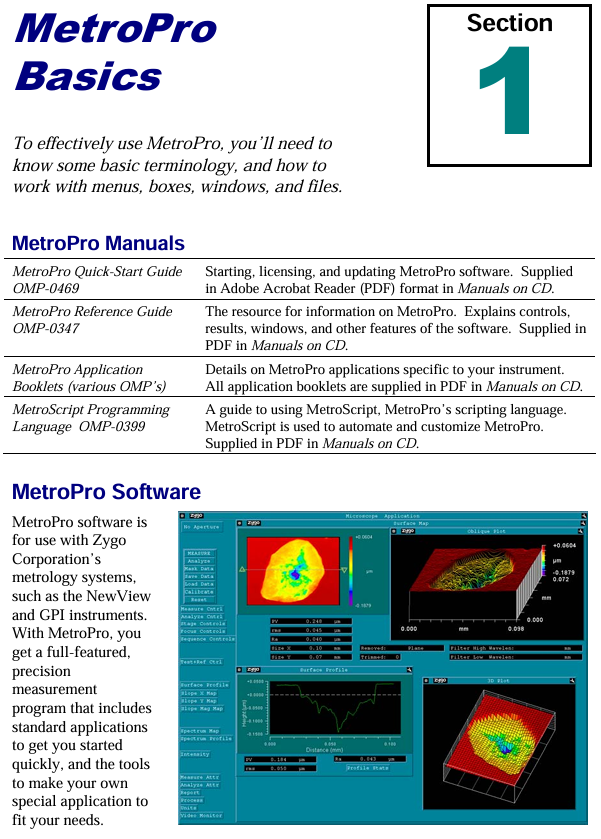
ZYGO MetroPro 9.0 Reference Guide (OMP-0347M)

Software Fundamentals and Core Architecture

1. Basic Information and Document System

Software positioning: Suitable for Zygo precision optical measurement equipment, providing data acquisition, analysis, visualization, and automation functions, supporting custom application configuration to adapt to different measurement scenarios (such as surface morphology, roughness, wavefront analysis).

Version history: From version 4.0 in 1993 to version 9.0 in 2011, the manual revision records cover functional updates in each version (such as the addition of FDA high-resolution analysis in version 7.10 and optimized pattern editor in version 8.0).

2. Software architecture and hierarchical logic

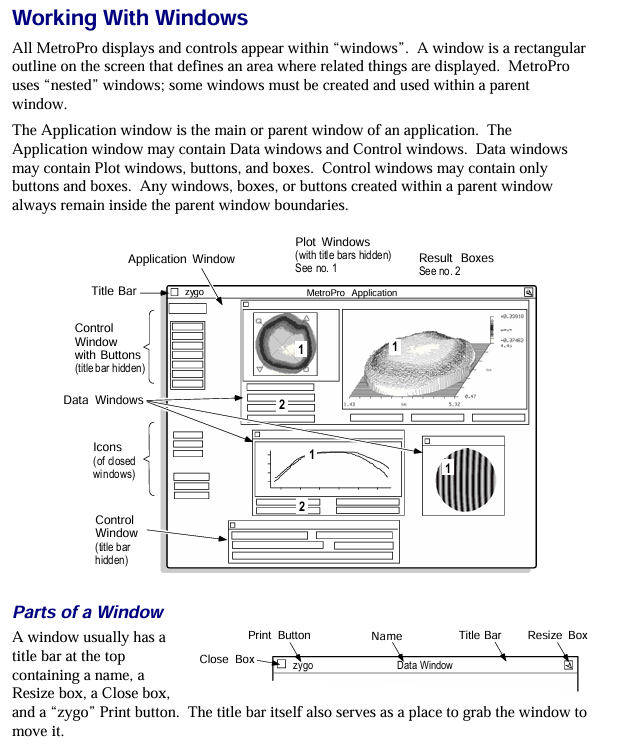
MetroPro adopts a nested window structure, with each component nested in a hierarchical order of “MetroPro main window → application window → function window (control/data/drawing, etc.)”. The core components are defined as follows:

Component Type Core Function Example

The top-level interface of MetroPro main window software after startup, which can load/create multiple application windows and display loaded application icons (such as Micro. app)

Application Window is a set of configurations for specific measurement tasks, including sub windows for surface morphology measurement applications such as control and data (including objective control and data display windows)

Control Window manages measurement parameters (such as laser power, scanning mode), triggering operations (measurement/calibration), including the “MEASURE” button and laser intensity control slider

The Data Window displays measurement data, supports plotting (3D/profile), and displays numerical results including filled plots and profile result tables

Plot Window data visualization tools, such as fill plots (surface morphology), profile plots (2D contour), 3D model plots, power spectral density plots (PSD)

Controls/Buttons control parameter adjustment (such as filter type, unit selection), trigger specific function “Auto Focus” button, “Filter Type” dropdown control

3. Basic operating standards

Keyboard and Mouse Operations:

Shortcut keys: F1 triggers measurement, F5 automatically adjusts light intensity, Ctrl+Alt+Delete exits software;

Mouse functions: right-click to bring up menus, middle click to move windows, left click to select/trigger (such as button clicking, text input).

File Management

Supports 10 core file formats, including application configuration (. app), measurement data (. dat), mask (. mas), script (. scr), etc;

File naming convention: The first character is a letter/number, supporting underscores and periods, with a maximum length of 20 characters (after version 7.4). It is recommended to add an extension (such as “Sample01. dat”);

Directory operation: Create/switch directories through the “File Handler” dialog box, supporting cross drive file access.

Window Control: Supports window movement, scaling, cascading, and closing (converted to icons), and can be hidden, renamed, deleted, and other operations through the “Window Control” menu.

Detailed explanation of core functional modules

1. Working with Applications

The application is the core task unit of MetroPro, which can be customized to meet different measurement needs. The core operations include:

(1) Application type and loading

Type classification:

Standard application: Pre installed software (such as “Micro. app” for microscopic measurement), write protected, needs to be copied and modified through the user directory;

Custom application: Modify based on existing applications (such as adjusting control positions, adding new drawings) or create from scratch.

Loading process: Right click on the MetroPro main window menu ->”Load Application”, select the. app file in the file browser, and support loading multiple applications simultaneously (up to 3 can be opened at the same time).

(2) Application configuration and saving

Core component configuration:

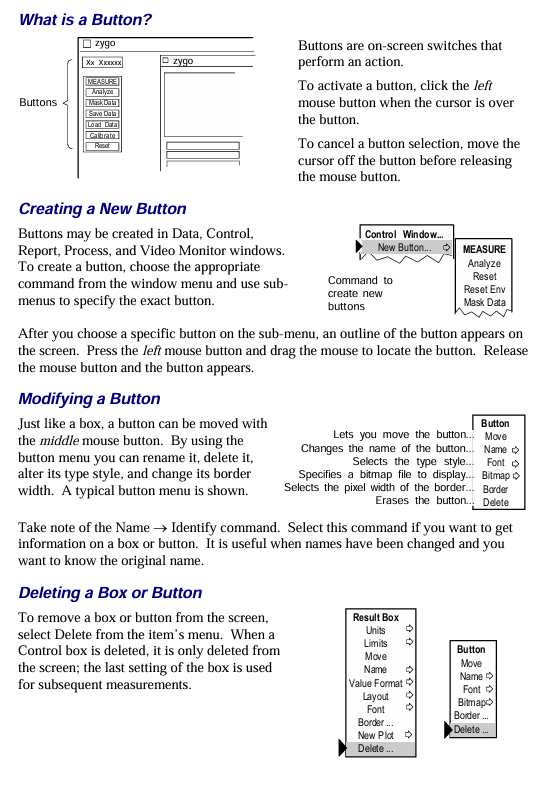
Control window: Add measurement parameter controls (such as objective lens selection, scan length), function buttons (such as “Calibrate” calibration);

Data window: Add plots (such as fill plots, profile plots), result value boxes (such as PV values, RMS values);

Other windows: Report window (generate measurement report), Video monitoring window (real-time display of measurement area).

Save rules:

Save Application “: Specify a name and path when saving for the first time (such as” Customs Surface. app “);

Re save Application “: Overwrite the current application configuration without the need to reselect the path;

Lock application: Press Ctrl+Shift+L to lock the application (to prevent accidental changes), supports password protection (4-13 letters/numbers).

2. Mask Editor

Masks are used to define measurement areas (including/excluding specific areas), supporting 4 types of masks and adapting to different measurement scenarios:

(1) Mask type and function

The core role of mask types in application scenarios

Default (default mask) takes effect by default when no other masks are defined for regular measurements, covering the entire camera field of view

Eliminate interference areas (such as edge diffraction and low reflectivity areas) during the data acquisition phase of the Acquisition mask to reduce data volume and improve speed

Test/Reference Mask Area Comparison Measurement defines “test area” and “reference area”, used for analyzing differences in different areas of the same part (such as surface flatness comparison)

(2) Mask creation and editing

Basic operation: Click the “Mask Data” button to open the editor, which supports drawing shapes such as circles, rectangles, polygons, etc. Use “Fill/Fill” to control whether the area is included in the analysis (the filled area is the valid area);

Advanced features:

Auto Aperture: Automatically generate circular/rectangular masks based on data, and can set the center position (such as data centroid, fixed coordinates) and the ratio of inner and outer diameters;

Fiducials: Define reference marker points for aligning parts (such as position calibration when assembling multiple data sets), and support saving as. gid files for reuse.

3. Pattern Editor

For instruments with programmable motor stages, used to define automatic measurement position sequences, supporting 3 types of pattern types:

(1) Pattern type and parameters

Pattern type applicable scenario core parameters

Rectangular regular array measurement (such as multiple chips on a wafer) includes row/column count, row/column spacing, and motion sequence (snake/grating)

Circular area measurement (such as lens surface) includes the number of circles, the number of radial points, and the radius range (Radius 1/Radius 2)

Free Rect irregular position measurement manual addition/editing of position coordinates, supports online (capturing position after stage movement)/offline (directly inputting coordinates) creation

(2) Pattern operation and control

Run settings: Specify the operation (measurement/run script), pause time (Pre Pause/Post Pause), and error handling (retry/skip/terminate) for each location;

Position management: Edit the position (including/excluding specific points) through the “Position Editor”, and view the measurement status of each position through the “Position Status” (identified by code: P=qualified, F=failed,?)? =Unmeasured).

4. Drawing function (Filled Plot&Profile Plot)

Drawing is the core of data visualization, and the most commonly used “Filled Plot” and “Profile Plot” are used in conjunction to cover 3D surfaces and 2D contour analysis

(1) Filled Plot

Functional positioning: Display 3D surface morphology and distinguish height differences by color (such as spectral colors representing different height ranges);

Controller function:

Color settings: Supports 16 color bands, grayscale, CMYK, and other color schemes. “Color Fit” optimizes the display of data with a high proportion of a single color;

Slice tool: Draw linear/radial/circular slices, define the analysis path of the cross-sectional view;

Show PV: Mark the highest (Peak) and lowest (Valley) points on the surface to display the PV value;

Limit display: Combined with the upper and lower limits of PV results, it is highlighted in red when exceeding the limit.

(2) Profile Plot

Function positioning: Display the 2D height contour on the slicing path, support precise numerical analysis;

Core operation:

Axis scaling: Fixed X/Y axis range (such as Y-axis set to 0-100nm), or automatically adapted to data range;

Inspection tool: Move the crosshair to read the coordinates of any point (X=distance, Y=height), calculate the distance between two points (xDst) and the height difference (yDst);

Result export: Export profile data as text (CSV/Tab separated) or images (BMP/CIF).

5. Instrument Control

Covering key operations such as equipment calibration, error correction, and light intensity adjustment to ensure measurement accuracy:

(1) Automatic function

Auto Focus: Suitable for devices with a Z-axis motor, set the focus range through “Focus Max Adjust” and the minimum modulation threshold through “Focus Min Mod” to ensure focus accuracy;

Auto Tilt: For platforms with pitch/roll motors, adjust the angle of the parts to reduce stripe tilt, and set the “Auto Tilt Iterations” adjustment frequency (recommended 2-3 times to ensure convergence);

Auto null: Used for measuring spherical parts, adjusting the X/Y/Z axes to minimize interference fringes, requires inputting the nominal radius of curvature (RadCrv) of the spherical surface.

(2) Calibration and Error Correction

Lateral Calibration:

Purpose: To establish a correspondence between camera pixels and actual length (e.g. 1 pixel=2.5 μ m), Zygo standard calibration parts are required;

Process: Draw a calibration line in the “Lateral Calibrator” window, enter the actual length (such as 1mm), and save the calibration parameters;

System Error Correction:

Method: Measure high-precision standard components (such as reference planes with ≤ 2 Å RMS), save them as a system error file (. dat), and enable error subtraction through the “Abstract Sys Err” control;

Applicable scenarios: Eliminate the inherent aberrations of the instrument (such as optical system errors in interferometers) and improve measurement accuracy.

(3) Light intensity control

Manual adjustment: Press F4 to open the light intensity window, use the+/- (fine) and */(coarse) keys to adjust, ensuring that the saturation pixels are below the threshold (default ≤ 4);

Automatic adjustment: Press F5 to start AGC (automatic gain control), automatically adapt the reflectivity of the parts, optimize the signal-to-noise ratio, and set the “Target Range” with a safety margin for light intensity saturation (default 0.1).

Data processing and result output

1. Data format and conversion

Support import/export of multiple data formats, suitable for different analysis scenarios:

Binary format:. dat (raw measurement data, including phase/intensity matrix),. app (application configuration),. mas (mask);

Text formats:. csv (comma separated, used for Excel analysis),. rep (report file),. zfr (Zernike polynomial, CODE V format);

Universal format: Supports interaction with optical design software, such as CODE V (. wfr/. sur), ZEMAX (grid height data), OSLO compatible files.

2. Results and Reports

Result types: covering surface morphology (PV, RMS, Ra), wavefront analysis (Zernike coefficient, Seidel coefficient), geometric parameters (curvature radius, tilt angle), etc., supporting custom result units (imperial/metric/optical units such as wavelength);

Report generation:

Report Window: Add result values, attributes (such as measurement time, operator ID), and comment text, and save them as. rp files;

Q-DAS report: compatible with Q-DAS quality analysis system, supporting Gage Type 1/3 studies (measurement system repeatability analysis), outputting. dfq (merged files) or. dfd/. dfx (split header/data files).

Key Terminology Annotations

QPSI ™: Zygo’s patented fast phase-shift interferometry technology, with a shutter speed of 5ms, strong anti vibration ability, and no need for complex isolation;

FDA (Frequency Domain Analysis): Frequency domain analysis technology used in white light scanning interferometers to extract multi wavelength phase information through Fourier transform and solve the 2 π phase ambiguity problem;

Zernike Polynomials: Used for fitting wavefront errors, MetroPro supports 37 terms (Coef 0-Coef 36) and can be exported in CODE V format;

BRDF(Bidirectional Reflectance Distribution Function): Bi directional reflection distribution function, used to analyze surface reflection characteristics, requires input of incident angle and scattering angle.

Zygo Device Standard Operating Procedure (SOP)

Core operating prerequisites and safety warnings

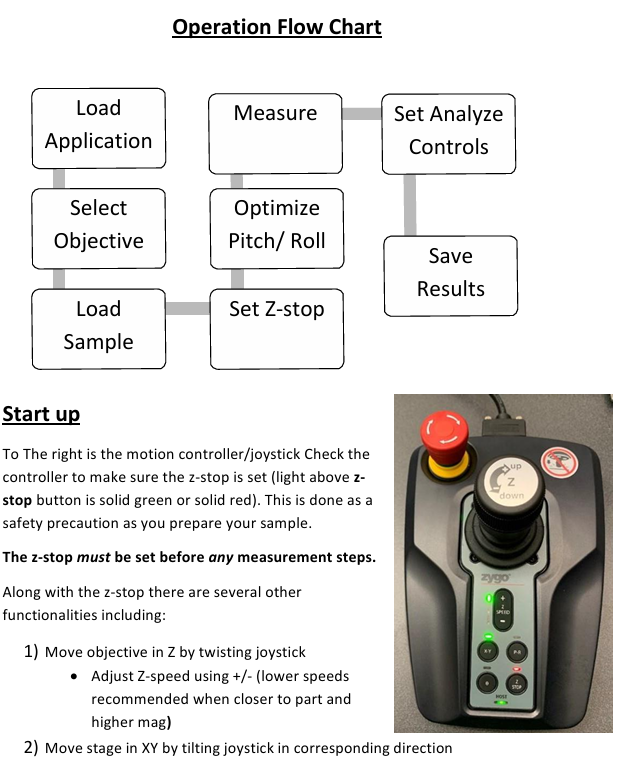
Core safety mechanism: The Z-axis limit (Z-stop) of the Motion Controller is a critical safety protection, and it must be confirmed that it has been set (the indicator light is constantly green or red) before all measurement steps to prevent collision between the objective lens and the sample/stage.

Emergency operation: If an abnormality occurs, immediately press the “Emergency Off” button on the motion controller, and the device will need to perform the “Homing” operation again in the future.

Complete operational process

1. Startup and initialization (Start Up)

(1) Inspection of motion controller

Confirm Z-stop status: The indicator light should be constantly on green/red. If it flashes red and accompanied by a beep, it needs to be reset (detailed steps to follow).

Familiar with controller functions:

Precautions for functional operation mode

When the Z-axis objective lens moves and rotates the Joystick near the sample or at high magnification, use low speed (adjusted by the “+/-” keys)

XY axis stage movement tilt control lever (need to select the “XY” button, corresponding green light on) is used for rough positioning of the sample to ensure that the objective beam is projected onto the sample

Pitch/Roll (P/R) adjustment tilt control lever (the “PR” button needs to be selected, corresponding green light is on) P (pitch), R (roll) maximum adjustment range ± 2 °, θ (rotation) function is invalid

(2) Software startup and application loading

Login to the computer: Enter the username “Zygo” and press Enter to enter the system.

Open the Mx software: Start the Mx program from the desktop, go to “File” ->”Load Application”, and load the “Micro. appx” application (the application list also includes other. appx files such as roughness measurement and low-pass filtering, which need to be selected accurately).

Instrument parameter initialization: After loading the application, a “F-stop/A-stop” setting window will pop up. Please confirm:

F-stop (aperture): in the “Open” state (locked by pressing the knob);

A-stop (aperture stop): in the “Open” state (locked by pressing the knob);

Filter: Set to “F1 (Measure)”, click “OK” to confirm.

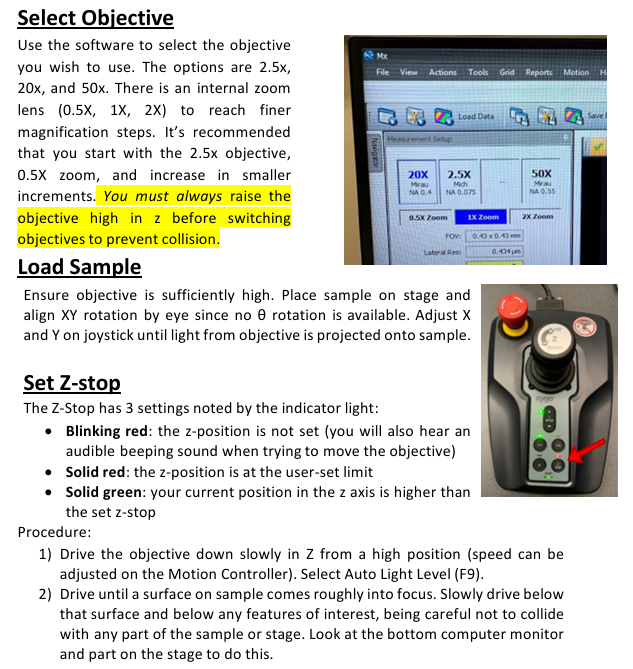
2. Sample and objective lens preparation

(1) Objective selection and switching

Optional objective lenses: 2.5X (NA 0.075), 20X (NA 0.55), 50X, paired with an internal zoom lens (0.5X/1X/2X) for fine magnification adjustment.

Switching principle:

Initial recommendation is to use a “2.5X objective lens+0.5X zoom” and gradually increase the magnification (to avoid collisions caused by using high magnification directly);

Before switching the objective lens, it must be raised to the highest position along the Z-axis to prevent collision with the sample.

(2) Load Sample

Confirm that the objective lens has been raised to a high position and place the sample on the stage;

Roughly adjust the XY direction rotation of the sample with the naked eye (the device does not have a θ rotation function);

Tilt the XY joystick and move the stage until the beam emitted by the objective lens is projected onto the surface of the sample.

(3) Z-stop setting (core security steps)

Slowly lower the objective lens from the Z-axis high position (adjust the controller speed, slightly faster in the initial stage, and slow down when approaching the sample), press “F9” to start “Auto Light Level”;

Continue to lower the objective lens until the sample surface is roughly in focus, and then slowly lower it to the position of “all features below the target measurement area” (combined with the display below and visual observation to avoid collision);

Press the “Z-stop” button on the motion controller, and the indicator light will change from flashing red to constantly on red, completing the setting (at this time, the lowest position of the Z-axis is locked).

3. Calibration before measurement (optimizing pitch/roll)

By adjusting the P/R (pitch/roll), ensure that the sample surface is perpendicular to the objective lens. The steps are as follows:

Move the XY stage to move the “smoothest and cleanest area” of the sample directly below the objective lens;

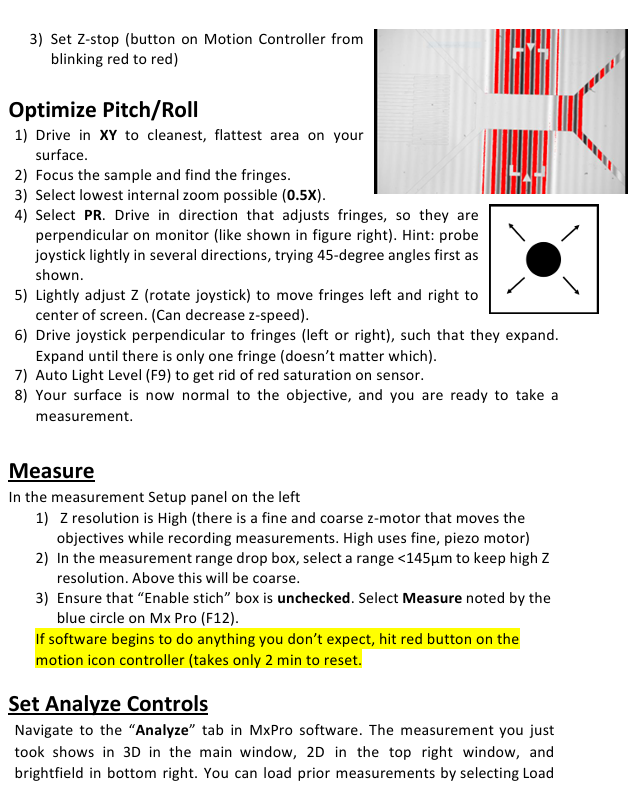
Focus on the sample and find the interference fringes, switch to the lowest internal zoom (0.5X) for easy observation of the fringes;

Select the “PR” button (green light on), lightly touch the joystick (try 45 ° direction first), and adjust the stripes to be perpendicular to the monitor;

Fine tune the Z-axis (rotate the joystick to reduce speed) and move the stripes to the center of the screen;

Tilt the joystick in the direction perpendicular to the stripes to expand them until only one stripe remains on the screen (direction not limited);

Press “F9” again to perform automatic light intensity adjustment, eliminate sensor red saturation, and complete calibration.

4. Perform Measurement

(1) Measurement parameter settings

Configure in the left “Measurement Setup” panel:

Z resolution: set to “High” (enable fine piezoelectric motor to ensure accuracy);

Measurement Range: Select a range of<145 μ m (if exceeded, it will automatically switch to coarse precision mode);

Enable Stitch function: Uncheck (default off to avoid multi area stitching errors).

(2) Start measurement

Click the blue “Measure” button in the Mx software (or press “F12”);

Exception handling: If the software performs an unexpected operation, immediately press the red emergency button on the motion controller to reset the device (approximately 2 minutes).

5. Data Processing (Set Analyze Controls)

After the measurement is completed, the data will be displayed in “3D view (main window), 2D view (upper right window), bright field image (lower right window)”, and horizontal correction needs to be performed through post-processing:

(1) 2D horizontal correction (applicable for profile analysis)

Right click on the 3D image in the main window and select “2D” to switch views;

Select the “Linear” option at the top of the window, click on two points on the image, and determine the profile to be analyzed (the profile curve will be automatically generated below);

Right click on the profile curve and add “Inspector 1” and “Inspector 2” in sequence;

Move the Inspector to the baseline surface, right-click and select “Level” to complete the calibration.

(2) 3D horizontal correction (applicable to overall surface analysis)

In the “Surface” panel on the left, click on “Surface Processing” (a settings window will pop up);

Check the “Immediate Update” and “Use Fit Mask” options in the bottom left corner, and click on “Mask Editor”;

Check ‘Form Remove’ and draw a geometric shape to frame the surface shape to be removed (such as protrusions and depressions);

Close the “Mask Editor” and “Surface Processing” windows, and the correction effect will be automatically applied to the 3D data.

6. Save Results&Clean Up

(1) Save Results

Raw data (. datax format): Use “File” → “Save Data” to save to the “Data (D:) \ ZygoData” folder on drive D;

Image/Table Export: Right click on any chart and select “Export” to export the image as an image format or the 2D section as a. csv file.

(2) Shutdown process

Raise the objective lens: Raise the objective lens to the highest position along the Z-axis and reset the Z-stop (press the button until the indicator light stays on in red);

Software and System Shutdown: Close the Mx software, exit the “Zygo” account, and turn off the monitor;

Record and report: Sign in the experimental log book. If any errors occur during use, take a screenshot and save it to the data folder, and indicate the fault situation in the log.

Key precautions

Collision protection: All operations involving Z-axis movement (switching objectives, loading samples, setting Z-stop) must ensure sufficient safety distance between the objective and the sample, and prioritize the lowest speed when high magnification (50X);

Magnification selection logic: Starting from low magnification (2.5X+0.5X), gradually increasing to avoid using high magnification directly causing “sample not found” or collision;

Data storage standard: The. datax original file should be named with “sample name+date”, and screenshots and. csv files should be associated with the original data for easy traceability in the future;

Priority of exception handling: In case of equipment failure, press the emergency button first, and then record the fault phenomenon (screenshot+text description). It is prohibited to disassemble or modify software parameters by oneself.

Zygo Verify Laser Interferometer

Core positioning and technological highlights of the product

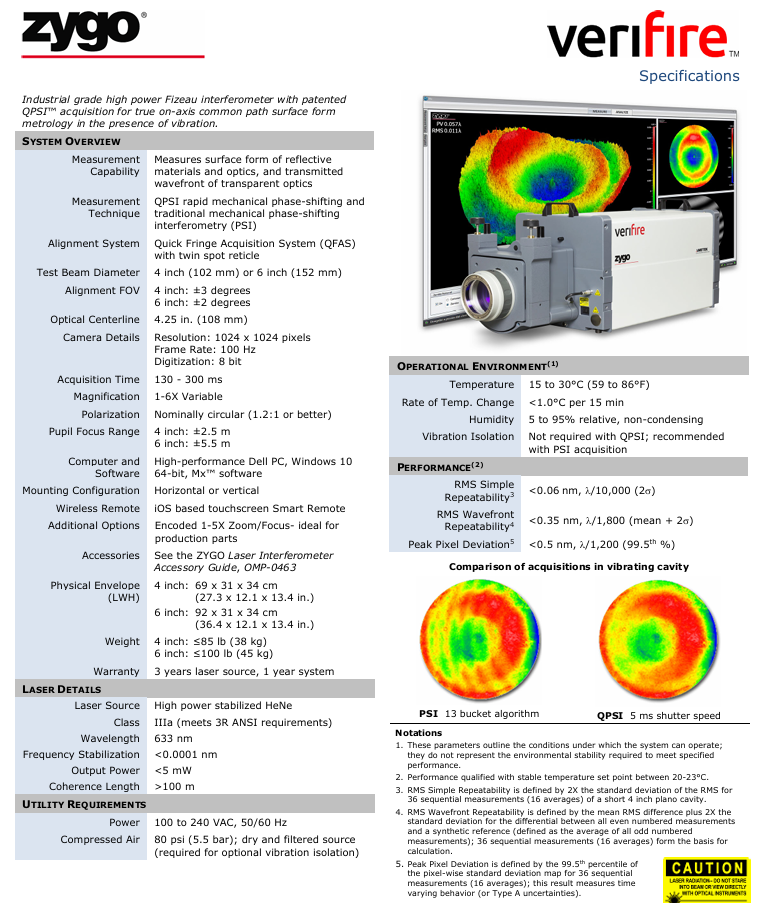
Zygo Verify is an industrial grade high-power Fizo interferometer, with the core advantage of being equipped with patented QPSI ™ The (Fast Phase Shift Interference) acquisition technology can achieve true coaxial common optical path surface morphology measurement in vibration environments, and is compatible with the traditional PSI (Phase Shift Interference) 13 bucket algorithm, balancing measurement accuracy and anti-interference ability. It is suitable for surface morphology detection scenarios of precision optical components.

Key system parameters

1. Optics and acquisition system

Parameter category 4-inch (102mm) model 6-inch (152mm) model supplementary explanation

Test beam diameter of 4 inches and 6 inches to meet the detection requirements of optical components of different sizes

Align the field of view (FOV) ± 3 degrees ± 2 degrees to assist in rapid positioning of the test piece and ensure alignment of the optical path

The optical centerline distance is 4.25 inches (108mm), and the fixed size is 4.25 inches (108mm) to ensure the stability of the measurement optical path

Camera parameter resolution 1024 × 1024 pixels, 8-bit digitization, frame rate 100Hz, same as 4-inch model, high frame rate supports fast data acquisition, 8-bit digitization ensures grayscale accuracy

Collection time 130-300ms 130-300ms Fast response improves detection efficiency

The magnification can be adjusted from 1 to 6 times, and the observation accuracy can be adjusted according to the detailed requirements of the measured object

Polarization pupil close to circular (1.2:1 or better) ensures beam polarization consistency and reduces measurement errors

Focusing range ± 2.5m ± 5.5m. The 6-inch model has a wider focusing range and is suitable for large-sized components

2. Laser source parameters

Type: High power stable helium neon (HeNe) laser, compliant with ANSI Class 3R safety requirements (Class IIIa)

Wavelength: 633nm (red light band, suitable for most optical component reflection/transmission measurements)

Frequency stability: < 0.0001nm, extremely low frequency drift ensures long-term measurement accuracy

Output power:<5mW, high power enhances signal strength, compatible with low reflectivity components

Coherence length:>100m, long coherence length supports large optical path difference measurement scenarios

Operating environment requirements

Remarks on specific requirements for environmental indicators

Stable operation is required within the temperature range of 15-30 ℃ (59-86 ℉). If performance indicators need to be met, it is recommended to set the temperature at 20-23 ℃ (performance verification reference temperature)

Temperature change rate<1.0 ℃/15 minutes to avoid rapid temperature changes that may cause thermal expansion and contraction of equipment components, affecting measurement accuracy

Humidity 5% -95% relative humidity, no condensation to prevent moisture from causing mold on optical components and short circuits in electronic components

Under vibration isolation QPSI technology, no additional vibration isolation is required; It is recommended to configure QPSI technology as the core anti vibration advantage in PSI acquisition mode to reduce the vibration control requirements for the installation environment

Measurement performance indicators (based on a stable temperature environment of 20-23 ℃)

Specific numerical definitions and calculation criteria for performance parameters

Perform 36 consecutive measurements (16 averages) on a 4-inch short planar cavity with RMS simple repeatability ³<0.06nm (λ/10000, 2 σ), and take 2 times the RMS standard deviation

RMS wavefront repeatability ⁴ < 0.35nm (λ/1800, mean+2 σ), the mean difference between all even numbered measurements and the “composite reference value of odd numbered measurement mean” in 36 consecutive measurements (16 averages), plus 2 times the standard deviation

In the pixel level standard deviation graph of 36 consecutive measurements (16 averages) with peak pixel deviation ⁵<0.5nm (λ/1200, 99.5 percentile), the deviation value corresponding to 99.5 percentile reflects the temporal variability (Class A uncertainty)

Physical and configuration information

1. Physical specifications

Model size (length x width x height) Weight

4 inches 69 × 31 × 34cm (27.3 × 12.1 × 13.4 inches) ≤ 85 pounds (38kg)

6 inches 92 × 31 × 34cm (36.4 × 12.1 × 13.4 inches) ≤ 100 pounds (45kg)

2. Hardware and software configuration

Computer: High performance Dell PC, equipped with Windows 10 system

Software: 64 bit Mx ™ Software that provides measurement control, data processing, and result analysis functions

Control accessories: iOS system touch screen intelligent remote control (wireless); 1-5 times zoom/focusing component with encoding (suitable for mass production part inspection)

Optional accessories: vibration isolation device (to be used with compressed air), other specialized testing accessories (see Zygo accessory guide for details)

3. Compressed air demand (optional for vibration isolation)

Pressure: 80psi (5.5bar)

Requirement: Dry and filtered air source to avoid moisture/impurities damaging vibration isolation components

Annotations on Core Terminology

QPSI ™: Zygo’s patented fast phase shifting interferometry technology has the core advantage of a 5ms shutter speed, strong anti vibration ability, and no need for complex vibration isolation environments.

PSI 13 bucket algorithm: The traditional 13 bucket phase shifting algorithm has high measurement accuracy, but is sensitive to environmental vibrations and needs to be used in a stable environment.

λ (wavelength): This specifically refers to the wavelength of the laser source at 633nm. “λ/XXX” in the performance indicators is a precise expression that is easy to understand (such as λ/10000, which is 633nm ÷ 10000 ≈ 0.063nm, consistent with RMS simple repeatability<0.06nm).

image.png

Zygo MicroLUPI interferometer

Product basic information

1. Product positioning and core functions

MicroLUPI is a micro aperture laser unequal path interferometer (LUPI) developed by Zygo. Based on phase-shift interferometry technology, it focuses on non-contact high-speed automated measurement of micro optical components, which can accurately detect the surface morphology and curvature radius of spherical/planar optical components. It also supports batch measurement of optical arrays and is equipped with a 3mm diameter collimated measurement beam. The core components include a granite base, a stable gantry column, an electric focusing mechanism, and an X/Y electric stage.

2. Optional configurations

Configuration items, specific parameters/instructions

Objective 50X SLWD (ultra long working distance), NA value 0.45 (usable 0.38); 100X SLWD, NA value 0.73

Laser wavelength standard 632.8nm, customizable blue to near-infrared band

Z-axis digital indicator incremental Z-axis length gauge, used for high-precision curvature radius measurement (standard on some models)

Vacuum suction cup suitable for 3/4/6 inch wafer fixed stage vacuum suction cup

3. Key technical parameters

Laser: Stable frequency helium neon laser (fiber output), power ≤ 1mW, coherence length ≥ 10m

Motion system: The X/Y stage and Z-axis focusing are both driven by DC brushless micro stepper motors, with a stroke of 152mm (6 inches), a resolution of 0.1 μ m (4 μ in), and a maximum speed of 12.7mm/s (0.5in/s)

Imaging and Observation: Maximum 640 × 480 pixel camera, 9-inch monochrome video monitor for real-time display, supports manual/auto focus

Environmental requirements: temperature 15-30 ℃ (59-86 ° F), temperature change rate<1.0 ℃/15 minutes, humidity 5% -95% (no condensation), vibration isolation frequency 1-120Hz

Laser safety: Complies with DHHS Class II laser standards, emits only visible red light, and has no visible radiation

Installation and initialization

1. Preparation before installation

Environmental requirements: Concrete floor should be used to reduce vibration, avoid air conditioning/fan direct blowing causing airflow disturbance, and stay away from optical pollution sources such as smoke and dust

**Utility requirements * *: 100-240VAC 50/60Hz power supply (with grounding), vibration isolation table requires ≥ 60psi compressed air (1/4 inch interface), vacuum suction cup requires 1/8 inch NPT interface vacuum source

Installation restriction: The device must be operated by Zygo trained personnel, and after opening the box, it must be left to stand in the installation environment for 24 hours to adapt to temperature and humidity

2. Core installation steps

Position the vibration isolation system and workbench, and install the granite base, column, Z-axis stage, and MicroLUPI machine head in sequence

Connect the laser power supply, motion controller, motor driver and other cables, ensure that the hardware key is connected to the parallel port of the computer, and the controller board cables are correctly connected

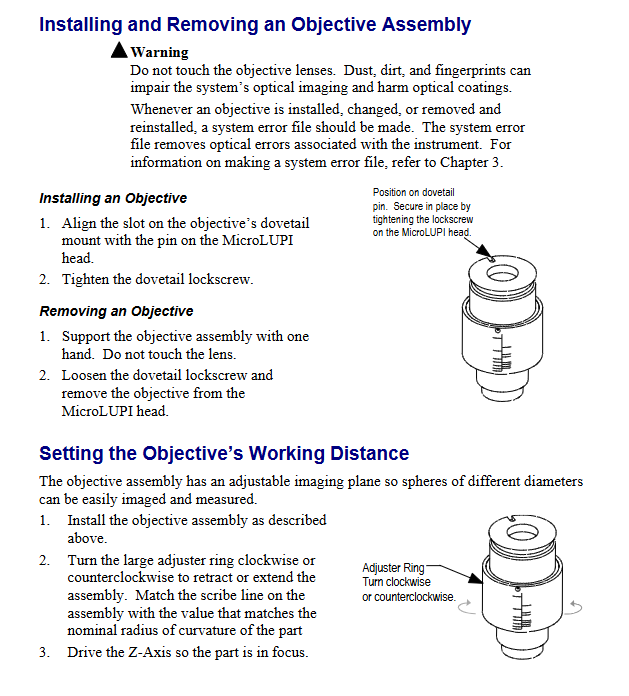
Install the objective lens (align with the dovetail groove pin and tighten the locking screw), adjust the working distance of the objective lens (match the engraved line according to the nominal curvature radius of the measured part)

Calibrate the machine head and X/Y stage: After removing the objective lens, place the optical flat mirror and adjust the X/Y axis adjustment screws to minimize the number of interference fringes

3. Startup initialization process

Turn on the laser power with the key and wait for the “Locked” indicator light to turn on; Turn on all components through the power manager

Log in to Windows NT on the computer (default username “zygo”), open MetroPro software and load MicroLUPI.app application

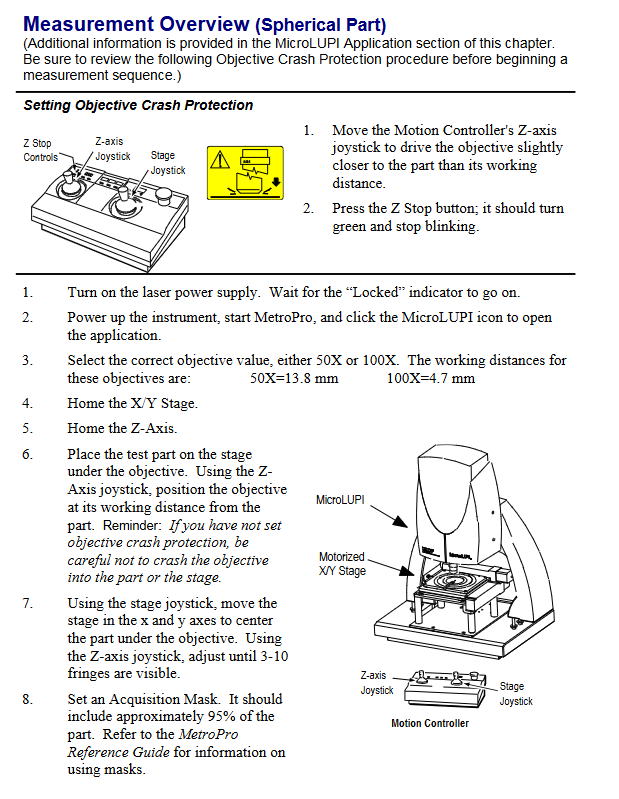
Perform X/Y stage and Z-axis “home” operation, set Z-axis collision protection (move the objective lens to a slightly smaller distance than the working distance, press the Z Stop button until the green light stays on)

Measurement operation process

1. Basic operation preparation

Controller usage: Adjust the height of the objective lens through the Z-axis joystick (push/pull to control lifting, deflection amplitude to control speed), move the stage with the X/Y joystick, and the emergency stop button (Motion Stop) can interrupt all movements

Light intensity adjustment: Press F4 to open the light intensity window, adjust all indicators to green through the numeric keypad (to avoid saturation and data loss), and F5 can automatically set the light intensity

2. System error calibration (key steps)

Calibration purpose: To eliminate inherent errors in the optical system of the instrument and improve measurement accuracy, recalibration is required after replacing the objective lens, adjusting the camera mode/phase resolution, or changing the ambient temperature

Operation steps:

Place the Zygo standard reference ball (avoid touching the optical surface), adjust X/Y/Z to align the center of the ball and hide the stripes

Set the average number of phase measurements in the measurement control window (recommended to be 3 times that of regular measurements, with a minimum of 8 times), and turn off “Subtext Sys Error”

After measuring with F1, save the data (named in a format such as “SysErrLN1x. dat” to distinguish between camera mode and phase resolution). During subsequent measurements, enable “Subtext Sys Error” and load the corresponding error file

3. Typical measurement scenarios (curvature radius of spherical parts)

Select the matching objective lens (50X working distance 13.8mm, 100X working distance 4.7mm), place the test piece and center it through the stage control lever

Enable AutoNULL (optional Power/Focus mode), set Lateral Pass Limit and Power/Focus Pass Limit

Click on “Auto Calibrate” to calibrate the X/Y/Z calibration coefficients (the fitting quality should be close to 1), and execute AutoNULL to optimize the stripes

Start measuring with F1, and the system automatically collects “cat’s eye” and “confocal” data to calculate the curvature radius; Batch measurement can create rectangular/circular measurement paths through the “Pattern Editor” (setting parameters such as row and column count, spacing, etc.)

Maintenance and after-sales service

1. Daily maintenance

Cleaning of optical components:

Dust: Blow off with compressed air, and wipe the remaining dust in one direction with lens paper dipped in isopropanol/methanol

Fingerprints/oil stains: Dip in 1% neutral soap solution to wipe, then use distilled water to remove residue, and finally finish with alcohol (do not reuse wiping materials)

Mechanical and electronic components: Use a soft cloth dipped in mild cleaner to wipe the external surface, and do not disassemble components such as motor drivers and controllers (no user repairable parts)

2. Malfunctions and after-sales service

Warranty Policy: The equipment comes with a 1-year warranty from the date of shipment (for material/process defects), standard support is provided for 5 years after discontinuation, and “best effort” support is provided thereafter; The warranty service includes free repair/replacement (with transportation, cleaning, and calibration fees to be borne), a 90 day warranty for replacement parts, or the remaining warranty period of the original warranty (whichever is longer)

Return requirement: Unused and well packaged products can be returned within 30 days, with a 20% restocking fee charged; Customized products cannot be returned, and returns must first obtain a Return Authorization (RA) number

Technical Support: In North America, you can call (800) 994-6669 (Monday to Friday 8:00-17:00 EST). In other regions, you need to provide the device model, serial number, and software version to contact the local agent

Safety and Compliance

1. Laser safety operation

Do not stare directly at the laser beam or its strong light reflection. When the device is turned on, ensure that the laser exit is unobstructed

Laser emission control: The key switch on the laser power supply is the main control (no radiation after turning off), and the “Emission Indicator” light is on to indicate that there may be laser output

Safety signs: The equipment is labeled with Class II laser warning signs (“CAUTION LASER RADATION DO NOT STARE IN BEAM”), exit port signs, non interlocking protective shell signs, etc., which must be kept clear and visible

2. Compliance certification

Compliant with the EU EMC Directive and Low Voltage Directive, meeting standards such as EN 55011 (ISM equipment RF interference), EN 61010-1 (safety of measuring equipment), EN 60825-1 (laser safety), etc

Having CE certification and JISO 9001 certification, the relevant conformity declaration is archived at Zygo’s US headquarters

ZYGO ZMI-1000 Displacement Measuring Interferometer System

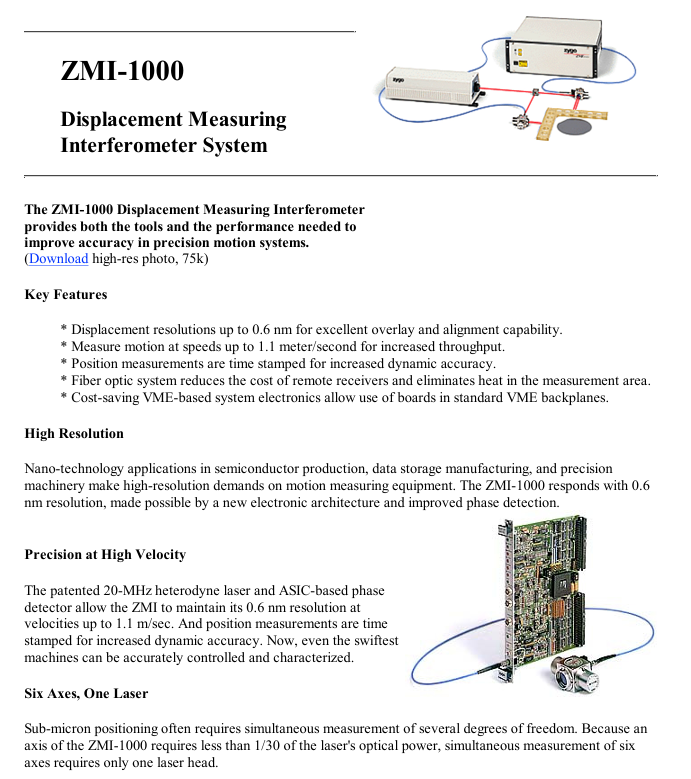
The ZMI-1000 Displacement Measuring Interferometer provides both the tools and the performance needed to improve accuracy in precision motion systems.

Key Features

* Displacement resolutions up to 0.6 nm for excellent overlay and alignment capability.

* Measure motion at speeds up to 1.1 meter/second for increased throughput.

* Position measurements are time stamped for increased dynamic accuracy.

* Fiber optic system reduces the cost of remote receivers and eliminates heat in the measurement area.

* Cost-saving VME-based system electronics allow use of boards in standard VME backplanes.

High Resolution

Nano-technology applications in semiconductor production, data storage manufacturing, and precision machinery make high-resolution demands on motion measuring equipment. The ZMI-1000 responds with 0.6 nm resolution, made possible by a new electronic architecture and improved phase detection.

Precision at High Velocity

The patented 20-MHz heterodyne laser and ASIC-based phase detector allow the ZMI to maintain its 0.6 nm resolution at velocities up to 1.1 m/sec. And position measurements are time stamped for increased dynamic accuracy. Now, even the swiftest machines can be accurately controlled and characterized.

Six Axes, One Laser

Sub-micron positioning often requires simultaneous measurement of several degrees of freedom. Because an axis of the ZMI-1000 requires less than 1/30 of the laser’s optical power, simultaneous measurement of six axes requires only one laser head.

High Reliability Heterodyne

The ZMI overcomes the alignment difficulty and environmental sensitivity typical of single-frequency (DC) systems. Our patented, AOM-generated, two-frequency design provides the high reliability and ease of use required in precision motion applications. The ZMI’s 20 MHz frequency difference has ten times the bandwidth of older Zeeman systems, providing fast target speeds and precision time stamps lacking in other designs.

Solutions for the Real World

Measurement applications aren’t always in the controlled environment of a lab or limited to linear motions.With the ZMI-1000, you can measure linear displacements as small as 0.6 nm and as much as 20 meters, and angular rotations up to 60 degrees with 0.1 µrad resolution

Simple Dynamic Analysis with Position Oscilloscope Tools

To simplify the process of dynamic analysis, the ZMI contains internal functions designed to aid the process of dynamic motion characterization. Internal storage and trigger options allow the user to acquire a stream of position and time data up to 133 kHz. This data can then be analyzed with the assurance that each data point is accurate to nanometers, with time of the position known to 16 ns.

Need More Information?

If you have an application in mind and have some questions you would like answered by one of our applications engineers, or if you would simply like more information sent to you, click the “Talk to Zygo” link(below) and send us a note.

Zygo’s ZMI 2000 displacement measurement interferometer system

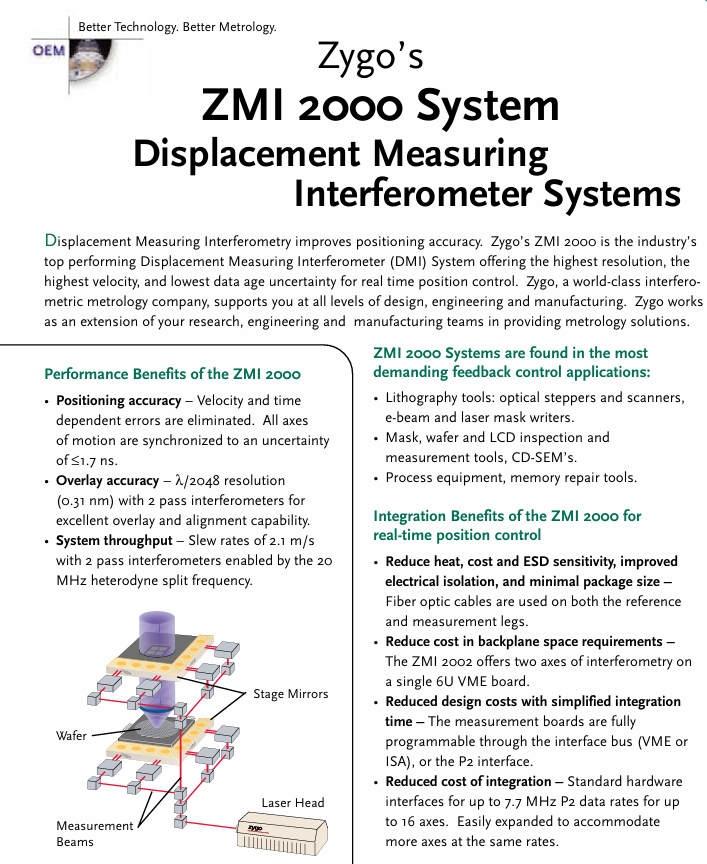
Displacement Measuring Interferometry improves positioning accuracy.  Zygo’s ZMI 2000 is the industry’s top performing Displacement Measuring Interferometer (DMI) System offering the highest resolution, the highest velocity, and lowest data age uncertainty for real time position control.  Zygo, a world-class interfero metric metrology company, supports you at all levels of design, engineering and manufacturing.  Zygo works as an extension of your research, engineering and  manufacturing teams in providing metrology solutions.

Performance Benefits of the ZMI 2000

• Positioning accuracy – Velocity and time dependent errors are eliminated.  All axes of motion are synchronized to an uncertainty of ≤1.7 ns.

•Overlay accuracy – λ/2048 resolution(0.31 nm) with 2 pass interferometers for excellent overlay and alignment capability.

• System throughput – Slew rates of 2.1 m/s with 2 pass interferometers enabled by the 20 MHz heterodyne split frequency.ZMI 2000 Systems are found in the most demanding feedback control applications:

• Lithography tools: optical steppers and scanners,e-beam and laser mask writers.

•Mask, wafer and LCD inspection and measurement tools, CD-SEM’s.

• Process equipment, memory repair tools.Integration Benefits of the ZMI 2000 for real-time position control

•Reduce heat, cost and ESD sensitivity, improved electrical isolation, and minimal package size 

Fiber optic cables are used on both the reference and measurement legs.

•Reduce cost in backplane space requirements

The ZMI 2002 offers two axes of interferometry on a single 6U VME board.

•Reduced design costs with simplified integration time – The measurement boards are fully programmable through the interface bus (VME or ISA), or the P2 interface.

•Reduced cost of integration – Standard hardware interfaces for up to 7.7 MHz P2 data rates for up to 16 axes.  Easily expanded to accommodate more axes at the same rates.

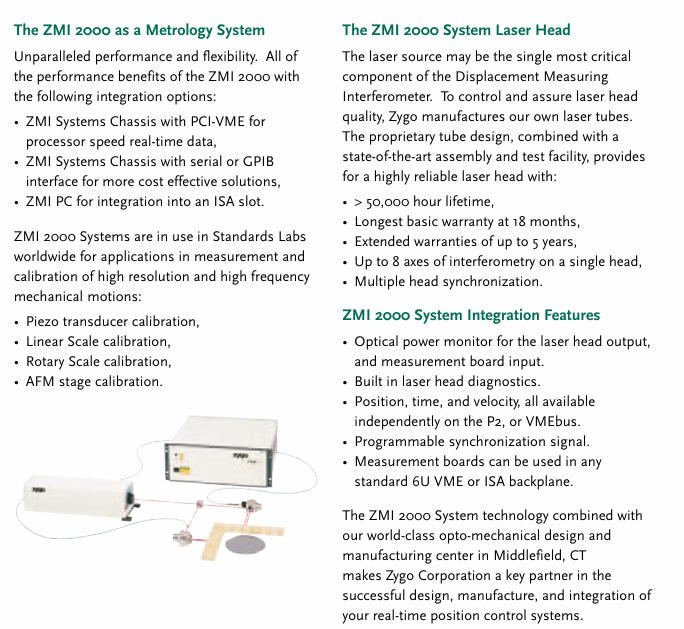
The ZMI 2000 as a Metrology System Unparalleled performance and flexibility.  All of the performance benefits of the ZMI 2000 with the following integration options:

• ZMI Systems Chassis with PCI-VME for processor speed real-time data,

• ZMI Systems Chassis with serial or GPIB interface for more cost effective solutions,

• ZMI PC for integration into an ISA slot.ZMI 2000 Systems are in use in Standards Labs worldwide for applications in measurement and calibration of high resolution and high frequency mechanical motions:

• Piezo transducer calibration,

• Linear Scale calibration,

• Rotary Scale calibration,

• AFM stage calibration.

The ZMI 2000 System Laser Head

The laser source may be the single most critical component of the Displacement Measuring Interferometer.  

To control and assure laser head quality, Zygo manufactures our own laser tubes.

The proprietary tube design, combined with a state-of-the-art assembly and test facility, provides for a highly reliable laser head with:

• > 50,000 hour lifetime,

• Longest basic warranty at 18 months,

• Extended warranties of up to 5 years,

• Up to 8 axes of interferometry on a single head,

• Multiple head synchronization.

ZMI 2000 System Integration Features

• Optical power monitor for the laser head output,and measurement board input.

• Built in laser head diagnostics.

• Position, time, and velocity, all available independently on the P2, or VMEbus.

• Programmable synchronization signal.

• Measurement boards can be used in any standard 6U VME or ISA backplane.

The ZMI 2000 System technology combined with our world-class opto-mechanical design and manufacturing center in Middlefield, CT makes Zygo Corporation a key partner in the successful design, manufacture, and integration of your real-time position control systems.

ZMI 2000 System Performance

4 Pass PMI*、 2 Pass PMI、1 Pass LI**

Position Resolution: λ/4096 (0.15 nm)、 λ/2048 (0.31 nm)、 λ/1024 (0.62 nm)

Position Range: ± 5.3 m、 ±10.6 m、± 21.2 m

Velocity Limit: 1.05 m/s、 2.1 m/s、 4.2 m/s

Maximum Acceleration:980 m/s2, (100 g)

Data Age: 335 ns

Data Age Uncertainty

Two Axes: Uncompensated, ±15 ns (ZMI 2001) / ±12 ns (ZMI 2002) / ± 16 ns (ZMI PC)

Compensated, ±1.2 ns (ZMI 2001, ZMI 2002)

Compensated, ±1.5 ns (ZMI PC)

Three Axes: Uncompensated, ±19 ns (ZMI PC)

Compensated, ±1.7 ns (ZMI PC)

Eight Axes: Uncompensated, ±36 ns (ZMI 2001) / 22 ns (ZMI 2002)

Compensated, ±1.4 ns (ZMI 2001, ZMI 2002)

ZMI 2000 System Laser Head

Type:HeNe, cw, two frequency

Power Minimum / Typical: 425 µW / 600 µW Will support up to 8 axes

Lifetime: >50,000 hrs, 18 month warranty

Frequency split:20 MHz ± 1600 Hz

Vacuum Wavelength Accuracy:±0.1 ppm (lifetime)

Vacuum Wavelength Stability: ±0.01 ppm (24 hrs)

Reference Signal: Fiber Optic

ZMI 2000 System Measurement Boards

# of Axes per Board: 1 (ZMI 2001, ZMI PC) / 2 (ZMI 2002)

Power Requirement:+5V ± 5% @ 3.5A (ZMI 2001, ZMI 2002, ZMI PC)+12V ± 10% @ 0.1A (ZMI PC)

Position Format: 36 bit – 2’s complement

Velocity Format: 32 bit – 2’s complement

Time Range: 107.4 seconds

Time Format:32 bit – 2’s complement

Time Resolution: 25 ns

Fiber Optic Signals: Reference and Measurement

Error Status: Reference (signal, PLL, DLL)

Measure (Missing, Dropout, Glitch)

Velocity (Board, User Defined)

Acceleration

Overflow (32 bit, 36 bit)

System Synchronization: Clock in or Clock out

ZMI VME Compliance: VMEBus specification revision C.1

6U size

A16 or A24 addressing

D16 or D32 data transfer

D08 (0) interrupt acknowledge cycle

ZMI PC Compliance:UL94V0

Full length ISA card

16 bit ISA bus

32 bit P2 bus

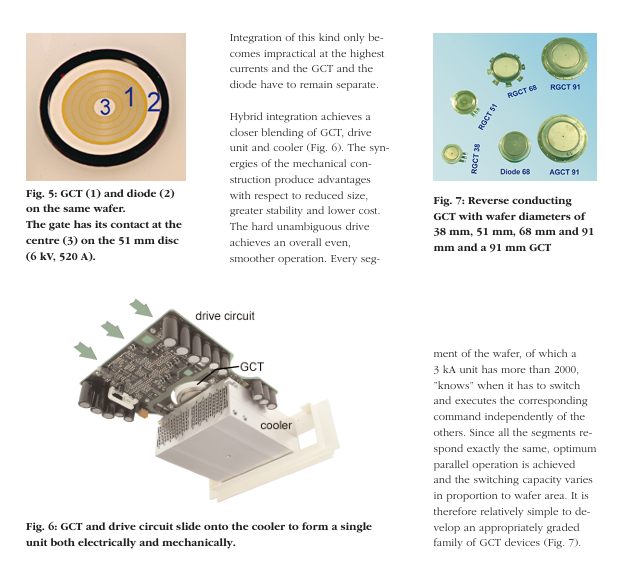
ABB IGCT Technology: A Revolutionary Breakthrough

Background and original intention of technology research and development

The development of power semiconductors has always been aimed at pursuing the “ideal switch”, which requires the characteristics of low pass state and commutation loss, high commutation frequency, and simple driving circuit. In the low-voltage field, the technological iteration from transistors and Darlington transistors to IGBT (Insulated Gate Bipolar Transistor) has achieved significant results. However, in the medium to high voltage field, the long-term dependence on GTO (Gate Turn Off Thyristor) poses problems such as complex control and limited performance.

To solve this dilemma, ABB Switzerland is exploring a new research and development path aimed at integrating the high-power advantages of IGBT with the core strengths of GTO, ultimately developing GCT (Gate Commutated Thyristor) and further developing it into IGCT, becoming an ideal alternative technology for GTO.

Principles and Breakthroughs of IGCT Core Technology

(1) Core improvement of GCT: solving GTO control problems

GTO has serious control issues and requires an unstable transition zone where both anode voltage and cathode current act simultaneously during shutdown, relying on buffer circuits for support. GCT breaks through this limitation through “hard drive” technology:

The rate of change of gate current reaches µ

(far exceeding GTO’s 50 A/µ s), it can switch the current from the cathode to the gate before there is a significant change in the charge distribution between the gate and anode.

Directly switch the device from thyristor mode to transistor mode, with stable and fast turn off process, no need for buffer circuit, and performance close to IGBT.

(2) The Four Key Development Steps of IGCT Converter

Low inductance drive design

To avoid the GCT entering the unstable working zone, the cathode current needs to be turned off within 1 µ s, and the leakage inductance of the gate circuit corresponding to the 3kA GCT should be ≤ 6nH (only 1/50 of the conventional value of GTO).

Low inductance is achieved through a multi-layer connection between the coaxial device connection structure and the driving power output, while using a gate voltage of -20V to balance reliability and cost-effectiveness.

Optimize silicon wafer technology

Hard drive technology allows GCT silicon wafers to be designed thinner without compromising on switch characteristics, combined with plasma engineering technology, significantly reducing losses (compared to GTO of the same specification, the commutation loss is similar but the on state loss is lower).

High integration and linear scaling of current

Integration is divided into two levels: one is single-chip integration (integrating anti parallel diodes and GCTs on the same silicon wafer to reduce diode stacking and high current connections); The second is hybrid integration (integrating GCT, driving unit, and cooler to reduce volume, improve stability, and lower costs).

Each unit of the silicon wafer (3kA devices containing over 2000 units) synchronously responds to switch instructions, achieving optimal parallel operation. The current capacity is linearly related to the silicon wafer area, making it easy to develop multi specification GCT series (such as devices with silicon wafer diameters of 38mm, 51mm, 68mm, and 91mm).

Simplify circuit complexity

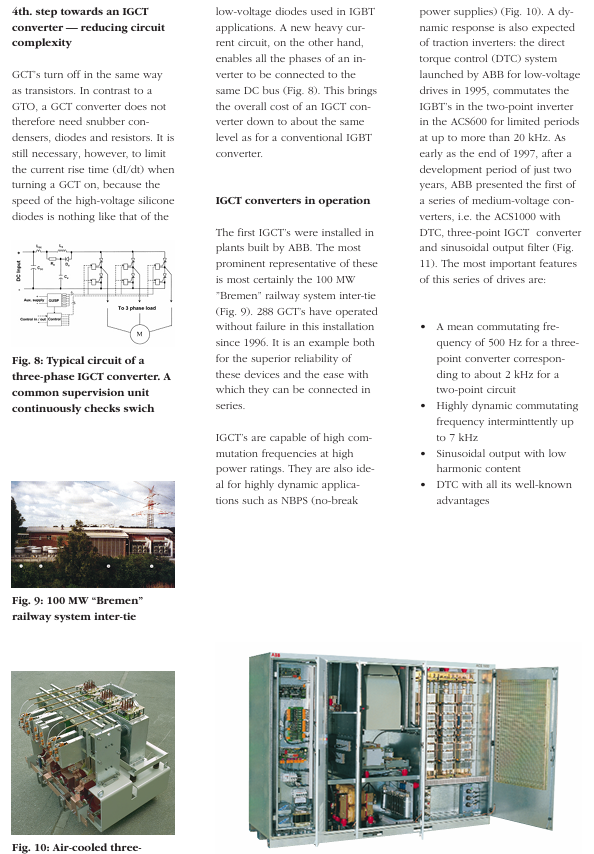
No buffering capacitors, diodes, and resistors are required for GTO converters, only the current rise rate when GCT is turned on needs to be limited (as high-voltage silicon diodes are slower than low-voltage IGBT diodes).

By adopting a new high current circuit, all phases of the inverter can be connected to the same DC bus, which is comparable in cost to conventional IGBT converters.

(3) Modular design and high-voltage adaptation

Modular component system: In response to the diverse application requirements and small batch size of high-power converters, IGCT adopts modular design, which can cover a power range of 250kW to 100MW through unit series connection and adapt to different scenarios.

Pressure contact technology: Traditional module technology is difficult to handle high voltage and high current. IGCT adopts an improved pressure contact technology, which integrates the driving unit, power semiconductor, and cooler into a single functional unit. It replaces expensive chip parallel arrays with optimized silicon wafers in standard packaging, simplifies manufacturing, reduces costs, and is easy to maintain.

Performance advantages and application cases of IGCT converters

(1) Core performance advantages

Category specific advantages

Component characteristics include high rated voltage, low turn-on and commutation losses, high commutation frequency (intermittent up to 7kHz, average 500Hz for three-point converters, equivalent two-point 2kHz), high silicon wafer utilization, uniform current distribution, linear correlation between current capacity and silicon wafer area, and easy modeling

Circuit design includes a three-phase shared DC bus, a central dI/dt limiter with integrated clamping, simple intermediate circuit connection, safety and reliability under extreme working conditions, and a simple driving circuit (directly coupled with switch signals, no dV/dt or dI/dt regulation circuit required, dual line low-power power supply)

Overall performance with few and no special components, modular mechanical structure, single-chip integration even under high fixed values, high compatibility between power semiconductor control system cooler, stable and easy to center pressure contact technology, easy maintenance, efficiency exceeding 98%, high reliability (MTBF>6 years), small size and light weight, clear interface definition, support for high-power and reliable series operation, and series redundancy design to enhance reliability

(2) Typical application cases

100MW Bremen railway system interconnection device: put into operation in 1996, with 288 IGCTs running without faults, verifying the high reliability and series ease of use of IGCTs.

High dynamic application scenarios: such as uninterruptible power supply (NBPS), traction inverters, etc. Taking the ABB ACS1000 series medium voltage inverter as an example (launched in 1997 with a research and development cycle of only 2 years), it adopts a three-point IGCT inverter and a sine wave output filter, supports direct torque control (DTC), adapts to 2.3kV-4.16kV voltage and 315kW-5MW power range, and can be used for the transformation of existing non speed regulating motors. The debugging difficulty is comparable to that of low-voltage ACS600.

1.5MW air-cooled three-phase phase module: with a commutation frequency of 1050Hz, suitable for high-frequency demand scenarios.

Technological Development History and Future Prospects

(1) Development History (Key Nodes from 1993 to 2003)

1993: Hard drive GTO technology began;

In 1995, 3kA/4.5kV GCT was launched;

In 1997, 6kV/1kA reverse conducting diode (without buffer circuit) and transparent emitter technology were implemented, and the ACS1000 series inverter was launched;

Follow up: Gradually develop 4.5kV/6kA (91mm silicon wafer) GCT and 250A-4kA GCT series, achieve improvements such as integrated coolers and modular driver units, and expand application scenarios.

(2) Future prospects

IGCT technology has firmly established itself in the medium and high voltage field in just a few years, combining the advantages of GTO and IGBT to overcome their shortcomings. With excellent performance, reliability, and cost-effectiveness, IGCT will continue to expand high-power application scenarios and become one of the core technologies of medium and high voltage converters, further promoting the efficient and miniaturized development of the power electronics field.

Possible models that may be used

S-073N 3BHB009884R0021

S-093N 3BHB009885R0021 

3ASC25H705/-7

HVC-02B

5SGY35L4510

XTB750B01

751010R0815

SA811F

TP830

CI857K01

PPC902CE101

CI858K01 3BSE018135R1

PM820-1

PM820-2

PM825-1

TC820-1

SD802F

EI802F

AM801F

AM811F

UCD240A101

Siemens 6AG1204-2BB10-4AA3 Ethernet Switch

Product basic information

Product model: 6AG1204-2BB10-4AA3

Series: Siemens SIPLUS NET SCALANCE X series, full name SIPLUS SCALANCE X204-2, designed based on 6GK5204-2BB10-2AA3, specifically for medium stress environments. The document version date is April 13, 2017, and was last modified on April 5, 2017. The content may be adjusted with product iteration.

Core positioning: Management type industrial Ethernet switch, supporting PROFINET-IO device functions, integrated redundancy manager, suitable for industrial communication scenarios that require stability and redundancy, with electronic manual (CD format) and optional C-type plug.

Core hardware and electrical specifications

(1) Interface configuration

Number and specifications of interface types

Four 10/100Mbit/s RJ45 Ethernet ports for connecting network components or terminal devices

Ethernet optical ports with 2 100Mbit/s multi-mode BFOC optical ports, supporting optical signal transmission and compatible with multi-mode optical fibers

One 2-pole terminal block for signal contact interface, used for external signal feedback

1 4-pole terminal block (main power supply)+1 redundant power interface for power interface, supporting redundant power supply and improving system reliability

Storage expansion supports C-PLUG removable storage for configuring backups, firmware updates, etc

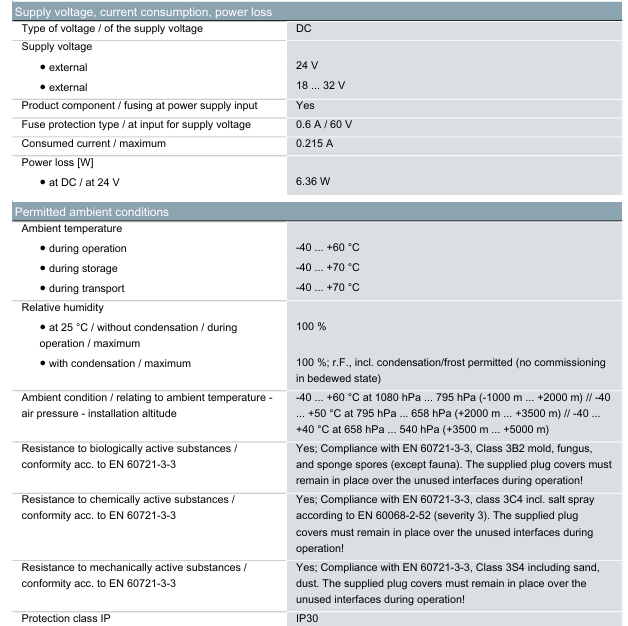
(2) Power supply and power consumption

Parameter category specific specifications

Power supply type: direct current (DC) power supply

The normal power supply range is 24V, and the allowable range is 18-32V

Input protection built-in fuse, specification 0.6A/60V, to prevent overcurrent damage to equipment

Current and Power Consumption Maximum Consumption Current 0.215A, Typical Power Consumption 6.36W at 24V DC

Electrical parameters of signal contacts: rated operating voltage 24V DC, maximum operating current 0.1A

(3) Machinery and Protection

Parameter category specific specifications

Dimensions width 60mm, height 125mm, depth 124mm, compact design, saving installation space

Weight net weight 0.78kg, lightweight and easy to install

Installation methods support 35mm DIN rail installation, wall installation, S7-300 rail installation, suitable for various industrial site layouts

Protection level IP30, can prevent solid foreign objects from entering (diameter>2.5mm), suitable for installation in control cabinets

Environmental adaptability

(1) Temperature and humidity

Environmental condition range requirements

Working temperature -40 ° C to+60 ° C, suitable for high and low temperature industrial environments

Storage/transportation temperature -40 ° C to+70 ° C, meeting harsh transportation and storage needs

Maximum 100% without condensation at a relative humidity of 25 ° C, condensation/frosting allowed (not adjustable in condensation state)

(2) Special environmental tolerance

Pressure and altitude:

-1080hPa-795hPa (altitude -1000m to+2000m): operating temperature -40 ° C to+60 ° C

-795hPa-658hPa (altitude+2000m to+3500m): operating temperature -40 ° C to+50 ° C

-658hPa-540hPa (altitude+3500m to+5000m): operating temperature -40 ° C to+40 ° C

Biological/Chemical/Mechanical Tolerance: Complies with EN 60721-3-3 standard,

-Bioactive substances: 3B2 grade (resistant to mold, fungi, sponge spores, excluding animals)

-Chemical active substance: Grade 3C4 (including EN 60068-2-52 salt spray test, Grade 3)

-Mechanical active substance: 3S4 level (resistant to sand and dust), unused interfaces need to be covered with dust caps

(3) Compliance in hazardous areas

Compliant with EN 60079-0:2006 and EN 60079-15:2005 standards, certified level II 3 G Ex nA II T4 KEMA 07 ATEX 0145X, suitable for use in hazardous areas of the corresponding level.

Functional characteristics

(1) Network Management and Configuration

Specific abilities of functional categories

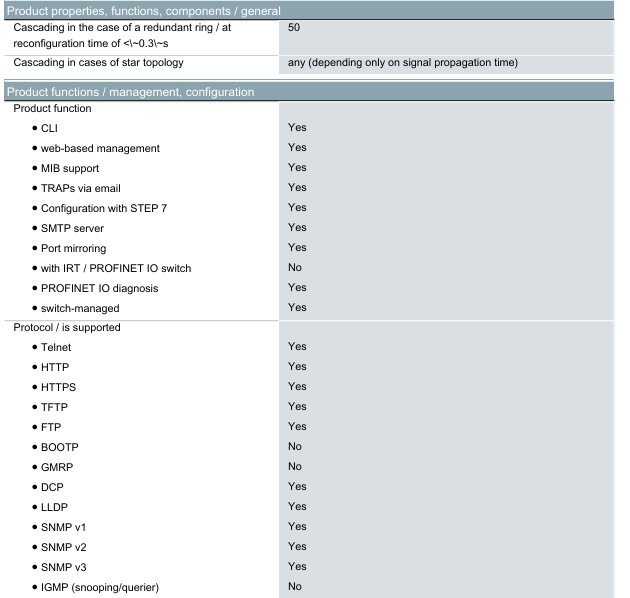
Management methods support CLI (Command Line Interface), web-based management, MIB support, STEP 7 configuration, and multiple ways to adapt to different user habits

Alarm and log support sending TRAP alarms via email for remote monitoring; Support port diagnosis, packet size/type statistics, error statistics, and assist in fault location

Protocol support – Basic protocols: Telnet, HTTP, HTTPS, TFTP, FTP, DCP, LLDP

-SNMP protocol: v1/v2/v3, meeting network management requirements of different security levels

-Security protocol: SSH, ensuring remote management communication security

(2) Redundancy and Topology

Specific abilities of functional categories

The redundancy protocol supports MRP (Media Redundancy Protocol) and HRP (High Speed Redundancy Protocol), integrates a redundancy manager, and does not support HRP backup redundancy

Redundancy performance: When cascading redundant loops, the reconstruction time is less than 0.3s, quickly restoring communication and reducing the impact of faults

Topology supports star topology that can be cascaded arbitrarily (limited only by signal propagation time), suitable for complex industrial network layouts

(3) Other key functions

DHCP function: Supports DHCP clients, can automatically obtain IP addresses, and simplifies network configuration.

Time synchronization: Supports SICLOCK and SNTP protocols, but does not support NTP to ensure time consistency of network devices.

PROFINET Function: As a PROFINET-IO device, it supports PROFINET IO diagnostics but does not support IRT (Real Time) function.

Port function: Supports port mirroring, facilitating network traffic analysis and troubleshooting.

Certification and Compliance

(1) Basic certification

CE certification, KC certification, in compliance with EN 61000-6-2 (anti-interference) and EN 61000-6-4 (interference emission, Class A) electromagnetic compatibility standards.

(2) Special scenario authentication

Not supporting railway applications (EN 50155, EN 50124-1 standards), not supporting maritime classification society certification (ABS, BV, DNV, etc.), only applicable to conventional industrial and hazardous area scenarios.

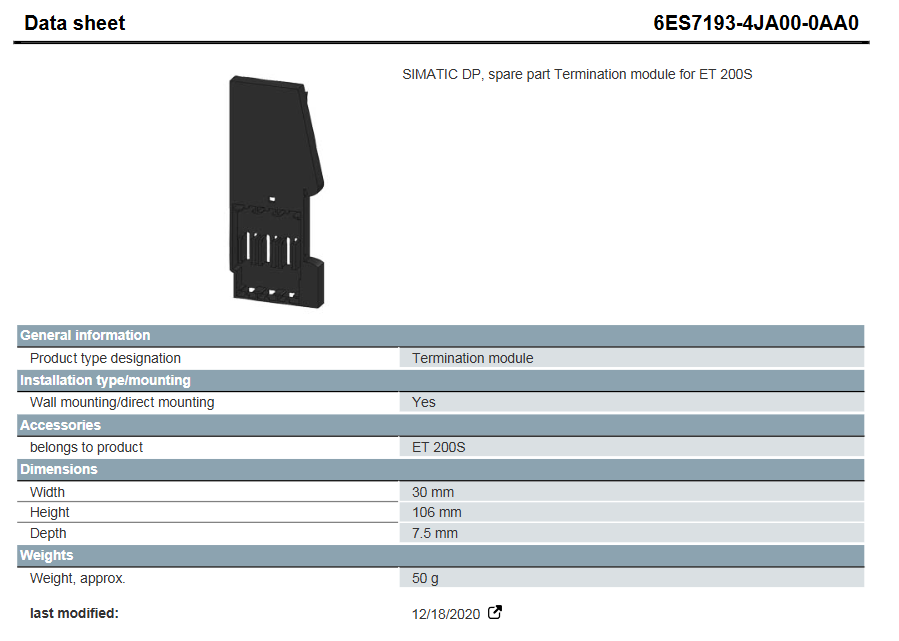
Siemens 6ES7193-4JA00-0AA0 Terminal Module

Product basic information

Product model: 6ES7193-4JA00-0AA0

Product type: Siemens SIMATIC DP series terminal module, positioned as a spare part, designed specifically for the ET 200S distributed I/O system. Its core function is to assist in the signal terminal connection and stable transmission of the ET 200S system. The document was last modified on August 22, 2025, and the content may be adjusted with product iteration.

Core specification parameters

(1) Installation and adaptation

Installation method: Supports wall installation/direct installation, compatible with ET 200S system, no additional installation accessories required.

Belonging product: Clearly belongs to the ET 200S series and is only used for the matching of this series of systems. It is not compatible with other series of devices.

(2) Size and weight

Parameter category specific specifications

Size width 30mm, height 106mm, depth 7.5mm, compact structure, saving installation space

Weight approximately 50g, lightweight design, convenient for transportation and on-site installation and operation

Certification and Compliance

(1) Basic certification

Universal product certification, EMV (Electromagnetic Compatibility) certification, manufacturer’s declaration, CE certification, EG Konf. certification, RCM certification, in compliance with safety and electromagnetic compatibility standards for basic industrial equipment, and can be used compliantly in conventional industrial environments.

(2) Special scenario authentication

Hazardous area use: Through FM certification, UL certification, and IECEx certification, it supports deployment in hazardous areas (such as industrial flammable and explosive environments) and meets special safety requirements.

Maritime applications: Certified by CCC Ex, NK (Japan Classification Society), ABS (American Bureau of Shipping), LRS (Lloyd’s Register of Shipping), CCS (China Classification Society), suitable for maritime scenarios such as ships and offshore platforms, meeting the stringent standards of maritime equipment.

Precautions

Safety specifications are generally applicable to control system handling. Instructions and warnings related to a specific subject or operation of the product.

The following norms must be strictly observed:

  must strictly comply with the technical specifications and typical applications of the product system

  Personnel training: Only trained personnel shall install, operate, maintain or repair the product system. must

Provide guidance and explanation of the situation in danger areas to these personnel.

  Unauthorized changes: Changes or structural changes to the product system may not be made.

  Maintenance responsibility: Must ensure that the product system is used only under appropriate conditions and in full fitness for use.

 Working environment: The user must meet the specified environmental conditions:

Safety regulation

The following safety provisions of EN 50110-1 shall be fully complied with when handling product systems (maintenance) :

1 Disconnect completely.

2 Secure to prevent reconnection.

3 Verify that the installation is complete.

4 Ground and short-circuit the device.

Warning: Only qualified maintenance personnel can remove and insert the module. In order to ensure the personal safety of the operator, before each pulling out or inserting, you must

Disconnect the power supply and ensure that there is no voltage on all terminals at the back, and the product is effectively grounded with the ground screw at the back.

Installation precautions

First, the importance of industrial equipment installation

In modern industrial production, various equipment and machines are widely used in various fields, such as manufacturing, energy industry, chemical industry and so on. The installation of industrial equipment is directly related to production efficiency and product quality. Proper installation and commissioning of good equipment can ensure the stable operation of the production line, improve production efficiency and product quality, reduce maintenance costs, and ensure the safety of employees.

Second, the steps of industrial equipment installation

1. Preparation: Before the installation of industrial equipment, it is necessary to carry out adequate preparation work. This includes the tools and equipment required for installation, cleaning and preparation of the installation site, and making installation plans and schedules.

2. Determine the installation position: Determine the installation position of the equipment according to the requirements of the equipment and the layout of the production line. When determining the location, the weight and size of the equipment need to be considered, as well as the coordination of the equipment with the surrounding environment.

3. Install the device: Assemble and install the device according to the installation instructions. Ensure that the device is securely and accurately connected, while protecting the appearance and internal components of the device.

4. Connect power supplies and pipelines: For devices that require power supplies and power supplies, properly connect power supplies and pipelines. The connection of power supply and pipeline should comply with safety standards to avoid hazards such as electric shock and leakage.

5. Commissioning the device: After the installation is complete, you need to commission the device to ensure that the device can run properly. It includes checking the functions and performance of the equipment, adjusting the parameters and Settings of the equipment, and carrying out the necessary tests and inspections.

6. Training operators: After the installation of the equipment, it is necessary to train the operators to understand the operation methods and precautions of the equipment, and improve the operation skills and safety awareness of the employees.

Third, industrial equipment installation precautions

1. Safety first: When installing industrial equipment, safety is the most important consideration. You must operate in strict accordance with safety regulations and wear necessary protective equipment to ensure the safety of the workplace.

2. Strictly follow the equipment instructions: Industrial equipment usually comes with detailed installation instructions, you must carefully read and understand the contents of the instructions, and install the operation in accordance with the requirements of the instructions.

3. Pay attention to the assembly sequence: When installing the device, follow the correct assembly sequence to ensure that all components of the device are assembled correctly to avoid equipment failures or safety accidents caused by incorrect assembly sequence.

image.png

Search for products

Back to Top
Product has been added to your cart