

Module classification and core technical parameters
1. Simulation module (including HART communication version)
Module Model Type Core Parameters Accuracy Current Consumption (5V DC/24V DC)
ASI133 analog input (built-in isolation gate) with 8 channels and 4-20mA input; 2/4-wire system is optional; Data update cycle 10ms ± 16 µ A 150mA/450mA
ASI133-H analog input (with HART) supports HART communication; Up to 16 devices/modules; 1200bps speed ± 16 µ A 150mA/450mA
ASI533 analog output (built-in isolation gate) with 8 channels and 4-20mA output; Load resistance 0-750 Ω (20mA) ± 48 µ A 150mA/350mA
ASI533-H analog output (with HART) supports HART communication; Multi station connection up to 5 units/channel ± 48 µ A 150mA/350mA
2. Temperature input module
Module Model Type Core Parameters Accuracy (23 ℃) Current Consumption (5V DC/24V DC)
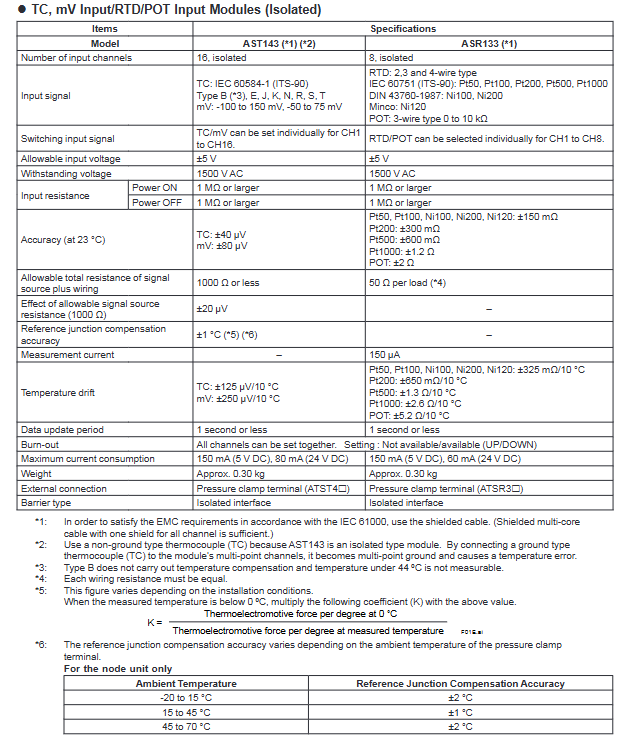
AST143 TC/mV input (built-in isolation barrier) 16 channels; TC supports 8 types (IEC 60584-1); MV range -100~150mV TC: ± 40 µ V; mV: ± 80 µ V 150mA/80mA
ASR133 RTD/BOT input (built-in isolation barrier) with 8 channels; RTD supports Pt/Ni series; POT 0-10kΩ RTD:±150mΩ;POT:±2Ω 150mA / 60mA
3. Digital modules
Module model type Core parameters Response time Current consumption (5V DC/24V DC)
ASD143 digital input (with built-in isolation barrier) 16 channels; NAMUR compatible (IEC 60947-5-6) status input: 15ms 150mA/110mA
ASD533 digital output (built-in isolation barrier) with 8 channels; Output characteristics 12V (40mA), 26V (0mA) 10ms 150mA/500mA
Key characteristics and explosion-proof parameters
1. General characteristics
Electrical protection: All modules have a 1500V AC withstand voltage strength; Input resistance ≥ 1M Ω during power outage;
Environmental adaptability: working temperature -20 to 70 ℃; Compliant with ISA S71.04 G3 level anti-corrosion standard;
Redundancy support: Supports single redundancy/dual redundancy configurations, with dual redundancy installed in adjacent slots (odd+even);
Channel characteristics: module level galvanic isolation, no isolation between channels; The overall explosion-proof function of the module fails when there is a multi-channel short circuit.
2. Explosion proof parameters (ATEX/FM certification)
Module Model ATEX Parameters (Single Redundancy) FM Parameters (Single Redundancy)
ASI133 Uo=27.8V,Io=84mA,Po=584mW Voc=27.8V,Isc=84mA,Po=584mW
AST143 Uo=16.8V, Io=7mA (single channel), Po=30mW Voc=16.8V, Isc=7mA (single channel), Po=30mW
ASD143 Uo=9.8V,Io=21mA,Po=52mW Voc=9.8V,Isc=21mA,Po=52mW
ASD533 Uo=27.16V,Io=108.6mA,Po=738mW Voc=27.16V,Isc=108.6mA,Po=738mW
Detailed explanation of HART communication function
1. Core specifications
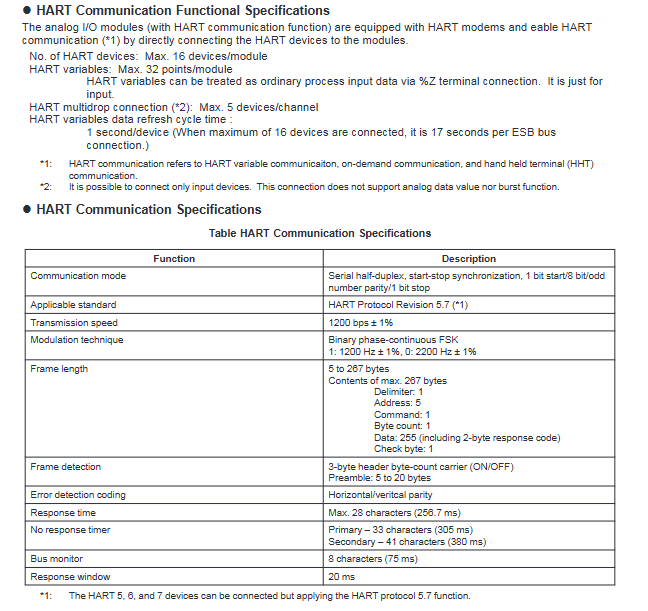
Communication mode: Serial half duplex, start stop synchronization (1-bit start/8-bit data/1-bit odd parity/1-bit stop);
Applicable standard: HART Protocol Revision 5.7 (compatible with HART 5/6/7 devices);
Transmission rate: 1200bps ± 1%;
Connection capability: up to 16 devices/modules, up to 5 devices/channels for multi station connection (input devices only);
Data refresh: 1 second per device (17 seconds per ESB bus connection for 16 devices).
2. System configuration
Support dual redundancy configuration: Two modules are installed in adjacent slots of the same node unit;
Data flow: FCS reads and writes analog data and HART variables through the I/O mapping area. The HART variables are connected through the% Z terminal and only support input.
Installation and compatibility requirements
1. Hardware compatibility
On site control unit (FCU): AFV30S, AFV30D (equipped with PW481-11/PW482-11/PW48284-11 power modules);
Node units: ANB10S/10D, ANB11S/11D (specific model suffix);
Connection method: pressure clamp terminal (single redundant: ATSA3S/ATSS3S, etc.); Dual redundancy: ATSA3D/ATSS3D, etc.
2. Software and Engineering Requirements
Control function: VP6F1700 on-site control station control function (applicable to AFV30 );
Engineering tool: VP6E5100 standard builder function;
EMC requirement: Shielded cables are required (one layer of shielding can be shared across all channels).
Module size and model code
1. External dimensions (unit: mm)
ASD143: Width 32.8, Height 130, Depth 94 (including protrusion 13.5);
Other modules (ASI133/533, AST143, ASR133, ASD533): Same size as ASD143;
Tolerance standard: 0.5-120mm dimensional tolerance ± 0.8mm, combination tolerance ± 1.5mm; follow JEM 1459 for dimensions greater than 120mm.
2. Model coding rules (taking ASI133 as an example)
Basic model: ASI133 (analog input, built-in isolation gate);
Suffix codes: – S (standard type), – H (with HART), 00 (fixed position);
Option codes:/SA3S0 (single redundant pressure clamp terminal),/SA3D0 (dual redundant pressure clamp terminal).
Key issues
Question 1: What is the explosion-proof adaptation scenario for the built-in isolation barrier I/O module in this series? What are the core requirements to pay attention to during installation?
answer:
Explosion proof adaptation scenario: The module can be installed in Zone 2/Division 2 environment and can connect to on-site equipment in Zone 0/1/Division 1, complying with ATEX and FM3610 certification standards;
Core installation requirements:
Hardware compatibility: Only compatible with specific models of AFV30 series FCU and ANB10/11 series node units, requiring PW481-1/PW482-11/PW482-11/PW48841-11 power modules;
Wiring requirements: Shielded cables must be used to avoid simultaneous short circuits in multiple channels (otherwise the explosion-proof function of the module will fail);
Redundant configuration: Dual redundancy should be installed in adjacent slots (odd+even), and the terminals should use dual redundancy pressure clamp terminals;
Environmental restrictions: Operating temperature -20 to 70 ℃, following ISA S71.04 G3 level anti-corrosion requirements.
Question 2: What are the core communication features of the module with HART communication function (ASI133-H/ASI533-H)? What scenarios are applicable?
answer:
Core communication characteristics:
Communication parameters: 1200bps rate, serial half duplex mode, compatible with HART Protocol Revision 5.7;
Connection capability: up to 16 devices/modules, supporting 5 devices/channels for multi station connection (input devices only);
Data processing: HART variables are connected through the% Z terminal and only support input. The data refresh cycle is 1 second per device;
Redundancy support: Can be configured with dual redundancy, consistent with the installation requirements of ordinary modules.
Applicable scenarios: In explosion-proof environments where analog signal transmission and remote monitoring of equipment are required (such as in the petroleum and chemical industries), additional parameters of on-site equipment (such as equipment status and diagnostic information) can be read through the HART protocol without the need for additional wiring.
Question 3: What are the differences in the number of channels, accuracy, and current consumption among different types of modules? How to select based on demand?
answer:
Summary of core differences:
Module type Channel number Accuracy range 24V DC Current consumption
Analog input (ASI133) 8 ± 16 µ A 450mA
Analog output (ASI533) 8 ± 48 µ A 350mA
TC/mV input (AST143) 16 ± 40~80 µ V 80mA
RTD/BOT input (ASR133) 8 ± 150m Ω~± 2 Ω 60mA
Digital input (ASD143) 16- (NAMUR compatible) 110mA
Digital output (ASD533) 8- (10ms response) 500mA
Selection principle:
Signal type: Select AST143 (multi-channel TC/mV) or ASR133 (RTD/BOT) for temperature signal; Analog selection ASI133/533; Select ASD143/533 for switch quantity;
Accuracy requirement: Select ASI133 (± 16 µ A) for high-precision analog acquisition; Select AST143 (± 40 µ V) for temperature acquisition;
Power consumption limitation: ASR133 (60mA) or AST143 (80mA) is preferred for low-power scenarios;
Expansion requirement: Remote monitoring equipment with HART ASI133-H/ASI533-H needs to be selected.
Leave a comment
Your email address will not be published. Required fields are marked *