

Equipment foundation and adaptation system
1. Core positioning and application scenarios
SC4AJ is a compact sensor designed specifically for low conductivity solutions, suitable for industries such as semiconductors, power, and pharmaceuticals that require high purity (such as ultrapure water detection). It needs to be paired with a specific analyzer/converter to form a complete detection system. The compatible equipment and corresponding manual information are as follows:
Corresponding manual number for supporting equipment type
FLXA202, FLXA21 2-wire analyzer IM 12A01A02-01E
FLXA402 4-wire converter IM 12A01F01-02EN, IM 12A01F03-01EN, etc
SC450G Conductivity Converter IM 12D08N05-01E
SA11 Smart Adapter IM 12A06S01-00EN-P
2. Equipment core classification and parameters
SC4AJ is classified into models based on electrode material, installation method, and battery constant. The core differences focus on adaptation scenarios and measurement ranges. The specific classifications are as follows:
Classification dimensions, specific types, key parameters/characteristics
Electrode material titanium (- T) is only suitable for adapter installation type (- AD), with strong corrosion resistance
316L stainless steel material (- S) is compatible with all installation methods and has strong universality
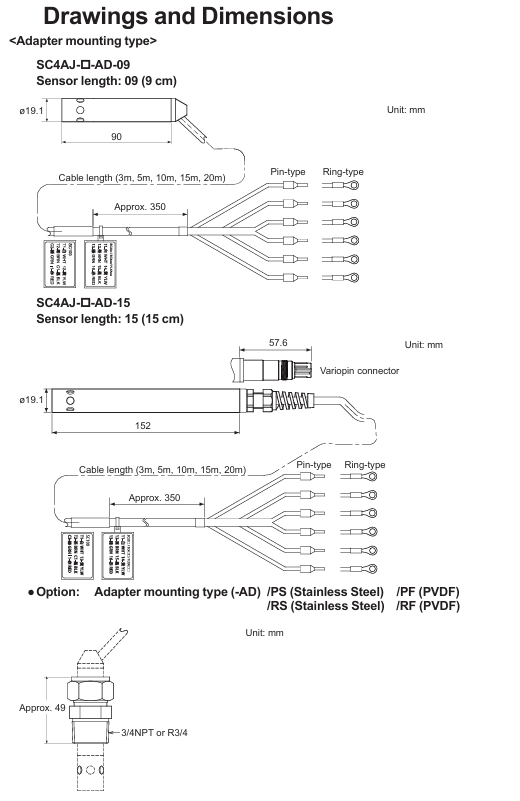
Installation method: Adapter installation type (- AD) with 3/4NPT or R3/4 adapter (stainless steel/PVDF material), sensor length 9cm/15cm
Welding socket type (- SA) requires straight type (/SA1) or 15 ° angle type (/SA2) welding socket, with fixed sensor length
Welding clip type (- SB/- SC) – SB compatible 1/1.5 inch clip (/SB1//SB2), – SC compatible 2-inch clip (/SC1), including sealing ring
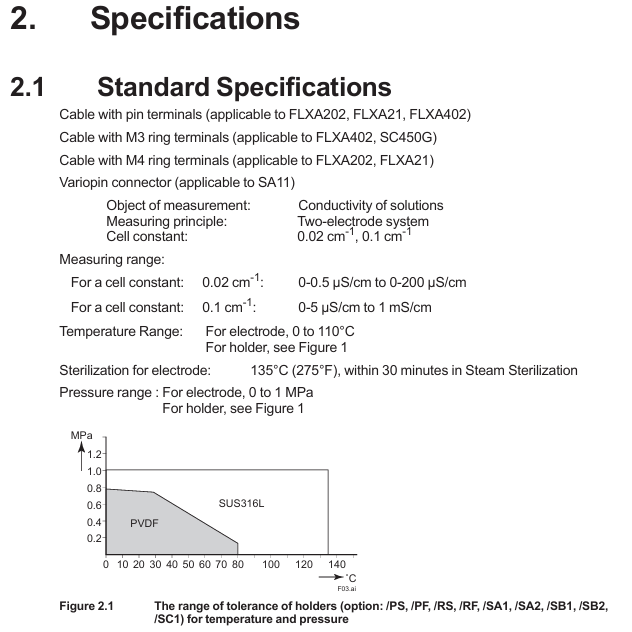
Battery constant 0.02 cm ⁻¹ (-002) measurement range 0-0.5 μ S/cm to 0-200 μ S/cm, suitable for extremely low conductivity solutions
0.1 cm ⁻¹ (-010) measurement range 0-5 μ S/cm to 1 mS/cm, suitable for low conductivity solutions
Cable terminal pin type/M4 ring type/M3 ring type/Variopin pin type compatible with multiple devices; M4 ring adapter FLXA202/FLXA21; M3 ring adapter FLXA402/SC450G; Variopin compatible with SA11
3. General technical specifications
Temperature and pressure: The electrode has a conventional temperature of 0-110 ℃ (can be steam sterilized at 135 ℃ for 30 minutes) and a pressure of 0-1 MPa; The tolerance range of the bracket varies with the material (stainless steel 316L has higher temperature resistance, PVDF has lower temperature resistance, please refer to the temperature pressure curve for details)
Contact fluid material: main body (316L stainless steel/titanium), O-ring (FKM fluororubber, EPDM EPDM EPDM), adapter (PVDF or 316L stainless steel)
Temperature compensation: Built in Pt1000 temperature sensor to calibrate the effect of temperature on conductivity
Protection restriction: The sensor mold and metal joint are not waterproof and cannot be immersed in process water
Safety regulations and usage restrictions
1. Core security principles
Prohibited unauthorized operation: Only use according to the instructions in the manual, unauthorized modification of the device will result in loss of protective function; Repairs require Yokogawa certified spare parts, unauthorized modifications are prohibited
Static electricity and explosion prevention: The flow of ultrapure water in plastic pipes may generate static electricity, and it is necessary to avoid the sensor conducting static electricity and damaging the converter circuit; Must comply with explosion-proof standards such as IEC 60079-11 and GB 3836.4-2010 (TIIS certified models cannot be connected), and if necessary, affix a “simple equipment” label
Temperature limit: The maximum process temperature needs to be determined based on the supporting analyzer (FLXA202/FLXA21) and temperature level (T1-T6). For example, under T6 level, the maximum process temperature at 40 ℃/60 ℃ ambient temperature is 49 ℃; At T5 level, the ambient temperature is 95 ℃ at 40 ℃ (note that the upper limit of T5 level is 100 ℃)
2. Manual usage guidelines
It needs to be handed over to the end user and properly stored, and unauthorized copying/dissemination is prohibited; Yokogawa reserves the right to improve manuals and equipment without prior notice
The manual only describes the device functions and does not guarantee adaptation to specific user scenarios; The equipment is provided as is, and Yokogawa is not responsible for unforeseeable direct/indirect losses
Installation and Wiring Guide
1. Core installation requirements
Installation principle: Ensure uniform composition and no dead zone when the solution flows through the sensor; The sensor needs to be submerged above the outlet to ensure continuous liquid flow between the electrodes; Reserve maintenance space for easy disassembly and release of process pressure; Confirm that the pressure at the installation site is within the tolerance range of the sensor and adapter
Steps for different installation methods:
Adapter installation type (- AD): Assemble in the order of “nut → adapter support (stainless steel adapter) → adapter → sealing ring → sensor body”, tighten the nut with a torque of about 190 N · m (tighten with fingers and then use a wrench to tighten 1.25 turns)
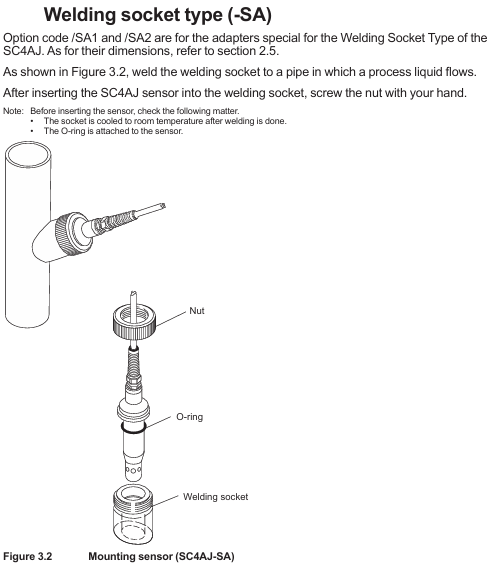
Welding socket type (- SA): First weld the welding socket to the process pipeline (cool to room temperature), insert the sensor into the socket after installing the O-ring, and fix it by hand tightening the nut
Welding clamp type (- SB/- SC): First weld the flange to the pipeline, insert the sensor into the flange after installing the sealing ring, and fix it with a special fixture
2. Wiring requirements
Wiring logic: Connect according to the cable end identification and the terminal number of the analyzer/converter, for example, connect the temperature sensor wire (brown/black/red) to the corresponding temperature terminal, and the electrode wire (green/yellow) to the corresponding electrode terminal; Variopin terminal (- VS) needs to be connected to SA11 adapter
Cable specifications: Cable length 3-20m (selected according to the order), avoid contact with high-temperature components, and ensure that the insulation resistance meets the requirements after wiring (such as 1000-1137 Ω between terminals 11-12 and>100 M Ω between terminals 11-13)
Operation and maintenance process
1. Preparation and calibration before operation
Pre operation inspection: Confirm that the cable connection is correct, the solution is leak free, the temperature/pressure is within the range, and the solution level reaches the outlet height
Battery constant setting: The factory calibrated battery constant on the cable label needs to be input into the matching analyzer/converter (refer to the corresponding equipment manual for operation steps)
Calibration requirements: Use a standard solution with known conductivity for calibration (the conductivity of the standard solution should be close to that of the test liquid). Before calibration, the sensor should be equilibrated with the temperature of the solution, and the temperature should be measured using a calibration thermometer
2. Core maintenance operations
(1) Sensor cleaning
Choose the cleaning method based on the type of pollutant, and prohibit mixing hydrochloric acid with chlorine containing solvents (to avoid producing toxic chlorine gas):
Scale and hydroxides: Clean with 5-10% hydrochloric acid solution
Organic dirt (oil, grease): Wipe with ethanol or acetone
Algae/bacteria: Clean with chlorine containing solution (household bleach)
Conventional pollution: cleaning with hot water and household detergent
After cleaning, visually inspect the sensor for any damage or deformation
(2) Abnormal judgment
After the sensor dries, measure the resistance between the terminals with a digital multimeter. If it exceeds the following range, it needs to be replaced:
Terminal combination (non VS) Variopin terminal combination (- VS) standard resistance at room temperature
11-12 E-F 1000-1137 Ω
11-13, 13-15, 12-15 E-C, C-A, F-A>100 M Ω
13-14, 15-16 C-D, A-B < 10 Ω
3. Spare parts information
Core spare parts need to be matched according to the installation method, and common spare parts are as follows:
Type description corresponding to spare part number
K9670MA SA (non VS) O-ring
K9670VY SA (- VS) O-ring set
K9670MK-SB sealing ring (compatible/SB1//SB2)
K9670MP SC sealing ring (compatible/SC1)
K9670MT/MU-AD 3/4NPT stainless steel/PVDF adapter
K9670ME/MD-SA straight/angle welding socket and installation nut
Leave a comment
Your email address will not be published. Required fields are marked *