

Model and component analysis
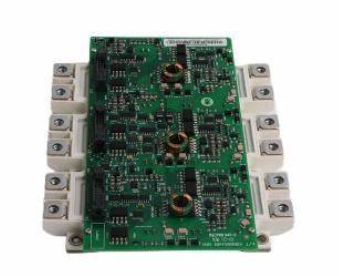
1. Core component composition
IGBT module:
Model: FS300R17KE3
Brand/Series: Infineon E3 series, which belongs to high-voltage and high-power IGBT modules.
Function: Used as a power switch for inverters, realizing the conversion of DC to AC electrical energy.
Driver board:
Model: AGDR-66C
Function: Provide gate drive signals for IGBT modules and integrate protection circuits (overcurrent, overheating, short circuit detection).
Product Code: 64717839 (ABB internal material code, used to uniquely identify the kit).
2. Meaning of Model Parameters
FS300R17KE3:
FS: Infineon Standard IGBT Module
300: Rated current 300 A (RMS, RMS)
17: Rated voltage 1700 V
KE3: E3 technology platform, low loss design
AGDR-66C:
AGDR: ABB Driver Board Series
66: Driver version compatible with high voltage level IGBT
C: Coated board (suitable for harsh environments, enhancing corrosion resistance)
Technical parameters
1. IGBT module (FS300R17KE3)
Electrical parameters:
Rated voltage (Vces): 1700 V
Rated current (Ic, RMS): 300 A
Pulse current (Icm): 600 A (10ms pulse width)
Saturation voltage drop (Vce (sat)): Typical value 2.1 V (@ Ic=300 A, Tj=25 ° C)
Switching frequency: up to 20 kHz (depending on heat dissipation conditions)
Mechanical characteristics:
Package: Press Fit, supports direct soldering or plug-in installation
Size: Approximately 121 mm x 44 mm x 14 mm
Weight: Approximately 0.5 kg
Heat dissipation requirements: thermal resistance R th(j−c)0.08 K/W (typical value), requires the use of an efficient radiator.
2. Drive board (AGDR-66C)
Supply voltage:
Main power supply:+15 V DC (driving IGBT on), -7 V DC (off bias)
Auxiliary power supply: isolated power supply, strong anti-interference ability
Interface features:
Optocoupler isolated input, compatible with TTL/CMOS levels
Fault feedback signal: Output overcurrent (OC) and overheat (OT) signals through LED or digital interface
Protection function:
Gate voltage monitoring (Vge undervoltage protection)
Active Miller clamp (suppresses oscillation)
Short circuit protection (DESAT detection, response time<1 μ s)
Application scenarios
1. Industrial sector
Medium and high voltage frequency converters: such as ABB ACS800 series models suitable for 1700 V level, used to drive high-power motors (such as mining machinery, steel rolling mills).
Renewable energy:
Wind power converter (doubly fed or full power converter), supporting high voltage ride through (HVRT) function.
Photovoltaic inverters (centralized or distributed) improve conversion efficiency and grid adaptability.
Power quality equipment:
Static Var Generator (SVG) and Active Power Filter (APF) are used for harmonic control and reactive power compensation.
2. Rail Transit and Ships
Traction inverter: a traction system for subways and high-speed trains that meets high reliability and vibration resistance requirements.
Ship electric propulsion: drives the propulsion motor, supports wide speed range and four quadrant operation.
3. Special power supply
High frequency heating power supply: The power module of induction heating equipment supports high switching frequency.
Pulse power supply: Pulse applications such as radar and particle accelerators that require fast switching.
Installation and maintenance
1. Installation points
Mechanical installation:
The module needs to be installed vertically on the heat sink, ensuring a flat contact surface, and using thermal conductive silicone grease (thickness ≤ 0.1mm).
Fixed torque: The screws need to be tightened in diagonal order, and the torque value should refer to the manual (usually 6-8 N · m).
Electrical connection:
Main circuit: Copper bars or low inductance cables are required for the DC bus (+/-) and output terminals (U/V/W) to reduce parasitic inductance.
Drive signal: using twisted pair shielded cables with a length of ≤ 0.5 meters to avoid electromagnetic interference (EMI).
Grounding: The driver board and module casing must be reliably grounded with a grounding resistance of<1 Ω.
2. Maintenance and troubleshooting
Daily inspection:
Visually inspect the surface of the module for cracks, erosion, or discoloration.
Measure the output voltage of the driver board: turn-on voltage+15 V ± 5%, turn off voltage -7 V ± 5%.
Cooling system: fan speed, radiator temperature (≤ 80 ° C is normal).
Common faults:
Overcurrent fault: It may be caused by motor short circuit, drive board failure, or IGBT aging, and an oscilloscope is needed to detect the gate waveform.
Overheating alarm: Failure of cooling fan, accumulation of dust in radiator, or failure of thermal grease, requiring cleaning or replacement.
Module damage: manifested as a phase loss in the inverter output, requiring a multimeter to detect module continuity (normally, unidirectional conduction between C-E).
Alternative models and compatibility
Upgraded models of the same series:
FS450R17KE4:450 A current level, E4 technology with lower losses, suitable for scenarios requiring higher power.
FS300R17KL4: 1200 V version, can be replaced if voltage requirements decrease (system voltage compatibility needs to be confirmed).
Driver board compatibility:
AGDR-66C is only compatible with IGBT at 1700 V level. If it is replaced with other voltage modules (such as 1200 V), the driver board (such as AGDR-61C) needs to be replaced synchronously.
Safety and Compliance
authentication:
Compliant with RoHS 2.0 environmental standards and certified by UL and CE safety regulations (please refer to specific documentation).
Compliant with IEC 60664-1 insulation standard, suitable for pollution level 2 environment.
Safe operation:
After power failure, wait for the capacitor to discharge (≥ 10 minutes) and use a multimeter to confirm that the bus voltage is less than 30 V.
Wear an anti-static wristband to avoid direct contact with IGBT pins (G is highly susceptible to electrostatic breakdown).
The faulty module needs to be professionally handled to avoid high-pressure residue or debris splashing during disassembly.
Leave a comment
Your email address will not be published. Required fields are marked *