
Call us 24/7uaedcs@163.com
Welcome to the official website of CNIACS Automation Technology Co., Ltd!
Call us 24/7uaedcs@163.com

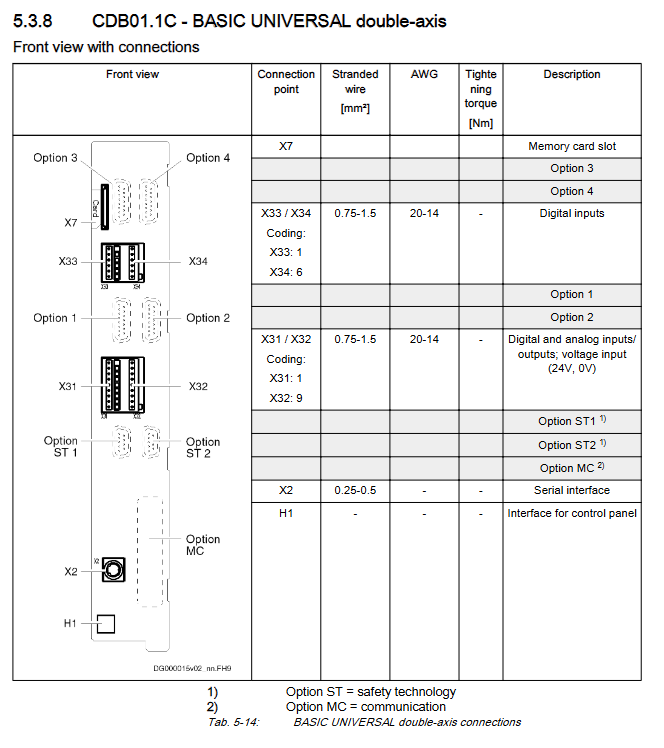
REXRTOH Drive Controllers Control Sections CSB01, CSH01, CDB01

Product Overview and Core Positioning

IndraDrive CSB01/CSH01/CDB01 is a modular servo drive control unit launched by Bosch Rexroth. As the control core of the IndraDrive drive system, it is divided into two series: BASIC (basic type) and ADVANCED (advanced type), suitable for single axis or dual axis drive scenarios. The product focuses on modular expansion, multi protocol compatibility, and high-precision control, which can be seamlessly matched with Rexroth IndraDyn series motors and various encoders. It is widely used in industrial automation equipment such as machine tools, packaging, printing, and material handling, meeting the driving and control needs of single machine or multi axis collaboration.

Product series and core configuration

Series model classification, number of axes, configuration characteristics, core differences

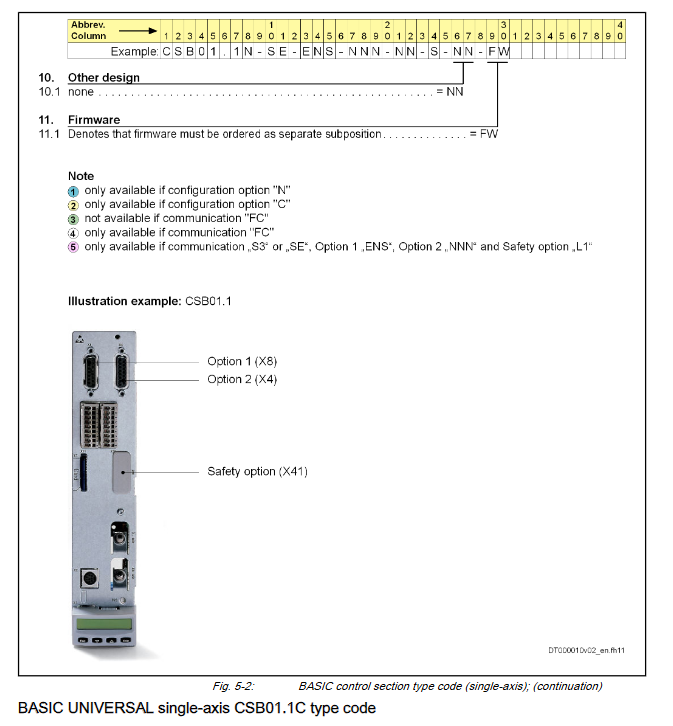
BASIC CSB01.1N (FC/SE/PB/AN) single axis fixed configuration, no additional expansion slots, only supports preset communication protocols, non expandable optional modules

BASIC CSB01.1C single axis configurable, including expansion slots to support communication, encoder, and security module expansion

BASIC CDB01.1C dual axis configurable, dual axis independent control supports dual axis synchronization, multiple expansion slots

ADVANCED CSH01.1C/CSH01.2C/CSH01.3C Single axis Advanced Configurable, Multiple Expansion Slot Supports Cross Communication (CCD), Higher Control Frequency (62.5 μ s)

Core functions and technical parameters

control performance

Control cycle: current control 62.5-125 μ s, speed control 250-500 μ s, position control 500-1000 μ s.

Switching frequency: Supports 2kHz-16kHz, adjustable through parameter P-0-0001.

Compatible with encoders: Supports 12V (ENS module), 8V (EN1 module), 5V (EN2 module) power supply, compatible with various encoder types such as Sin cos, Hiperface, EnDat 2.1, etc.

communication interface

Built in protocols: BASIC series supports fixed protocols such as Sercos, PROFIBUS, analog, etc; The ADVANCED series supports Multi Ethernet (EtherCAT/ProfiNet) and CANopen/DeviceNet.

Extension protocol: Supports Sercos III, Parallel interface, Cross Communication (CCD), etc. through optional modules.

Debugging interfaces: RS232 serial port (X2), Engineering Ethernet interface (X26), supporting control panel and MMC card parameter reading and writing.

I/O and scalability

Digital I/O: The basic unit includes 5-22 digital inputs and 0-4 digital outputs, supporting Type A/B/C/D inputs (24V, 3mA).

Analog I/O: The basic unit includes 2 analog inputs (± 10V/0-20mA) and 2 analog outputs (0-10V), which can be extended to 4-6 inputs and 4 outputs through AN/MA1 modules.

Expansion module: Supports encoder simulation (MEM), digital I/O expansion (MD1/MD2), SSI encoder evaluation (MD2 module integration).

safety technology

Basic security: L1 (start lock, compliant with EN60204-1 stop category 0) L2(Safe Torque Off,SIL3/PL e)。

Advanced security: S1 (Safe I/O), S2 (Safe Motion), supporting functions such as safe stop and safe speed limit, SIL2/PL d)。

Safe power supply: Independent 24V power supply (19.2-30V), maximum current 1.6A.

Environmental and power supply parameters

Power supply requirements: Control voltage DC 24V (fluctuation range 19-30V), basic unit power consumption 8-16W, optional module 1-6W.

Environmental conditions: working temperature 0-45 ℃, storage temperature -30-85 ℃, protection level IP20, anti electromagnetic interference (compliant with EN 61000 series standards).
Optional module details

Module type represents the model, core functions, and key parameters

Communication module SE (Sercos) fiber optic communication, supporting 16MBaud with fiber optic cable, maximum transmission distance of 100m

Communication module PB (PROFIBUS) bus communication, supports 12MBaud 9-pin D-Sub interface, shielded twisted pair cable

Encoder module ENS 12V encoder evaluation, compatible with Hiperface/EnDet 2.1 input frequency 400kHz, 12 bit A/D conversion

Encoder module EN1 8V rotary transformer/HSF encoder evaluation input frequency 18kHz, 12 bit A/D conversion

I/O expansion module MA1 2 analog inputs+2 analog outputs 12 bit resolution, ± 10V output

I/O expansion module MD2 16 channel digital I/O+SSI encoder evaluation digital I/O support 24V/0.5A, SSI clock frequency 100-1000kHz

The safety module S2 (Safe Motion) requires encoders for safety stop, speed limit, and position limit, and supports multiple safety function combinations

Installation and maintenance requirements

Installation specifications

Installation method: 35mm standard guide rail (EN 60715), vertically installed, with at least 2cm of reserved heat dissipation space above and below.

Wiring requirements: Digital I/O requires external 24V power supply. It is recommended to connect protective diodes in series to prevent polarity reversal; The signal cable and power cable are wired separately, and the shielding layer is grounded at both ends.

Insertion and removal restrictions: The control unit and power unit should not be inserted or removed more than 20 times to avoid poor contact.

Maintenance points

Firmware update: Update firmware through MMC card (PFM02.1) or Engineering interface, supporting parameter backup and recovery.

Fault diagnosis: Read fault codes through LED indicator lights, control panel or upper computer, and support 16 channel real-time data recording.

Spare parts requirements: Only Bosch Rexroth certified spare parts are allowed, and parameters need to be reconfigured after module replacement.

Typical Applications

Single machine drive: machine tool spindle/feed axis, packaging machinery actuator, printing machine tension control.

Multi axis collaboration: Material handling robots, assembly line multi axis synchronization, automated production line drive system.
REXRTOH Axial piston variable pump A4VG Series 40

Product Overview and Core Positioning

The A4VG Series 40 is a high-pressure inclined disc axial piston variable displacement pump launched by Bosch Rexroth, designed specifically for closed-loop hydraulic systems. Its core advantages are high power density and stable high-pressure performance. Its rated pressure reaches 450 bar, and the maximum pressure can reach 500 bar (single working time ≤ 10s, total working time ≤ 300h), suitable for scenarios such as machine tools, construction machinery, industrial transmission, etc. that require high-pressure power output. The product integrates a built-in auxiliary pump, which can provide pressure compensation and pilot oil supply, while supporting multiple control modes and expansion functions, with strong flexibility.

Core specifications and technical parameters

Key dimensions and displacement | Specification (NG) | Main pump displacement (cm ³/rev) | Auxiliary pump displacement (standard/large, cm ³/rev) | Weight (without through drive, kg) | Maximum speed (rpm)|

| 110 | 110.4 | 24.5/31 | 88 | 3150 |

| 125 | 125 | 31/- | 84 | 3000 |

| 145 | 145.3 | 32/39 | 106 | 2850 |

| 175 | 175.4 | 39/47 | 115 | 2650 |

| 210 | 210.6 | 46/60 | 152 | 2500 |

| 280 | 280.3 | 60/- | 160 | 2400 |

Hydraulic oil and environmental parameters

Recommended hydraulic oil: HLP mineral oil (DIN 51524), also compatible with environmentally friendly and fire-resistant hydraulic oil (please refer to the corresponding data manual).

Viscosity requirement: Continuous operation at 10-400 mm ²/s (optimal at 36-16 mm ²/s), cold start at ≤ 1600 mm ²/s (duration ≤ 3 minutes).

Temperature range: working temperature of hydraulic oil NBR seal ≤ 85 ℃, FKM seal ≤ 110 ℃; Storage and transportation temperature -30~+85 ℃.

Cleanliness requirements: ISO 4406 20/18/15, viscosity<10 mm ²/s needs to be increased to 19/17/14.

Control mode and functional configuration

Detailed Explanation of Mainstream Control Methods | Control Types | Model Codes | Core Features | Power Supply/Signal Requirements|

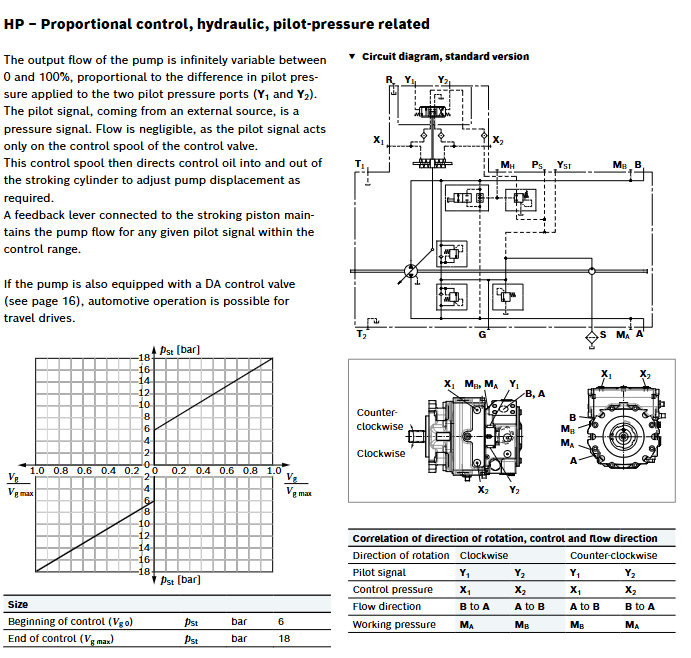
|Hydraulic proportional control (related to pilot pressure) | HP1/HW2/HW8 | Flow rate is continuously adjustable from 0-100%, proportional to pilot pressure (6-18 bar) | Hydraulic pilot signal|

|Mechanical servo control | HW series | Adjust flow rate through control rod swing angle, with spring centering | Mechanical force (maximum 170Ncm)|

|Speed related automatic control | DA1 (12V)/DA2 (24V) | Suitable for walking drive, flow rate automatically adjusts with engine speed | 12V/24V, rated power ≈ 26W|

|Electric proportional control | EP1/EP3 (12V)/EP2/EP4 (24V) | Flow proportional to control current (200-1200mA), some with manual emergency adjustment | 12V/24V, 100Hz jitter frequency|

|Electric two-point control | EZ1 (12V)/EZ2 (24V) | Only switch between “zero displacement/maximum displacement” | 12V/24V, minimum operating current 0.67-1.32A|

Core auxiliary functions

Pressure cut-off: After the pressure reaches the set value, reduce the displacement to the minimum, which should be 30 bar lower than the high-pressure relief valve to avoid frequent operation of the relief valve.

Bypass function: It can connect ports A and B (such as in towing scenarios), with a maximum towing flow rate of ≤ 30L/min.

Neutral valve: When the power is cut off, the pump torque is zero to ensure safety and adapt to safety critical scenarios.

Mechanical travel limiter: It can infinitely limit the maximum displacement and adapt to different load requirements.

Installation and maintenance requirements

Installation specifications

Installation position: Supports 12 installation methods, recommended bottom mounted (pump body below the lowest liquid level in the tank), maximum allowable suction height is 800mm.

Port connection: The working ports A/B are SAE J518 standard, and the oil suction port S and oil discharge port T1/T2 need to be connected according to the installation position (to avoid liquid accumulation).

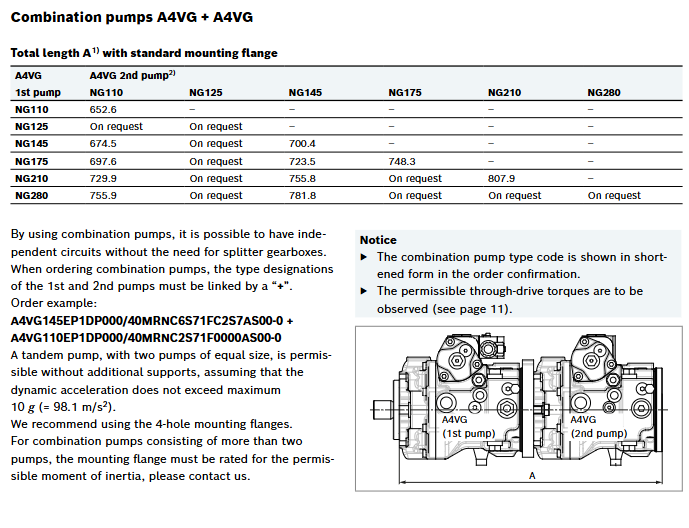
Through drive: Supports the installation of additional pumps of the same specifications, and attention should be paid to the through drive torque (934Nm for 110NG and 2641Nm for 280NG).

Filtering and pressure compensation requirements

Oil suction filter: It is recommended to install an oil suction filter with a cold start valve. When working continuously, the oil suction pressure should be ≥ 0.8 bar absolute pressure, and when starting cold, it should be ≥ 0.5 bar absolute pressure.

Pressure compensation circuit: The rated pressure of the auxiliary pump is 25 bar, with a maximum of 40 bar. It can be equipped with built-in or external filtration (to meet cleanliness requirements).

Safety and Maintenance

Safety protection: When working, the temperature of the pump body and electromagnetic coil is high, and protective equipment should be worn; To avoid valve group jamming caused by hydraulic oil contamination, filters need to be replaced regularly.

Filling and deflation: After the first start-up or long-term shutdown, it is necessary to fill hydraulic oil and deflate it. The oil outlet should be connected to the highest position of the oil tank to avoid negative pressure.

Shelf life: The standard rust prevention period is 12 months, and can be extended up to 24 months (please specify in the order and meet the optimal storage conditions).

Expansion configuration and accessories

Sensor options

Pressure sensor: PR4 series (0-600bar), installed on MA/MB port, suitable for high pressure monitoring.

Speed sensor: DSA/DSM series, capable of monitoring pump speed and steering, non retrofit.

Swing angle sensor: Hall effect type, outputting 1-4V analog signal, suitable for displacement closed-loop control, non retrofit.

Connectors and accessories

Electromagnetic coil connector: DEUTSCH DT04-2P-EP04 (IP67/IP69K protection), without suppression diode.

Filter accessories: oil suction filter (version S), pressure filter (version D), and installed filter with pollution indicator (versions B/F).

REXRTOH DDS02.1/03.1 Digital AC Servo Drive

Product Overview and Core Positioning

DDS02.1/03.1 is a digital AC servo drive launched by Bosch Rexroth (Indramat). It adopts a modular design and can be flexibly matched with MDD, MKD synchronous motors, and LAF/LAR linear motors to form a fast response drive system. Its core positioning is to provide high-precision and high reliability servo drive solutions for machine tools, textile machinery, printing and packaging equipment, robots, and material handling equipment, supporting complex control requirements such as single axis positioning and multi axis collaboration.

Product model and core configuration

Model classification and key parameters | Model series | Cooling method | Rated current range | Adaptive feedback type | Weight|

|DDS02.1-W | Air cooling (cabinet heat dissipation) | 15A-200A | DSF/RSF | Approximately 7.5kg|

|DDS02.1-A | External air cooling (cabinet heat dissipation) | 50A-200A | DSF/RSF | Approximately 11kg|

|DDS02.1-F | Liquid Cooling | 50A-200A | DSF/RSF | Approximately 11kg|

|DDS03.1-W | Air Cooling (Basic) | 30A-50A | DSF/RSF | Approximately 5.5kg|

Core component composition

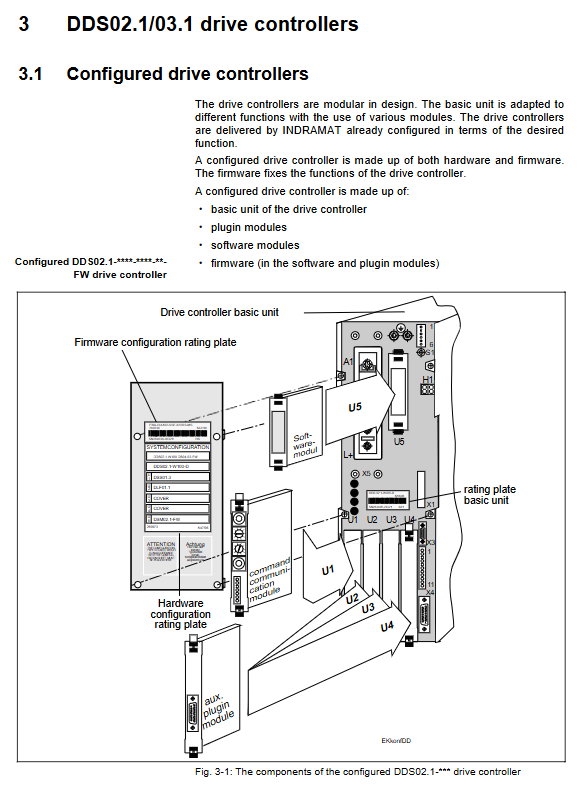
Basic unit: including power part, signal processing circuit, providing core connection points such as motor power supply, feedback interface, bus interface, etc.

Software module: Stores firmware and driver parameters, supports parameter backup and migration, and firmware can be independently ordered and updated.

Plugin module: optional SERCOS interface, analog interface, single axis positioning module (DLC01.1/02.1), INTERBUS-S slave interface, etc., to expand functionality and communication capabilities.

Core functions and technical parameters

core functionality

Servo drive: Supports position and speed closed-loop control, compatible with digital servo feedback (DSF) and rotary transformer feedback (RSF), with high control accuracy.

Positioning control: Up to 3000 program blocks can be programmed for motion sequence through a single axis positioning module (DLC series).

Fault monitoring: Integrated monitoring functions for overvoltage, undervoltage, short circuit, abnormal temperature, cable breakage, etc., to ensure system safety.

Communication Expansion: Supports bus protocols such as SERCOS and INTERBUS-S, and some models can expand communication interfaces through plug-in modules.

Key technical parameters

Power supply parameters: DC 300V ± 15% bus voltage, DC 24V (20-28V wide voltage) control voltage, control circuit current consumption of about 1.1A.

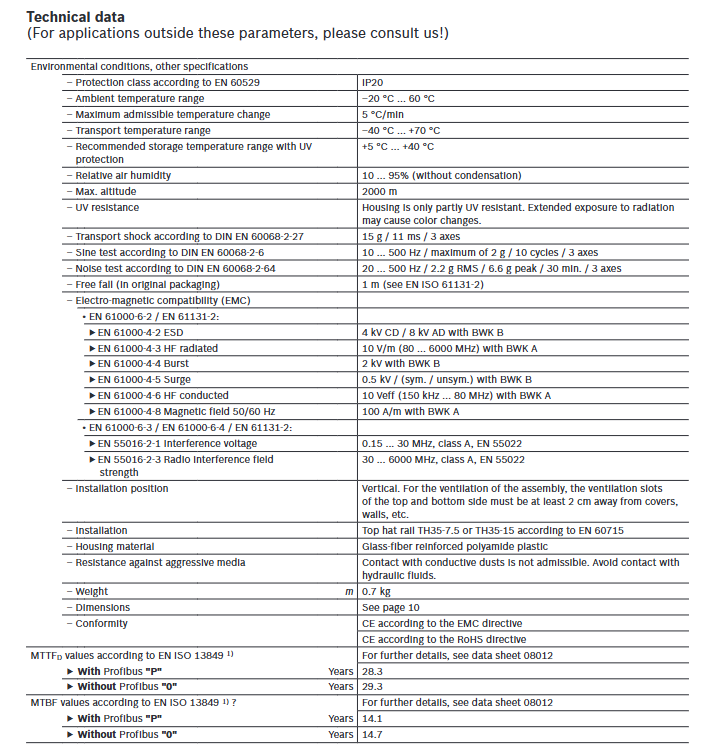
Environmental parameters: working temperature of 0-45 ℃ (with a capacity reduction of up to 55 ℃), storage and transportation temperature of -30~85 ℃, protection level of IP20, maximum installation altitude of 1000m.

Performance parameters: Continuous current of 10A-105A, peak current of 15A-200A, short control cycle, rapid response.

Installation and Electrical Connection Specification

Installation requirements

Installation method: 35mm standard top cap guide rail (EN 60715) is used for vertical installation, and at least 2cm/40mm heat dissipation space should be reserved for the upper and lower ventilation openings.

Layout principle: High power drivers should be located near the power supply unit, and signal cables and power cables should be routed separately to avoid interference.

Cooling precautions: The liquid cooling model should follow the dedicated installation guide, and the external air cooling model should ensure that the heat sink is exposed and well ventilated.

Core points of electrical connection

Motor connection: Shielded cables with a maximum length of 75m are required for the motor power cable, which should be connected to the power line, grounding wire, temperature monitoring wire (PTC), and brake wire.

Feedback connection: The feedback cable needs to be shielded. The DSF feedback corresponds to the DDSxx. 1-xxxx-D model, and the RSF feedback corresponds to the DDSxx. 1-xxxx-R model, and cannot be mixed.

Bus and control connection: Supports RS232 interface (parameter configuration), bus interface (X1), analog diagnostic output (X3), etc., and must be wired strictly according to the pin definitions.

Safety regulations and maintenance requirements

Safety operation standards

Anti electric shock: After power failure, wait for 5 minutes for discharge before carrying out maintenance operations. All units must be reliably grounded.

Anti dangerous sports: Safety devices such as emergency stop switches and protective fences should be equipped to avoid equipment or personnel injuries caused by misoperation.

EMC protection: Following electromagnetic compatibility standards, power cables and signal cables are wired separately, shielded cables are used, and reliably grounded.

Maintenance and Storage

Maintenance: The equipment comes with default parameters at the factory, and after repair, user parameters need to be re imported. Only spare parts approved by the manufacturer are allowed to be used.

Storage: It should be stored in a dry, dust-proof, and shock resistant environment with a temperature range of -30~85 ℃, avoiding contact with conductive dust and hydraulic oil.

Transportation: Shockproof packaging is required to avoid falling or collision, and to keep dry during transportation.

Core accessories

Connection kit: E. – DDS 2/3 series electrical connection kit, including bus cables, DC bus rails, etc.

Plugin modules: SERCOS interface module (DSS01.1/01.3), analog interface module (DAE01.1/DAA01.1), etc.

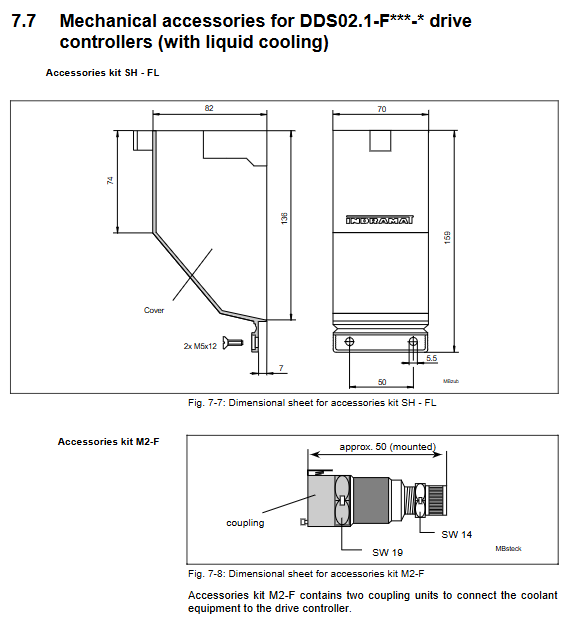
Special accessories: liquid cooling accessories (SH-FL, M2-F), external cooling fan (LE4 series), service cable (IKS0391).

REXRTOH VT-HPC Digital control electronics for axial piston pumps

​Product positioning and core applications

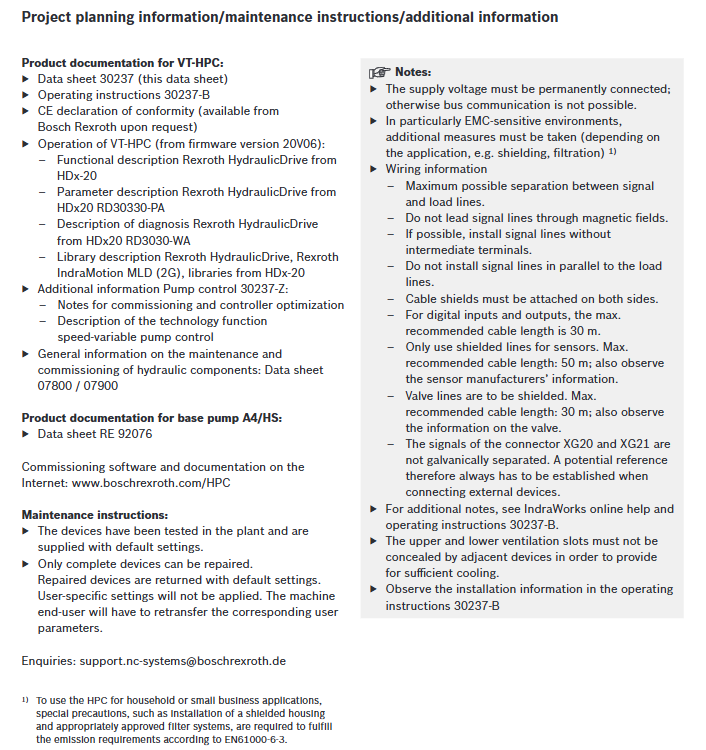
VT-HPC is a digital control electronic device launched by Bosch Rexroth, specifically designed to control A4VS series axial piston pumps with HS5 adjustment mechanism, compatible with pump bodies ranging from 40 to 1000 specifications. This device integrates multiple control algorithms to achieve precise control of pump body inclination, pressure, and torque. It also supports master-slave control, leakage compensation, and other functions, and is widely used in industrial hydraulic systems.

Core functions and working principles

Basic control function

Tilt angle/flow control: The position of the pump body tilt plate is controlled by a proportional valve, and the actual value is fed back by the tilt angle sensor to form a closed-loop control.

Pressure control: relying on pressure sensors to collect data, combined with PID algorithm to achieve stable pressure regulation.

Torque limit: Calculate the actual torque by multiplying the pressure and inclination angle, and use a minimum value generator to ensure the safety of the working point.

Expansion and optional features

Support master-slave control, leakage compensation, and mooring functions to meet the collaborative requirements of complex hydraulic systems.

Optional variable speed function and PLC function based on IEC 61131-3 standard, require separate order of SD card activation.

Working mode: It can achieve combined control modes such as pressure/tilt angle, pressure/flow rate, etc. The command values can be set through bus, analog interface or internal PLC program.

Communication and Interface Specifications

communication protocol

Supports mainstream bus protocols such as Sercos, PROFINET RT, EtherCAT, EtherNET/IP, POWERLINK, etc. PROFIBUS is an optional configuration.

It can be parameterized through standard Ethernet interfaces and has integrated switch functionality.

Input/output interface parameters

|Interface Type | Quantity | Key Parameters|

|Digital input (Di) | 4 channels | High level 11-28VDC, Low level -3-5VDC|

|Digital output (Do) | 4 channels | Maximum 50mA current load, short circuit protection|

|Analog input (Ai) | 6-channel | 5-channel universal input (14 bit resolution), 1-channel tilt sensor dedicated input (13 bit resolution)|

|Analog output (Ao) | 2 channels | 16 bit resolution, supporting voltage (± 10V) or current (0-20mA) output|

Technical parameters and environmental characteristics

Electrical parameters

Supply voltage: 24VDC, allowable range 20-28VDC, maximum residual ripple 5Vpp.

Current consumption: No load 0.2-0.4A, maximum load 2.6A, requires external 4A delay fuse.

Control performance: The minimum scanning time for the tilt/pressure controller is 0.5ms, and the startup time is less than 15 seconds.

Environment and installation characteristics

Protection level IP20, working temperature range * * -20 ℃ to 60 ℃ * *, storage temperature -40 ℃ to 70 ℃.

Installation method: 35mm top cap guide rail in accordance with EN 60715 standard, vertically installed, with at least 2cm space reserved for upper and lower ventilation openings.

Anti interference capability: meets the EN 61000 series EMC standards and can resist interference such as static electricity, surges, and radio frequency radiation.

Debugging Tools and Maintenance

software tool

Use IndraWorks DS for project planning, parameter configuration, and debugging; Enabling PLC functionality requires the use of IndraWorks MLD.

Support SD/SDHC card expansion storage, with a maximum capacity of 4G, used to save parameters, programs, or update variable speed functions. The card needs to be inserted before the device is turned on.

Monitoring and Diagnosis

Built in comprehensive monitoring functions can detect issues such as undervoltage, communication failures, sensor disconnections, output short circuits, and abnormal temperature of electronic components.

Display the working status through LED indicator lights, such as bus activation status, digital I/O level status, etc.

REXRTOH HNC100-3X Programmable motion control for electrohydraulic drives

1、 Product Overview
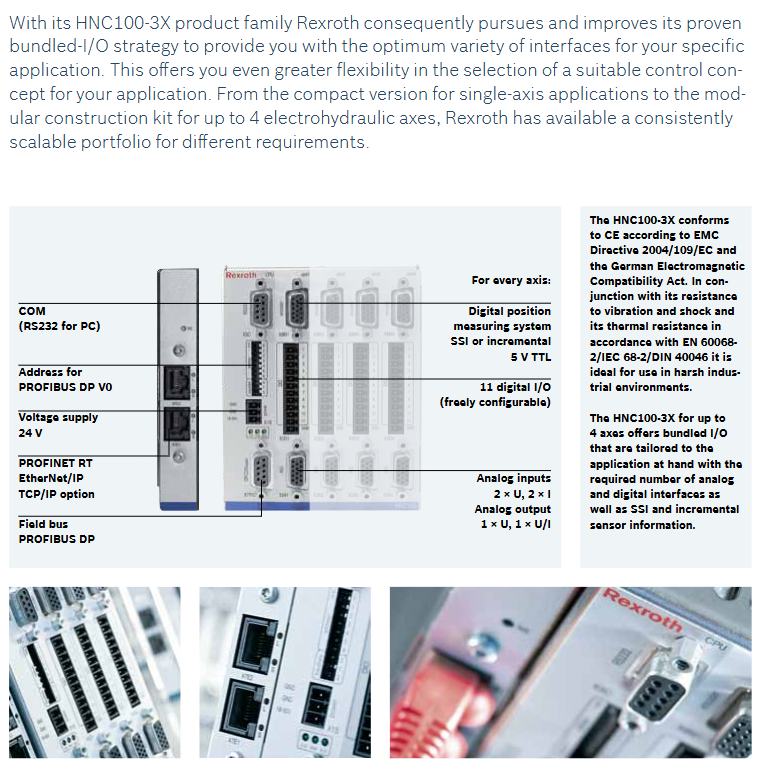
Bosch Rexroth HNC100-3X is a programmable motion controller for electro-hydraulic drive systems, optimized and developed based on the experience of thousands of hydraulic application projects. It focuses on hardware and software scalability, open system architecture, and hydraulic adaptive control algorithms, and can achieve high-precision control of 1-4 hydraulic axes, widely applicable to various industrial scenarios.
2、 Core advantages
Bidirectional scalability feature
Hardware Expansion: Covering compact single axis version to 4-axis modular version, the size increases with the number of axes, and the number of interfaces expands synchronously.
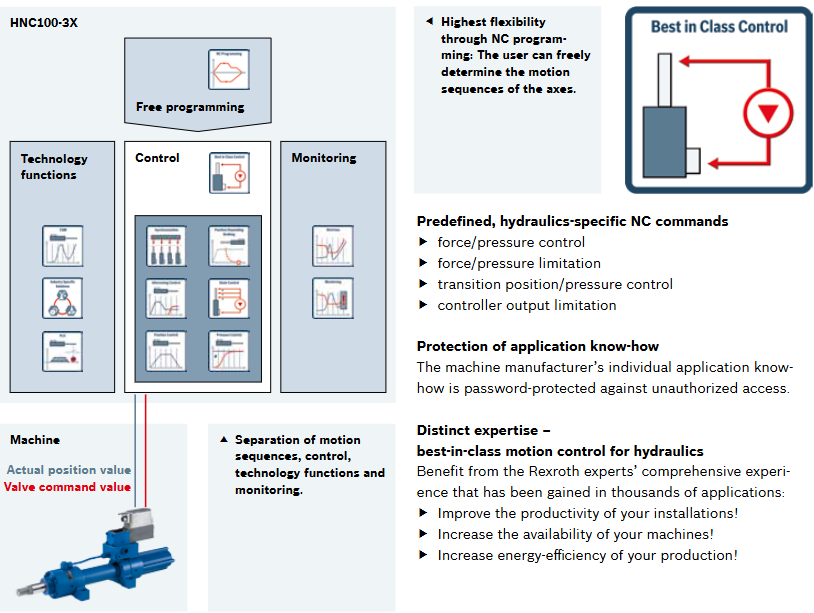
Software extension: Controller functions can be activated as needed, integrating control modules such as position, pressure, force, and synchronization without the need for additional hardware.
Open system architecture
Communication openness: Supports mainstream bus protocols such as PROFIBUS DP, PROFINET, EtherNet/IP, TCP/IP, and seamlessly integrates with existing automation architectures.
Programming openness: Supports DIN 66025 standard NC programming, allows free configuration of motion sequences, and supports open access to controller parameters.
Hydraulic exclusive optimization
Integrate commonly used hydraulic functions such as position pressure/force alternating control and synchronous control, adapting to the power density and robustness characteristics of hydraulic systems.
The control cycle is as low as 0.5ms/axis, greatly improving the response performance of the controller.
3、 Hardware specification details
Specifications: Compact version (single axis), 1 axis version, 2 axis version, 3 axis version, 4 axis version
Dimensions (height × depth × width) 120 × 108 × 34mm 120 × 124 × 48mm 120 × 124 × 65mm 120 × 124 × 82mm 120 × 124 × 99mm
Analog input 3 channels (1U+2I) 4 channels 8 channels (4U+4I) 12 channels (6U+6I) 16 channels (8U+8I)
Analog output 2 channels (2U) 2 channels (1U+1U/I) 4 channels (2U+2U) 5 channels (3U+2U) 6 channels (4U+2U)
Digital I/O 8, 11, 22 (maximum 20 outputs) 33 (maximum 20 outputs) 44 (maximum 20 outputs)
Bus Communication PROFIBUS DP PROFIBUS DP+PROFINET+EtherNet/IP Same 1 Axis Version Same 1 Axis Version Same 1 Axis Version Same 1 Axis Version
Basic hardware parameters: power supply voltage of 18-30VDC, working temperature of 0-50 ℃, in compliance with CE, EN 60068-2 and other standards, anti vibration and anti impact, suitable for harsh industrial environments.
Encoder support: SSI or incremental encoder interfaces are standard on each axis to meet high-precision position detection requirements.


4、 Software and Debugging Tools
Core control function
Position control: supports characteristic curve adjustment and fine positioning; Pressure/Force Control: Integrated PIDT1 controller and differential pressure evaluation.
Synchronous control: adapted to the synchronous coordination of multiple hydraulic shafts; Alternating control: Automatically achieve position pressure/force mode switching.
Monitoring function: including wire breakage detection, tracking error monitoring, travel limit monitoring, etc., to ensure equipment safety.
debugging tool
WIN-PED 7: Free downloadable engineering software that supports project configuration, parameter configuration, NC programming, and provides online assistance.
WinView: Integrated into WIN-PED, supports 16 channel real-time data recording and analysis, facilitating fault diagnosis.
5、 Application Fields and Technical Support
Typical Applications
Metallurgical industry: steel rolling and drawing equipment; Rubber and plastic industry: injection molding machines, rubber vulcanizing machines.
Machine tool industry: bending machines, press machines; Special machinery: packaging equipment, assembly lines.
Technical Support
Provide hydraulic drive selection, customized training, and on-site debugging services.
The official website provides software updates, technical document downloads, and supports email technical consultation.

key issue
What are the hardware scalability aspects of HNC100-3X? Answer: Hardware scalability is reflected in two dimensions: the number of axes and interfaces. The configuration covers 1-4 axes, expanding from the compact single axis version to the 4-axis modular version; As the number of axes increases on the interface, analog I/O expands from 3 to 16, and digital I/O expands from 8 to 44. It also supports flexible selection of multiple bus protocols such as PROFIBUS and PROFINET.
What exclusive optimizations has HNC100-3X made for hydraulic systems? Answer: One is to optimize the control algorithm, integrate commonly used hydraulic functions such as position pressure/force alternating control and synchronous control, and adapt to the power characteristics of the hydraulic system; The second is performance optimization, with a control cycle as low as 0.5ms per axis to improve response speed; The third is functional adaptation, providing hydraulic exclusive NC commands, supporting DIN 66025 standard programming, simplifying the development of hydraulic application programs.
How can the debugging tools and open features of HNC100-3X reduce the total cost of ownership for users? Answer: In terms of debugging tools, the free WIN-PED 7 software supports one-stop project configuration, programming, and diagnosis. WinView’s real-time data recording function can quickly locate faults and shorten debugging and downtime; In terms of open features, it supports mainstream bus protocols and can seamlessly integrate with existing automation architectures without the need for additional hardware adaptation. At the same time, the open parameters and programming interfaces facilitate users to customize functions according to their needs, reducing secondary development costs.

Search for products

Back to Top
Product has been added to your cart