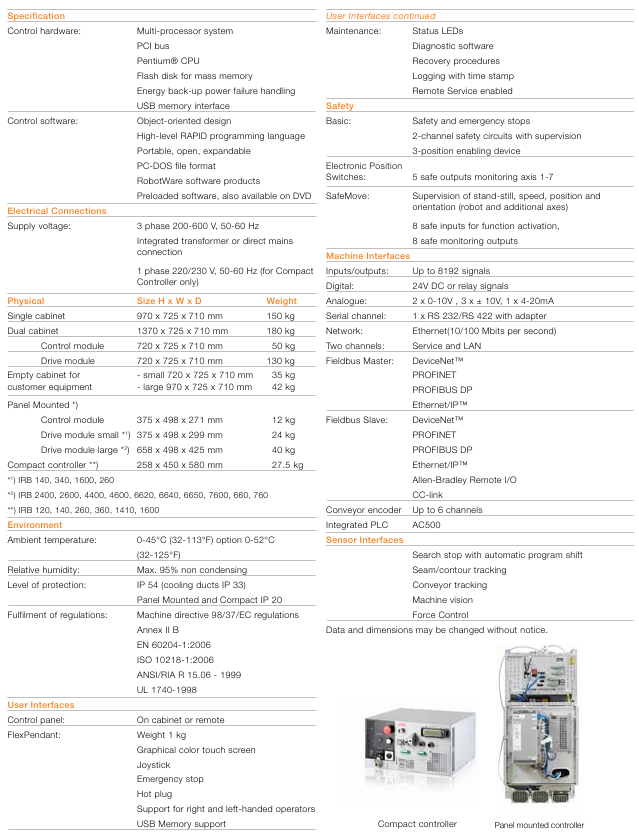
As a product based on ABB’s over 40 years of experience in robotics technology, IRC5 is centered around unique motion control technology, which combines flexibility, safety, modular design, customizable user interface, multi robot control, and PC tool support, setting an industry benchmark for industrial robot applications.
Key Features
Security: Passed third-party certification and complies with all relevant regulations. Equipped with electronic position switches and SafeMove safety systems, it achieves a new generation of safety protection and supports more flexible cell safety solutions (such as robot operator cooperation). Basic safety functions include safety emergency stop, dual channel safety circuit monitoring, and three position enabling devices.
Motion control: Based on advanced dynamic modeling, QuickMove achieves the shortest physical cycle time, TrueMove ensures precise path accuracy, and the path is independent of speed, automatically presenting predictable high-performance performance without the need for programmer debugging.
Modular design: Provides multiple variants to meet different needs, modules can be stacked, placed side by side, or distributed, optimizing footprint and cell layout. Including compact models (controlling low-end IRB series robots) and panel mounted models (inorganic cabinets, suitable for special environments).
Operation and programming: The FlexPendant interface adopts a color touch screen and 3D joystick, supporting customized applications; The RAPID programming language combines simplicity, flexibility, and powerful functionality, supporting structured programs, workshop languages, and various process applications.
Communication capability: Supports advanced I/O fieldbus and is a good node in the factory network, with functions such as sensor interface, remote disk access, socket communication, etc. Ethernet supports 10/100 Mbps, including service and LAN dual channels.
Remote services and tools: can be remotely monitored through GSM or Ethernet, providing advanced diagnostic, backup management, reporting, and preventive maintenance services; The RobotStudio tool supports online and offline processing of IRC5 data, with offline mode providing digital copies of the robot system and powerful programming and simulation capabilities.
MultiMove: A controller can control up to 4 robots, and for each additional robot, a compact drive module needs to be added to perfectly coordinate complex motion patterns.
Technical parameters
Maintenance: including status indicator lights, diagnostic software, recovery program, timestamp logging, and remote service functionality.
I/O signals: up to 8192, digital signals support 24V DC or relay signals, analog signals include 2 × 0-10V, 3 × ± 10V, 1 × 4-20mA, etc.
Fieldbus: Both master-slave modes support DeviceNet ™、 PROFINET、PROFIBUS DP、Ethernet/IP ™ It also supports Allen Bradley Remote I/O, CC link, and up to 6 channels of conveyor encoders, among other types.
Integrated PLC: AC500.
Sensor interface: supports search stop and automatic program displacement, weld/contour tracking, conveyor belt tracking, machine vision, force control, etc.
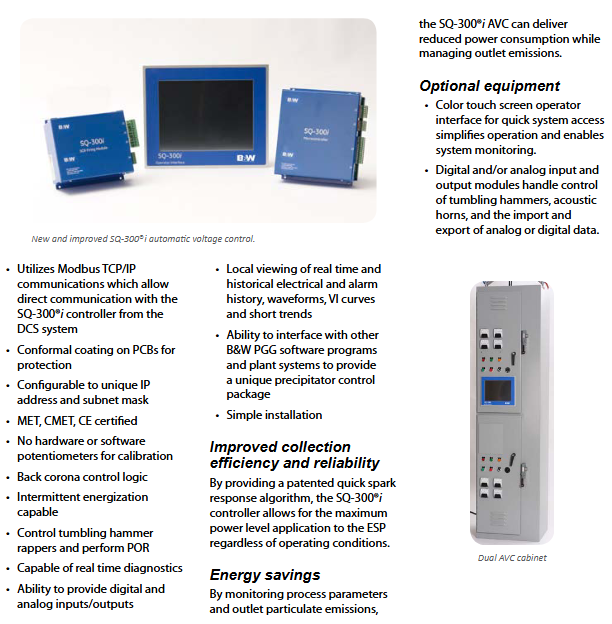
It is its original SQ-300 ® The redesign of the model, as the core component of the electrostatic precipitator (ESP) control system, can simultaneously control the dust collector, analyze alarms, and interface with computer-based data acquisition software.
With improved speed and processing capabilities, old or unreliable equipment can be replaced, helping to meet today’s government emission reporting requirements. It is also an ideal supplement to ESP upgrades and can generate key information for analyzing and improving dust collector performance.
Proven electrostatic precipitator solutions
To help keep your electrostatic precipitator (ESP) functioning at peak performance, Babcock & Wilcox Power Generation Group, Inc. (B&W PGG) provides innovative precipitator systems, mechanical and electrical components, controls and software.
New AVC design for improved performance and efficiency
B&W PGG’s SQ-300 ® i automatic voltage controller (AVC) is a redesign of our original SQ-300 ® model that has a reputation for optimizing ESP performance and collection efficiency in many worldwide industry applications.
Serving as an integral component of the precipitator control system, the SQ-300 ® i AVC simultaneously controls the precipitator, analyzes alarms, and interfaces with computer-based data acquisition software.
With its improved speed and process capability, the SQ-300 ® i controller can replace old or unreliable equipment and help maintain compliance with today’s governmental emissions reporting requirements. In addition, this versatile AVC is an ideal complement to an ESP upgrade for generating information that is critical to analyzing and improving precipitator performance.
Advanced AVC capabilities
• On-board five-trace oscilloscope permits triggering on events, such as sparking. Because the AVC cabinet can remain closed, users benefit from arc flash protection and improved personnel safety.
• Increased system flexibility provides operational benefits.
• Optional operator interface with large, color touch screen provides quick system access for simplified operation and system monitoring including VI curve, history and alarm log generation.
• Cost-effective, flexible design allows for simple or elaborate configuration.
• On-board data storage capacity for up to one year of data.
• No EEPROMs are required. Enhancements, troubleshooting and upgrades can be performed on-line and remotely from our diagnostic center.
Solid industry reputation
The SQ line of automatic voltage controls uses an advanced, patented spark response algorithm for higher performance, increased efficiency and improved emissions collection.
The SQ-300 ® i controller delivers the latest available technology and features, while maintaining the same high quality and benefits of its predecessors, the SQ-200 and SQ-300 controllers. Features include:
• Improved connectivity that interfaces with customer data acquisition systems, including Windows ® 7 operating system software
• Increased average power delivered to the field through the patented automated tuning of setback and spark rate, resulting in higher collection efficiency
• Obtains power quality analysis utilizing on-board waveform analysis
• On-board generation of Vl curves
• Monitors key operations of the T/R and precipitator field during operation the SQ-300 ® i AVC can deliver reduced power consumption while managing outlet emissions.
Optional equipment
• Color touch screen operator interface for quick system access simplifies operation and enables system monitoring.
• Digital and/or analog input and output modules handle control of tumbling hammers, acoustic horns, and the import and export of analog or digital data.
• Utilizes Modbus TCP/IP communications which allow direct communication with the SQ-300 ® i controller from the DCS system
• Conformal coating on PCBs for protection
• Configurable to unique IP address and subnet mask
• MET, CMET, CE certified
• No hardware or software potentiometers for calibration
• Back corona control logic
• Intermittent energization capable
• Control tumbling hammer rappers and perform POR
• Capable of real time diagnostics
• Ability to provide digital and analog inputs/outputs
• Local viewing of real time and historical electrical and alarm history, waveforms, VI curves and short trends
• Ability to interface with other B&W PGG software programs and plant systems to provide a unique precipitator control package
• Simple installation
Improved collection efficiency and reliability
By providing a patented quick spark response algorithm, the SQ-300 ® i controller allows for the maximum power level application to the ESP regardless of operating conditions.
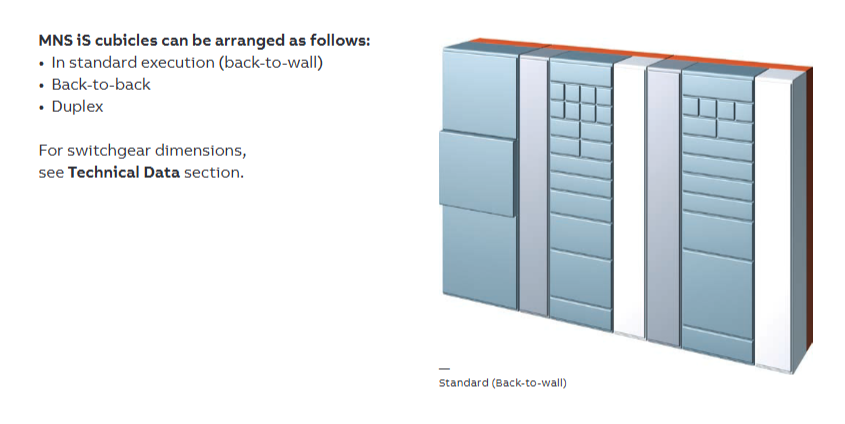
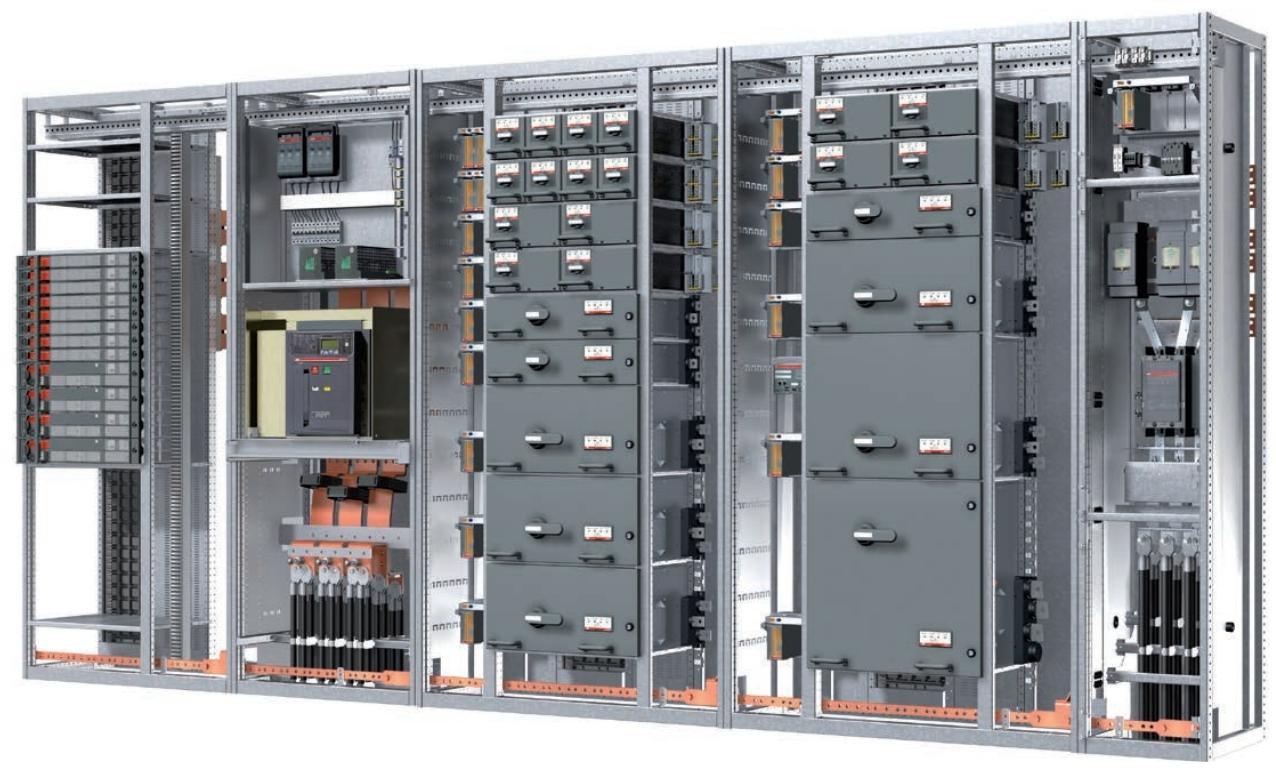
Product positioning: MNS iS is an intelligent motor control center upgraded based on MNS series technology, integrating protection, control, and monitoring functions, suitable for industrial production lines, energy facilities, and other scenarios. Through modular design, it achieves efficient operation and maintenance as well as full lifecycle cost optimization.
Core characteristics and values of the system
1. Core advantages
High safety: The power and control areas are physically isolated, complying with the IEC 61439 series standards, supporting arc fault protection (up to 100 kA/300 ms), ensuring the safety of personnel and equipment.
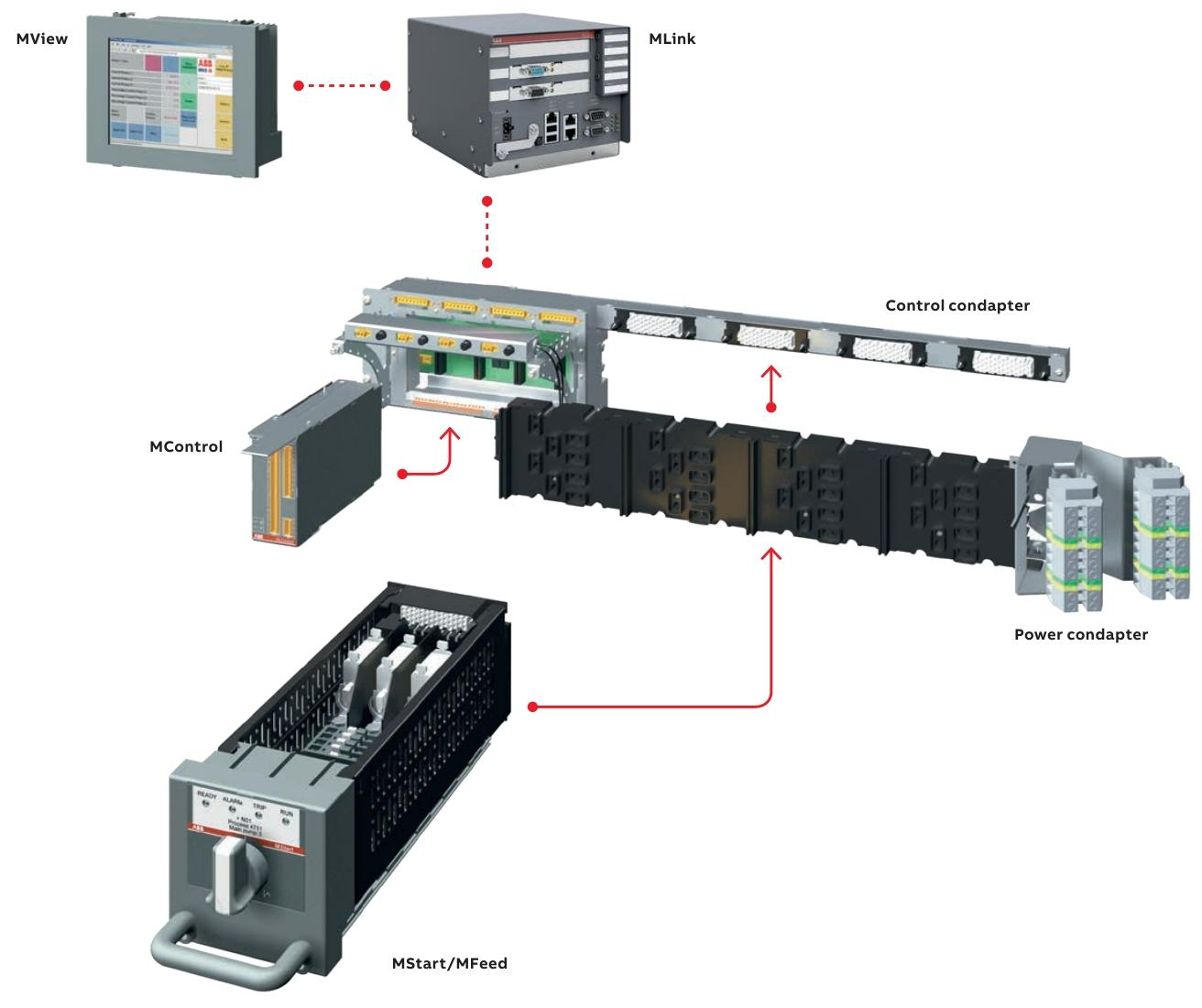
Standardization and flexibility: The fully pre installed power module (MStart) supports multiple starter types (direct start, star delta start, etc.), and the control module (MControl) can expand its functionality through software configuration without the need for additional hardware.
Low lifecycle cost: Reduce downtime through predictive maintenance (condition monitoring), standardize modules to lower inventory requirements, and simplify troubleshooting processes.
Intelligent information management: integrates web servers with industrial communication protocols (Profibus, Profinet, etc.), supports remote monitoring and data analysis, and achieves digital operation and maintenance.
2. Innovative design
Functional module separation: The power module (MStart) and control module (MControl) operate independently, supporting live module replacement and improving system availability.
Transformer free sensing technology: high-precision shunt sensors are used to measure current, voltage, and temperature, replacing traditional transformers and reducing energy consumption and space occupation.
Plug and play architecture: modules automatically identify location and type, communication networks automatically configure, reducing engineering complexity.
System Architecture and Components
1. Hardware composition
Power module (MStart):
Includes isolators, short-circuit protection devices (fuses or circuit breakers), contactors, and sensor modules.
Supports drawer style (6E/4 to 24E sizes) and fixed style (suitable for motors ≥ 250 kW) installation, compatible with voltage levels of 400 V, 500 V, and 690 V.
Control module (MControl):
The core controller is responsible for protecting algorithms (overload, phase loss, ground fault, etc.), logic control, and data acquisition.
Support the expansion of I/O interfaces (digital, analog, PTC/PT100 temperature input) to meet different on-site signal requirements.
Communication and Interface Module:
MLink: As a gateway connecting upper level systems, it supports protocols such as Profibus DP, Profinet, Modbus, and has a built-in web server.
MView: Local Human Machine Interface (HMI), supports touch operation and status monitoring, and can be accessed remotely through the network.
2. Structural design
Partition separation: Vertical and horizontal partitions strictly distinguish equipment areas, control cable areas, power cable areas, and busbar areas to avoid electromagnetic interference, and support different key lock control access permissions.
Busbar system: The main busbar is located at the rear of the cabinet and adopts a maintenance free design (copper material, optional silver plating or insulation sleeve). It is safely isolated from the equipment area through a multifunctional isolation wall (MFW).
Cable management: Power and control cable partition wiring, supporting up and down incoming lines, suitable for different installation scenarios.
Control and protection functions
1. Protection function module
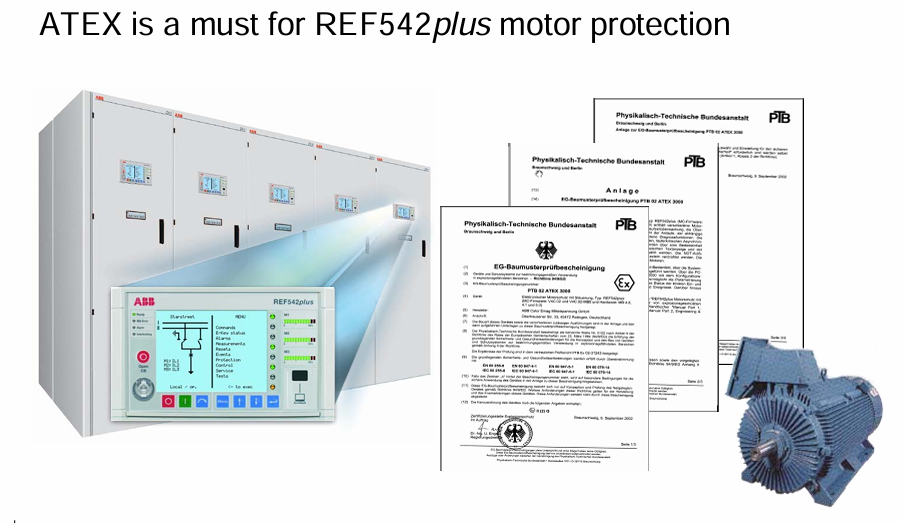
Thermal Overload Protection (TOL): Based on the IEC 60947-4-1 standard, it calculates the motor’s thermal capacity, provides “trip time” and “reset time” warnings, and supports ATEX certification scenarios.
Motor abnormal protection: monitors phase loss, current imbalance, undervoltage, grounding faults, etc., and can be configured with alarm or trip actions.
Process monitoring and protection: including blockage, underload, no-load, and limit of starting times, to prevent mechanical failures (such as pump cavitation).
2. Maintenance and status monitoring
Predictive maintenance: Monitor parameters such as the number of contactor actions, module insertion times, operating hours, and contact temperature, and trigger an alarm when the threshold is exceeded.
System self diagnosis: Automatically verify module type and position matching, communication status, and control voltage to ensure system integrity.
Communication and Integration
Communication architecture and core components
1. Communication nodes and hierarchy
The communication system of MNS iS adopts a distributed architecture and is divided into three levels of nodes:
On site level: With MControl as the core, responsible for the protection, control, and data acquisition of a single motor, communicating with the power module (MStart) through an internal bus.
Network level: Multi node aggregation is achieved through MLink gateway, supporting interaction with upper level systems, and can connect up to 60 MControl modules.
Monitoring level: Integrated MView local human-machine interface and web server, supporting remote access and configuration.
2. Key communication components
Component Function Description
MControl has a built-in communication interface that supports real-time data exchange with MStart modules (current, temperature, status, etc.) and can be directly connected to Profibus DP/Profinet networks.
As a system gateway, MLink supports protocols such as Profibus DP, Profinet, Modbus RTU/TCP, OPC, etc., enabling integration with PLC, SCADA and other systems, while also providing web server functionality.
MView local touch panel (optional), displaying motor status, alarm information, and operation buttons based on a web interface, supporting permission management.
Communication Protocol and Interface
1. Supported protocol types
Industrial bus protocol:
Profibus DP/DP V1 (slave mode, supporting process data and diagnostic information transmission);
Profinet I/O (compatible with ABB systems and supports real-time communication);
Modbus RTU (serial communication) and Modbus TCP (Ethernet communication).
General Agreement:
Built in web server, supporting access to monitoring interface through standard browsers;
OPC interface, easy to integrate with third-party SCADA or MES systems;
NTP (Network Time Protocol) enables system wide time synchronization.
2. Data transmission capability
Internal communication: A 10 Mbps real-time bus is used between MControl and MLink, with a command response time of approximately 2 ms for a single MControl and a total system response time of ≤ 258 ms for 60 nodes.
External interaction:
The maximum transmission rate of Profibus DP is 12 Mbps;
Profinet and Modbus TCP support 100 Mbps Ethernet transmission;
Support data block read and write (such as motor current, temperature, tripping reasons, etc.) and remote control commands (start/stop/reset).
System integration capability
1. Integration with upper level systems
Process Control System (PCS): Using MLink as a gateway, the motor status and measurement values (current, power, energy consumption) are uploaded to PLC or DCS, and control instructions are received to achieve remote operation.
Electrical network monitoring system: supports sending electrical parameters (such as harmonics and power factor) to the energy management system (EMS) to assist in energy optimization.
Maintenance management system: Push equipment health data (contactor action frequency, operating hours, temperature trend) to CMMS (computerized maintenance management system) through OPC interface, supporting the development of predictive maintenance plans.
2. Redundancy and reliability design
Dual redundant communication: supports two independent communication paths (primary/backup MLink). When the primary link fails, it automatically switches to the backup link to ensure uninterrupted operation, with a switching time of ≤ 100 ms.
Communication fault protection: Configure the “fail safe” mode (such as keeping the motor running/stopping in case of communication interruption) to avoid unexpected shutdowns caused by network issues.
Time synchronization and data consistency
Synchronization mechanism: Implement system wide time calibration through NTP protocol, support access to factory level time servers (such as GPS synchronization sources), and ensure that the timestamp accuracy of event records (alarms, trips) is ≤ 1 ms.
Data timeliness: The update cycle of key measurement values (such as current and temperature) can be configured (default 100 ms) to meet real-time monitoring requirements; Historical data (energy consumption, number of actions) is stored at the minute level and supports trend analysis.
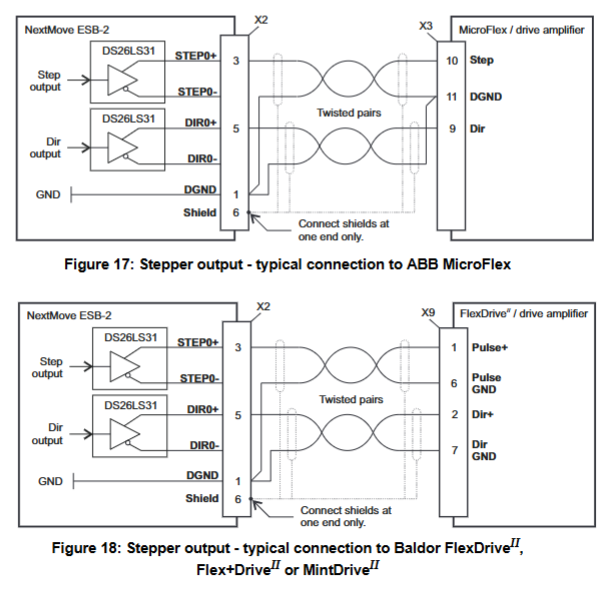
Product positioning: NextMove ESB-2 is a high-precision multi axis intelligent controller that supports servo motor and stepper motor control. It is suitable for automated production lines, precision machinery, and other scenarios, and uses Mint programming language to achieve complex motion control (such as point-to-point motion, electronic gears, cam synchronization, etc.).
Product Overview and Core Features
1. Model and classification
According to the number of servo axes, serial interface type, and stepper output type, there are 8 models, with the following core differences:
Model series, number of servo axes, number of stepper axes, additional encoder input, serial port, stepper output type
NSB202、3、4、2、RS232/485、 Differential Output
NSB203、3、4、2、RS232/485、 open collector
NSB204、4、4、1、RS232/485、 Differential Output
NSB205、4、4、1、RS232/485、 open collector
2. Core functions
Multi axis control: Supports 4 stepper axes+3/4 servo axes (model dependent), supports complex motion modes such as master-slave following and electronic gears.
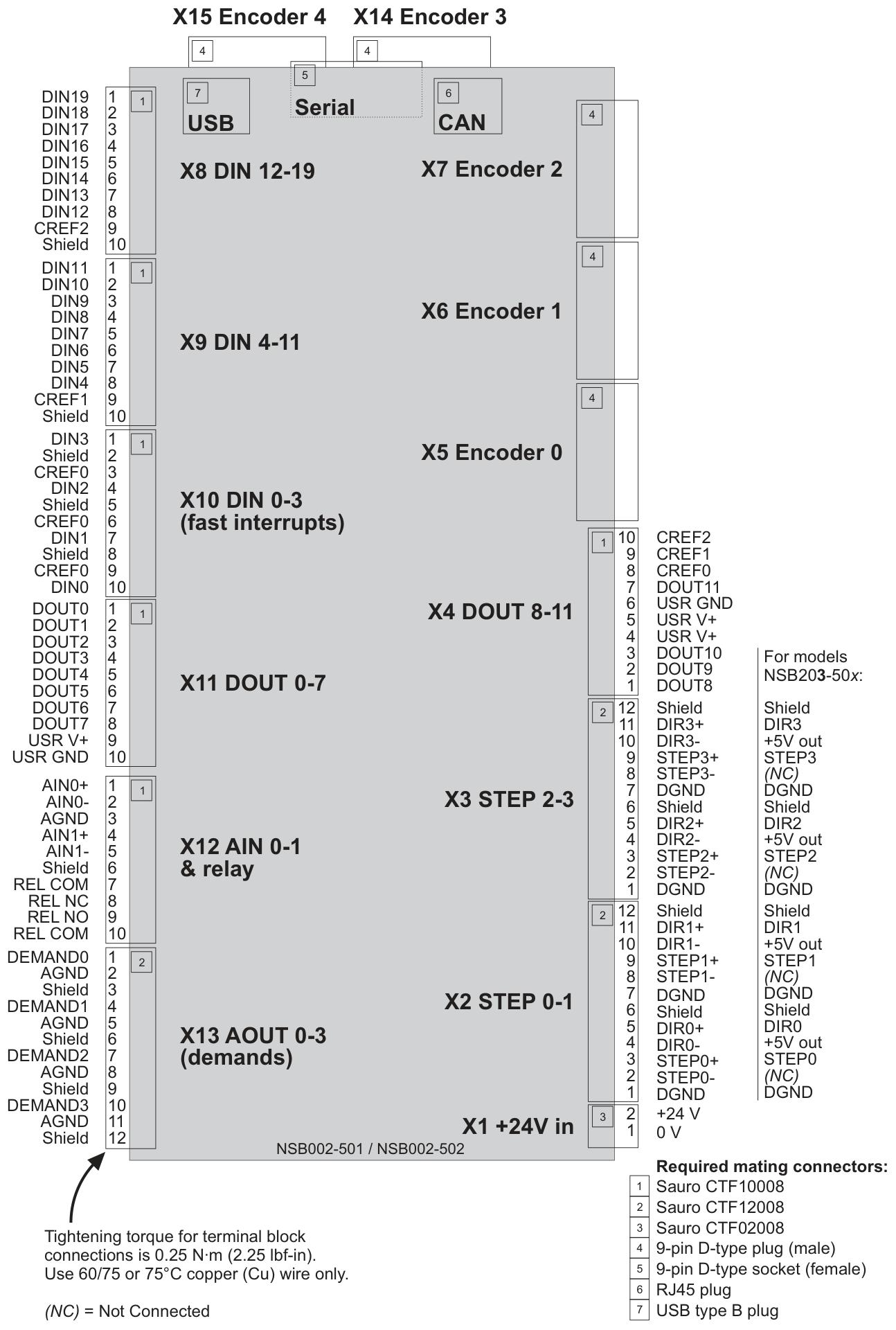
Rich I/O interfaces: 20 digital inputs, 12 digital outputs, 2 12 bit analog inputs, 4 12 bit analog outputs, suitable for various sensors and actuators.
Communication capability: comes standard with USB 1.1, RS232/RS485, CANopen (compatible with third-party devices), and Baldor CAN (proprietary protocol).
Programming flexibility: Based on Mint language (Structured Basic), it supports rapid development of simple motion programs and complex synchronous control logic.
Hardware and interface configuration
1. Power supply and installation
Power supply requirements:+24V DC (± 20%), continuous current of 2A, it is recommended to configure an independent power supply with 4A fuses.
Installation environment: Operating temperature of 0-45 ℃, relative humidity ≤ 80% (no condensation), vertical installation on non flammable surfaces, with a reserved heat dissipation space of ≥ 20mm around.
Mechanical dimensions: 245mm × 140mm × 45mm, weighing approximately 700g, fixed with M4 screws.
2. Key interface parameters
Analog input: differential input, ± 10V range, 12 bit resolution, input impedance of 120k Ω, maximum sampling rate of 4kHz
Analog output: Single ended output, ± 10V range, 12 bit resolution, maximum output current of 2.5mA, update frequency up to 10kHz
Digital input: Optocoupler isolation, supports level/edge triggering, 3 sets of common terminals (CREF0/1/2), input voltage 12~30V DC
Digital output: Maximum total current 500mA (DOUT0-7)/500mA (DOUT8-11), supports driving relays, solenoid valves, etc
Encoder input: Supports 5 incremental encoders (A/B/Z phase), RS422 differential signal, maximum input frequency 10MHz
CAN interface: Supports CANopen and Baldor CAN protocols, with a maximum baud rate of 1Mbps, requiring 12-24V power supply (optocoupler isolation)
Serial interface: RS232 (up to 115.2KBaud)/RS485 (supports multi machine cascading), USB 1.1 (compatible with USB 2.0/3.0)
Software and Programming Guide
Development Environment and Tools
1. Core software components
Mint WorkBench: An integrated development environment (IDE) used for programming, debugging, parameter configuration, and motion monitoring, supporting Windows XP and above systems (32/64 bit). The main functions include:
Code editing and syntax checking
Real time data collection and graphical display (position, velocity, current, etc.)
Axis parameter configuration and servo tuning
Firmware Update and System Diagnosis
Mint Machine Center (MMC): Used for managing multi controller networks, supporting scanning and connecting multiple NextMove ESB-2 nodes, creating visual system layouts, and saving workspace configurations.
2. Software installation and connection
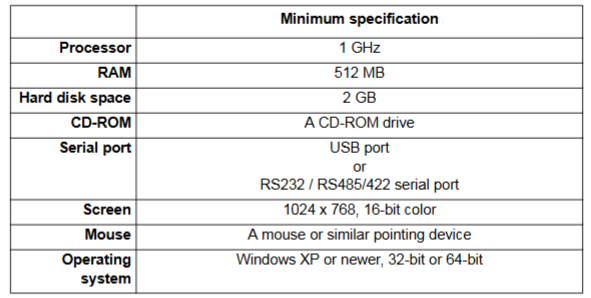
Installation requirements: The PC must meet the minimum configuration (1GHz processor, 512MB memory, 2GB hard disk space, USB or serial port), and administrator privileges are required for installation.
Connection method:
USB: Connect directly through USB Type B interface and automatically install drivers (compatible with Windows XP/Vista/7).
Serial port: RS232 (maximum 3m cable) or RS485 (supports multi machine cascading, requires terminal resistance matching).
Network: Connect distributed nodes through CANopen or Baldor CAN protocol.
Fundamentals of Mint Programming Language
Language characteristics
Mint is a structured language designed specifically for motion control, based on Basic syntax and extending motion control specific commands. Its features include:
Multi axis support: Control objects are distinguished by axis numbers (0-7), and multiple axes can be operated simultaneously.
Real time performance: The cycle time can be configured (1ms or 2ms) to ensure efficient execution of motion instructions.
Rich library functions: covering specialized commands such as point motion, speed control, synchronous following, etc
PFCL 201 series sensors are based on Presductor ® High precision force measurement equipment for technology is mainly used for tension detection of coils (such as paper, metal strips, plastic films) in medium and high voltage industrial environments. By measuring the vertical reaction force generated by coil tension, precise control of the production process is achieved.
Product Overview and Core Features
1. Model and classification
The PFCL 201 series includes three models, divided by structure and environmental adaptability:
PFCL 201C: Basic model, equipped with detachable cable connectors, suitable for conventional environments;
PFCL 201CE: Cable with fixed protective hose, enhanced mechanical protection, suitable for vibration scenarios;
PFCL 201CD: Made of acid resistant PTFE insulated cable and stainless steel material (1.4404), suitable for corrosive environments.
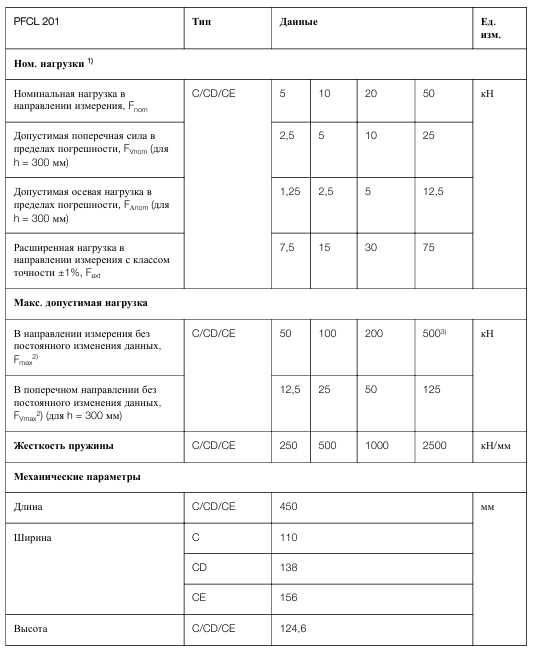
All three models support four ranges of 5kN, 10kN, 20kN, and 50kN, meeting the needs of different tension scenarios.
2. Measurement principle
Based on the magnetostrictive effect: The sensor core is a magnetostrictive diaphragm integrated in a steel block. The primary winding is fed with 330Hz AC power to generate a magnetic field, and the secondary winding induces a voltage signal proportional to the tension due to mechanical force. It is only sensitive to forces in the vertical direction (measurement direction) and has strong anti-interference ability against lateral and axial forces (with an allowable error of ≤± 0.5%).
3. Key technical parameters
Parameter specification range
Accuracy level ± 0.5% FS
Linear deviation<± 0.3% FS
Lag error<0.2% FS
Working temperature range -10~+90 ℃
Compensation temperature range+20~+80 ℃
Overload capacity (without permanent deformation) 10 times the rated load (up to 500kN for 50kN models)
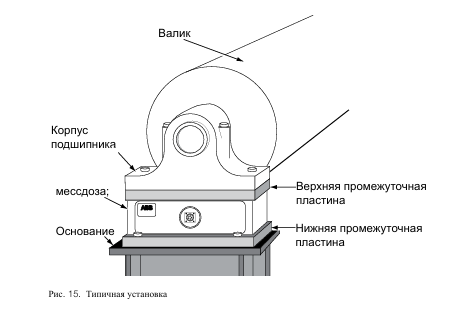
The sensor is fixed with 4 M16 screws (recommended 12.9 grade alloy screws, torque 170-286Nm) to avoid deformation of the base due to over tightening;
Horizontal or inclined installation is allowed (inclination angle ≤ 30 °), and the measurement force needs to be corrected through the angle compensation formula when tilting (see manual 2.5.3).
Electrical connection:
The cable needs to be twisted pair shielded, with the shielding layer grounded at one end (length ≤ 50mm) and a distance of ≥ 30cm from the power cable;
The primary winding provides a power supply of 0.5A/330Hz, and the secondary signal output impedance is 9-12 Ω, with strong anti-interference ability.
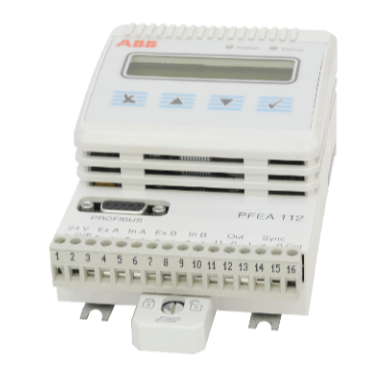
PFEA111/112 is based on Presductor ® A high-precision tension measurement and control system for technology, used for tension detection and control in the production process of coil materials such as paper, metal strips, and plastic films. Among them, PFEA111 is the basic model, and PFEA112 adds Profibus DP communication function, which is widely used in industries such as papermaking, printing, and metallurgy.
System composition and core technology
1. System composition
Core components: Tension electronic unit (PFEA111/112), weighing sensors (such as PFCL 301E, PFTL 301E, PFRL 101, etc.), junction box (PFXC 141), power module and communication interface (PFEA112 including Profibus DP).
Measurement principle: Based on the magnetostriction effect, the sensor core is a stacked alloy sheet. A 330Hz AC current is passed through the primary winding to generate a magnetic field. The secondary winding induces a voltage signal proportional to the tension due to mechanical force, and has strong resistance to lateral and axial force interference (error ≤± 0.5%).
2. Core Features
Functional differences:
PFEA111: Provides analog output (voltage/current), supports basic tension measurement and control.
PFEA112: Add Profibus DP communication on the basis of PFEA111, supporting remote data transmission and control.
Multi scenario adaptation: Supports single roll (1-2 sensors) and double roll (up to 4 sensors) applications, adapting to multiple types of weighing sensors.
High reliability: equipped with overvoltage, overcurrent, and overtemperature protection, supporting fault self diagnosis, with a protection level of IP20 (DIN rail installation) or IP65 (wall mounted).
Installation and wiring specifications
1. Installation environment requirements
Physical environment: Operating temperature -10~+55 ℃ (IP20), -25~+70 ℃ (IP65), relative humidity ≤ 95% (no condensation), avoid strong electromagnetic interference sources (such as frequency converters).
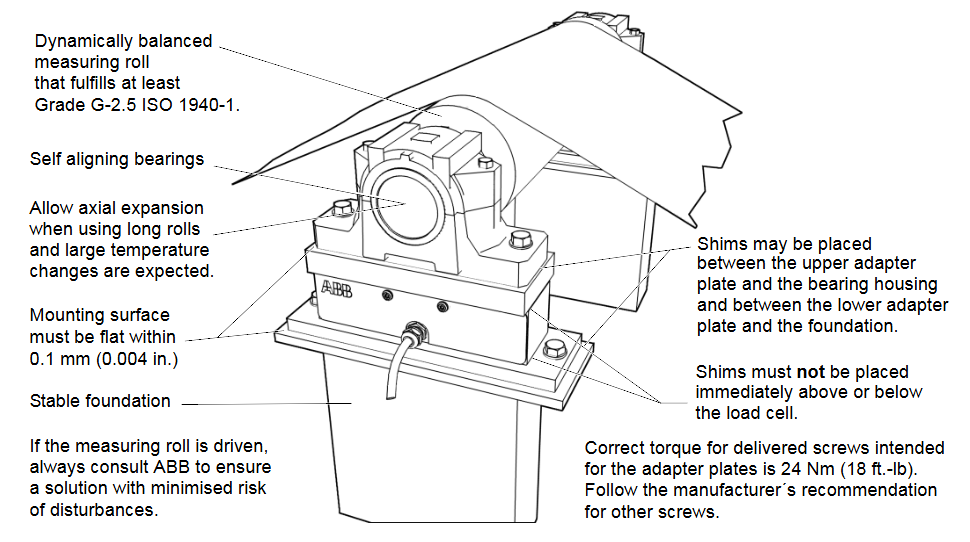
Mechanical requirements: The flatness error of the installation surface should be ≤ 0.1mm, and the gap between the sensor and the adapter board should be clean and free of debris to ensure accurate force transmission.
2. Hardware wiring
Sensor wiring:
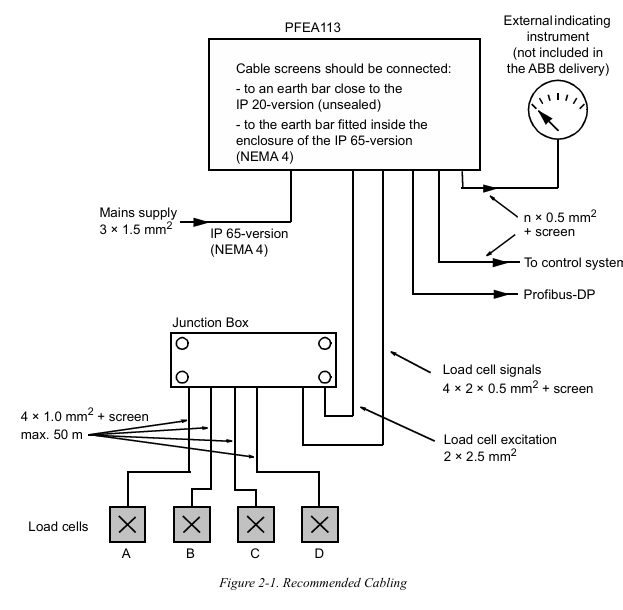
The analog signal adopts twisted pair shielded cable, with the shielding layer grounded at one end (length ≤ 50mm) and a distance of ≥ 30cm from the power line.
The maximum allowable cable resistance of the sensor excitation circuit is ≤ 5 Ω, which needs to be measured and confirmed before debugging.
Power and Communication:
The power supply supports wide range input (IP20: 24V DC; IP65: 85-264V AC or 24V DC), with a power consumption of ≤ 8W.
The Profibus DP interface of PFEA112 supports a maximum transmission rate of 12Mbps and requires the use of a dedicated bus cable (impedance 150 Ω) with terminal resistors at both ends.
Debugging and configuration process
1. Basic settings
Quick configuration: Set the language (English/German/French, etc.), unit (N/kN/kg, etc.), and web width (applicable to N/m, etc.) through panel buttons, and support fast zero calibration and wrrap gain calculation.
Complete configuration: including system definition (single roll/double roll), sensor type selection, nominal load setting, zero calibration, and calculation of wrrap gain (derived from suspension weight or formula).
2. Key parameter configuration
Wrap gain: the ratio of tension (T) to sensor measured force (FR), calculated as Wrap gain=T/FR, which needs to be derived through geometric relationships based on the installation angle (horizontal/inclined).
Communication settings (PFEA112): Profibus address (0-125), baud rate (up to 12Mbps), supports real-time data exchange with PLC or SCADA systems.
PFEA113 is based on Presductor ® The high-precision tension measurement and control system of technology is used for tension detection and control in the production process of coil materials such as paper, metal strips, and plastic films. It supports multiple types of weighing sensors (PFCL 301E, PFTL 301E, etc.) and is widely used in industries such as papermaking, printing, and metallurgy.
System composition and core technology
1. System composition
Core components: Tension electronic unit (PFEA113), weighing sensors (such as PFCL/PFTL series), junction box (PFXC 141), power module, and communication interface.
Measurement principle: Based on the magnetostriction effect, the sensor core is a stacked alloy sheet. A 330Hz AC current is passed through the primary winding to generate a magnetic field. The secondary winding induces a voltage signal proportional to the tension due to mechanical force, and has strong resistance to lateral and axial force interference (error ≤± 0.5%).
2. Core Features
Multi scenario adaptation: Supports single roll, double roll, and segmented roll applications, and can connect up to 12 sensors (cascaded through 3 PFEA113).
Flexible expansion: 6 configurable analog outputs, 4 digital outputs, supports Profibus DP communication, compatible with remote control and data upload.
High reliability: It has protection functions such as overvoltage (OVP), overcurrent (OCP), and over temperature (OTP), and supports fault self diagnosis.
Installation and wiring specifications
1. Installation environment requirements
Physical environment: Operating temperature -10~+55 ℃ (IP20 version), -25~+70 ℃ (IP65 version), relative humidity ≤ 95% (no condensation), avoid strong electromagnetic interference sources (such as frequency converters).
Mechanical requirements: The flatness error of the installation surface should be ≤ 0.1mm, and the gap between the sensor and the adapter plate should be clean and free of debris to avoid force diversion affecting measurement accuracy.
2. Hardware wiring
Sensor wiring:
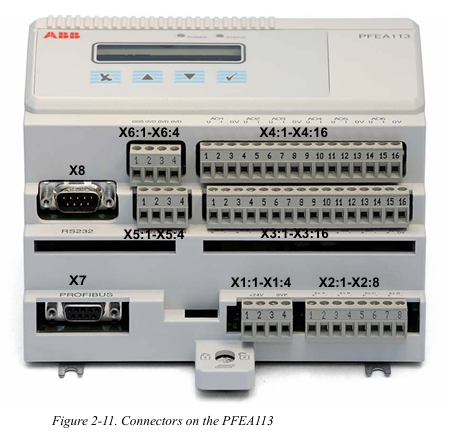
Analog input supports CT (1A/5A), VT (100V), and sensor signals, and the cable needs to be twisted shielded with a single end grounding of the shielding layer.
Switching input/output adopts optocoupler isolation, with digital output capacity 5A@250V AC/DC, Inductive loads require parallel freewheeling diodes.
Power and Communication:
Wide range auxiliary power supply (24-250V AC/DC, IP20 version) or 85-264V AC (IP65 version), power consumption<15W.
The communication interface supports Profibus DP (RS485) and RS232, with a standard 120 Ω terminal resistor and a maximum communication distance of 1200m.
Debugging and configuration process
1. Basic settings
Quick configuration: Set language (English/German/French, etc.), unit (N/kN/kg, etc.), and web width (applicable to N/m, etc.) through panel buttons, supporting fast zero calibration and gain scheduling.
Complete configuration: including system definition (single roll/double roll/segmented roll), sensor type selection, nominal load setting, zero calibration, and wrrap gain calculation (calculated by hanging weight or formula).
2. Key parameter configuration
Wrap gain: the ratio of tension (T) to sensor measured force (FR), calculated as Wrap gain=T/FR, which needs to be derived through geometric relationships based on the installation angle (horizontal/inclined).
Communication settings: Profibus DP address (0-125), baud rate (up to 12Mbps), supports real-time data exchange with PLC or SCADA systems.
Operation and maintenance
Daily operating procedures
1. Startup and shutdown
(1) Startup steps
Pre inspection
Confirm that the main power supply voltage matches the rated value of the equipment (IP20 version: 24V DC; IP65 version: 85-264V AC).
Check that the sensors, junction boxes, and communication cables are securely connected without looseness or damage.
Power on operation
Turn on the external power switch, and the IP65 version requires the internal switch of the device to be turned on at the same time.
The “Power” indicator light (green) on the observation panel is on, and the “Status” indicator light (green) is constantly on, indicating that the system is normal; If the “Status” light is red, the fault information needs to be viewed through the display screen.
(2) Shutdown steps
Turn off the external power switch. For IP65 version, the internal switch of the device needs to be turned off first.
When the machine is shut down for a long time, it is recommended to disconnect the main power supply and protect the equipment from dust.
2. Operation monitoring
(1) Panel operation
Display switching: Use the “Step up/down” button to switch display content, including single sensor tension (such as Tension A), total tension (such as TensionRoll 1), differential tension (such as TensionDiff A-B), and analog output values (AO1-AO6).
Parameter viewing: Press and hold the “OK” button for 5 seconds to enter the menu, where you can browse the system status, fault records, and configuration parameters (such as w_rap gain _, nominal load).
(2) Remote monitoring
Through Profibus DP communication, the upper computer (such as PLC) can read tension values, sensor status, and alarm information in real time, and support remote sending of zero calibration, gain switching, and other instructions.
3. Key operational functions
(1) Zero point calibration
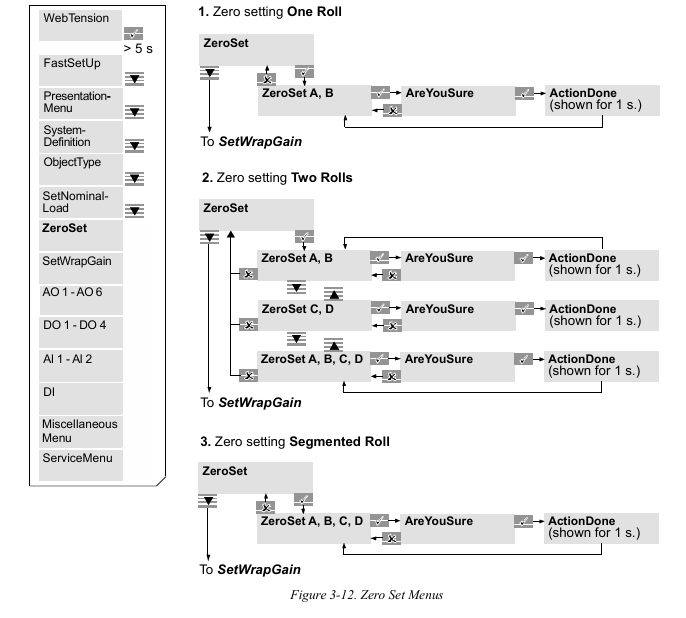
Trigger condition: When no tension is applied (such as when the coil is not running), execute it through the “Zero Set” menu on the panel or remote command.
Operation steps:
Enter the “ZeroSet” menu and select the corresponding sensor group (such as A, B).
After confirming that there is no tension, press “OK” and the display screen will show “ActionDone” to indicate completion.
(2) Gain scheduling
Application scenario: Suitable for changes in coil path (such as different wrrap angles), switching preset wrrap gain parameters through digital input or Profibus.
Setting method: Enable “GainScheduling” in the “SystemDefinition” menu, and configure the w_rap gain 1_ and w_rap gain 2h respectively.
2、 Maintenance and upkeep
1. Preventive maintenance
(1) Regular check (recommended every 6 months)
Key operating points for inspection items
Check the torque of the fixing screws for sensors and connectors (e.g. 24Nm for M12 screws), and clean the dust or debris in the gap between the sensor and adapter board.
Confirm that the cable and shielding layer are not worn, and that the shielding layer is grounded at one end (distance ≤ 50mm) to avoid interference caused by grounding at both ends.
Ventilation openings for heat dissipation and environmental cleaning equipment ensure that the working environment temperature and humidity are within the rated range (without condensation or corrosive gases).
(2) Calibration and verification
Calibration cycle: It is recommended to perform accuracy calibration once a year, using standard weight or calibration equipment to verify measurement errors (should be ≤ ± 0.5% FS).
Verification method: Enter a known tension value through the simulation function in “DataMenu”, and compare the displayed value with the theoretical value.
PFTL 101 series sensors are based on Presductor ® High precision force measurement equipment for technology is mainly used for tension detection of coils (such as paper and metal strips) in medium and low voltage industrial environments. By measuring the reaction force generated by the tension of the coil, precise control of the production process is achieved.
Product Overview and Core Features
1. Model and classification
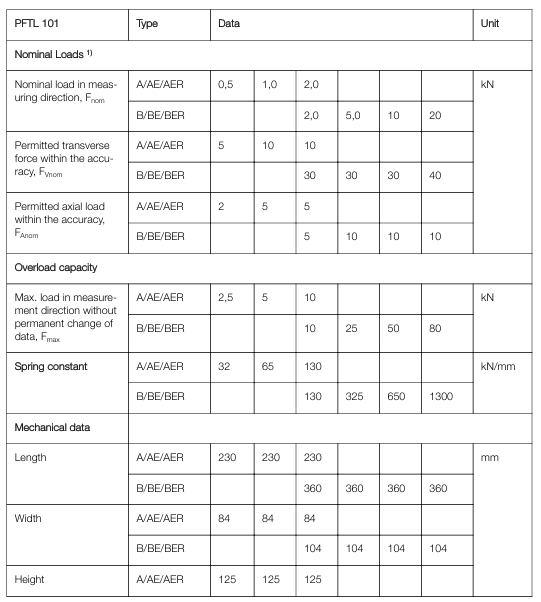
The PFTL 101 series includes 6 models, divided into two categories based on range and material:
A-series: Range 0.5-2 kN (PFTL 102A/AE/EAR), suitable for low tension scenarios;
B series: Range 2-20 kN (PFTL 101B/BE/BER), suitable for medium tension scenarios.
Among them, the “AE/BER” model is made of acid resistant stainless steel (1.4404 material), suitable for corrosive environments; The “AER/BER” model is additionally equipped with fixed cables to enhance sealing.
2. Measurement principle
Based on the magnetostriction effect: The sensor core is a laminated alloy sheet, and a magnetic field is generated by passing 330Hz AC power through the primary winding. The secondary winding induces a voltage signal proportional to the tension due to mechanical force. It is only sensitive to forces in the measurement direction and has strong anti-interference ability against lateral and axial forces (with an allowable error of ≤± 0.5%).
3. Key technical parameters
Parameter A series (0.5-2 kN) B series (2-20 kN)
Accuracy level ± 0.5% FS ± 0.5% FS
Linear deviation<± 0.3% FS<± 0.3% FS
Lag error<0.2% FS<0.2% FS
Working temperature range -10~+105 ℃ -10~+105 ℃
Compensation temperature range+20~+80 ℃+20~+80 ℃
Overload capacity (without permanent deformation) 5 times rated load 4-5 times rated load
System composition and installation specifications
1. System composition
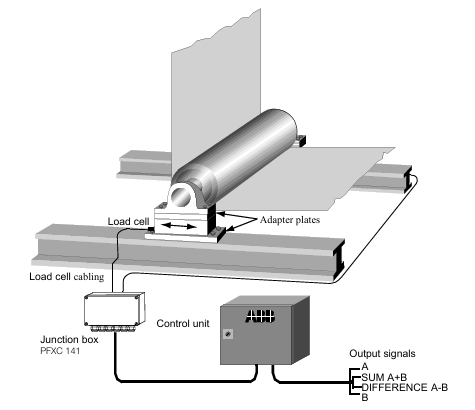
The complete measurement system includes:
2 weighing sensors (used in pairs);
Junction box (signal summary);
Control unit (such as PFXC 141, outputting signals A, B, A+B, A-B);
Adapt cables and installation accessories (adapter board, screws, etc.).
2. Installation requirements
Mechanical installation:
Installation surface flatness error ≤ 0.05mm, adapter plate thickness A series ≥ 30mm, B series ≥ 35mm;
The sensor is fixed with 6 screws (recommended 12.9 grade alloy screws, torque 136-649 Nm, depending on size) to avoid deformation caused by over tightening;
Horizontal or inclined installation is allowed, and when inclined, the measurement force needs to be corrected using the angle compensation formula (see manual 2.5.3).
Electrical connection:
The cable needs to be fixed to avoid generating additional force, and the shielding layer should be grounded at one end;
The primary winding provides a power supply of 0.5A/330Hz, and the secondary signal output impedance is 1-3 Ω, with strong anti-interference ability.
Debugging and maintenance
Debugging steps
Check the installation flatness, screw torque, and cable connection;
Perform zero calibration through the control unit (recalibration is required after replacing the sensor);
Calculate the measurement force under maximum tension (1/2 of the total force borne by each sensor) and set the control unit range.
Procontic T200 is a compact industrial automation control system designed for small and medium-sized industrial processes such as machinery manufacturing, light industry, water treatment, etc. It achieves logic control, data acquisition, and process monitoring through modular hardware design, while also considering flexibility and reliability.
Hardware composition and core modules
System architecture
Modular design: composed of central processing unit (CPU), input/output (I/O) modules, power module, communication module, and rack, supporting distributed expansion (connected to remote I/O stations through bus), with a maximum expansion of 2048 I/O.
Redundancy option: Supports CPU, power, and communication bus redundancy in critical scenarios to enhance the system’s ability to withstand failures.
Core hardware modules
(1) Processor module (CPU)
Model examples: T200-CPU110, T200-CPU120, based on 16 bit/32-bit microprocessors, with computational capabilities supporting complex logic control (such as ladder diagram and functional block diagram programming).
Key parameters:
Program storage capacity: 128KB~512KB (non-volatile memory), supports online program modification.
Data storage: 64KB RAM (with battery backup, power-off data storage ≥ 72 hours).
Integrated communication interface: standard RS485 (supporting Modbus RTU), some models include Ethernet port (supporting TCP/IP).
(2) Input/Output (I/O) Module
Digital input module:
Models such as T200-DI16 (16 point DC input), supporting 24V DC signals, response time ≤ 1ms, optocoupler isolation (2500V AC), compatible with proximity switches, limit switches, and other sensors.
Digital output module:
Model such as T200-DO16 (16 point relay output), contact capacity 5A@250V AC/DC, Support inductive loads (requiring external current diodes); Or transistor output (24V DC, 0.5A/point), response time ≤ 0.1ms.
Analog module:
Input module (T200-AI8): 8-channel, supports 4-20mA/0-10V signals, resolution of 12 bits, sampling period of 100ms, compatible with temperature transmitters, pressure sensors, etc.
Output module (T200-AO4): 4-channel, 4-20mA output, accuracy ± 0.1% FS, used to drive actuators such as regulating valves and frequency converters.
(3) Power module
Model: T200-PS24 (24V DC output), T200-PS110/220 (110V/220V AC input, 24V DC output), optional output current of 5A/10A, overload protection (150% load limited current), short circuit protection (self recovery).
When configuring redundant power supplies, it is necessary to achieve interference free switching through dedicated redundant modules.
(4) Communication and Expansion Module
Bus module: T200-BUS module supports PROFIBUS DP or MODBUS Plus bus, realizing communication between master station and remote I/O slave station, with a maximum transmission rate of 12Mbps and a distance of ≤ 1000m (without relay).
Ethernet module: The T200-ETH module provides a 10/100Mbps Ethernet port, supports TCP/IP and FTP, and is used to connect to HMI or SCADA systems on the upper computer.
Hardware installation and connection
1. Rack and module installation
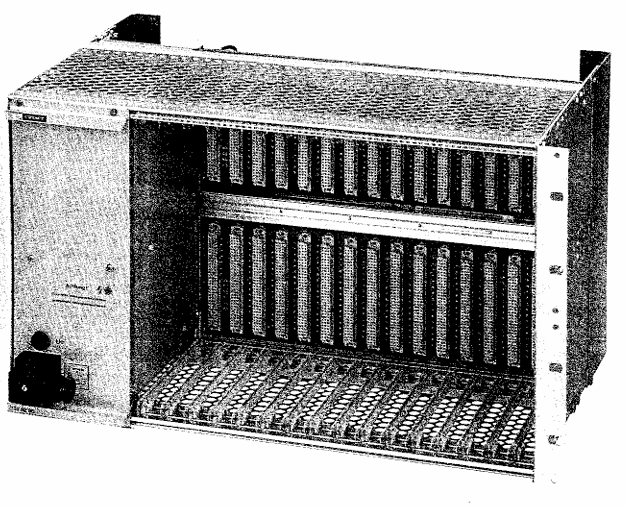
Rack specifications: Standard 3U rack (19 inches), supporting 16 module slots, with plug-in design for modules. The front panel screws need to be locked to prevent loosening during installation.
Installation environment: Operating temperature of 0-55 ℃, relative humidity of 5% -95% (no condensation), vibration level ≤ 5g (10~500Hz), and should be kept away from strong electromagnetic interference sources (such as frequency converters and high-power motors).
2. Electrical connection specifications
Power connection: The input side is connected to the protective grounding (PE), and the output side 24V DC “+” “-” should correspond to the I/O module. It is recommended to use a 1.5mm ² shielded wire with a single ended grounding of the shielding layer.
I/O wiring: Digital signals use 0.5mm ² wires, while analog signals require twisted pair shielded wires (with a distance of ≥ 30cm from the power line). The wiring terminal numbers correspond one-to-one with the module channels (such as AI1 corresponding to terminal 1/2).
Communication wiring: The PROFIBUS bus uses a dedicated bus cable (impedance 150 Ω) with terminal resistors (150 Ω) at both ends. The connector uses a D-type 9-pin plug to ensure good pin contact.
System Expansion and Compatibility
Local expansion: Connect up to 3 expansion racks through rack expansion interfaces, with a total I/O point count of no more than 2048 and an expansion distance of ≤ 1m (between racks).
Remote expansion: Connect remote I/O stations (such as T200-RIO) through the PROFIBUS DP bus, supporting up to 31 slave stations and a distance of up to 10km (with relays).
Compatibility: Supports communication with other ABB Procontic products (such as T300) and third-party devices (such as Siemens S7 series, Schneider Modicon series), and is compatible with OPC servers for data integration.
Application scenarios
Procontic T200, as a small and medium-sized distributed control system, is suitable for:
Logic control and production line linkage of packaging machinery and printing equipment;
Pump valve control and liquid level/flow regulation for water treatment and sewage treatment;
Temperature and pressure closed-loop control of reaction vessels in small and medium-sized chemical plants;
The conveyor belt speed control and material sorting system for warehousing and logistics.
Core protection: covering overcurrent, ground fault, circuit breaker failure and other protections, supporting timed and inverse time characteristics, and can be configured with multiple sets of fixed value groups to adapt to different operating conditions.
Featured features:
Three stage overcurrent protection (including quick break, time limited quick break, and overload).
Non directional grounding fault protection, supporting high-sensitivity zero sequence current detection.
Statistics of circuit breaker operation frequency and life monitoring, assisting in preventive maintenance.
Control and operation
Control mode: Supports 4 control modes (local, remote, no control, local+remote), switched by electronic key to prevent misoperation.
One device operation: The “select execute” mechanism on the HMI panel can be used to control the opening and closing of the circuit breaker, in conjunction with interlocking logic to ensure operational safety.
Measurement and monitoring
Measurement quantity: Real time monitoring of three-phase current, voltage, power, frequency, electrical energy, etc., with accuracy in accordance with IEC standards and a refresh cycle of about 0.5 seconds.
Events and Wave Recording:
Record 30 latest protection events (including time, fault type, measurement value) without loss during power outage.
Support fault recording, storing 4 analog signals (current/voltage waveforms) and 8 digital signals (switch status) for easy fault analysis.
Human Machine Interface (HMI)
Hardware composition
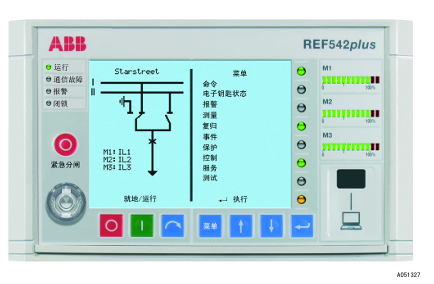
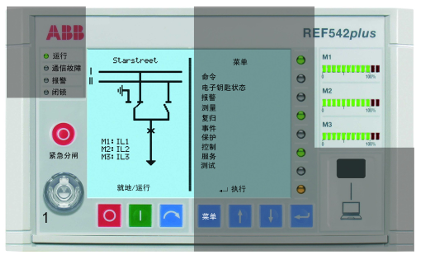
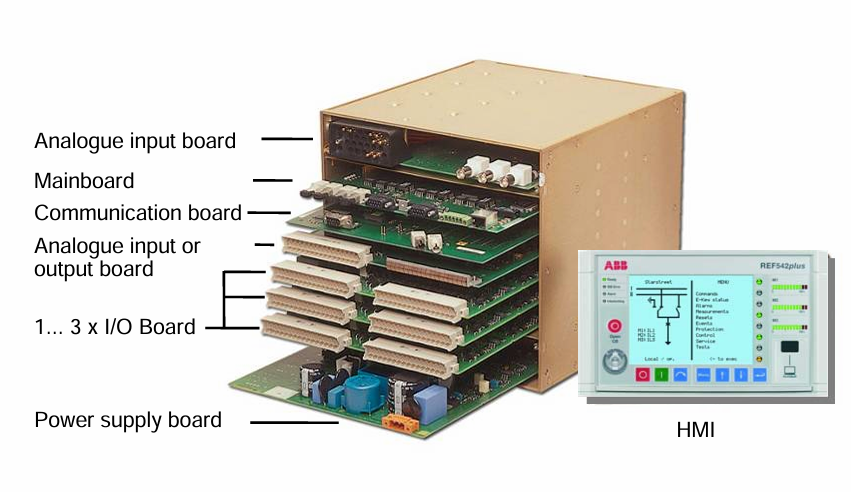
Display area: 320 × 240 resolution LCD, with a single line diagram (SLD) of the device displayed on the left and menus and data displayed on the right. It supports switching between multiple languages such as Chinese and English.
Operating components: 8 navigation buttons (menu, up and down, enter, etc.), 3 sets of LED indicator lights (M1-M3, displaying load rate), 8 programmable three color LEDs (indicating protection actions, alarms, etc.).
Security component: Electronic key sensor, distinguishing between “protection key” (modifying protection parameters) and “control key” (switching control modes), supporting hierarchical management of permissions.
Menu Structure
Main menu: Contains submenus such as commands, alarms, measurements, events, protection, control, services, and testing, supporting operations such as parameter viewing and modification, event queries, and device self checks.
Featured feature page:
Debugging mode: requires a super user key to enter, which can directly drive switch output and monitor analog input for wiring verification.
Time synchronization: Supports local settings or remote synchronization of time through GPS and SCADA systems.
Communication and Configuration
Communication capability
Supporting protocols: Modbus RTU, IEC 60870-5-103, SPA, LON, etc., standard RS485 interface, optional fiber optic communication module.
Data interaction: It can remotely upload/download configurations, read measurement values, record events and faults, and connect to a PC through infrared (IrDa) or RS232 interfaces.
Configuration management
Tool support: Configuration needs to be done through ABB’s dedicated operating tool (such as REF542comf), which supports offline configuration download and online configuration upload.
Parameter storage: Configuration and fixed values are stored in non-volatile memory, which is not lost when powered off. It supports two modes: temporary modification and permanent saving.
Installation preparation and environmental requirements
Environmental conditions
Temperature: Operating environment temperature -25 ℃~+55 ℃, storage temperature -40 ℃~+85 ℃, avoid drastic temperature changes.
Humidity: Relative humidity ≤ 93% (no condensation), avoid humid, dusty or corrosive gas environments.
Vibration and Shock: Compliant with IEC 60255-21 standard, vibration frequency 10-150Hz, acceleration ≤ 1g; shock acceleration ≤ 10g (11ms pulse).
Altitude: ≤ 2000m, if exceeded, it needs to be downgraded for use.
Installation space and safety
Space requirements: The device is approximately 177mm in width, 177mm in height, and 149mm in depth. At least 150mm of operating space should be reserved in front and behind for easy wiring and maintenance.
Safety regulations:
Only qualified personnel are allowed to install, strictly following local electrical safety regulations.
The device frame must be reliably grounded (grounding resistance ≤ 10 Ω) to avoid electrostatic damage to electronic components.
Cut off the auxiliary power supply before wiring to prevent electric shock.
Hardware installation and wiring
Mechanical installation
Installation method: Supports panel embedded installation, 19 inch rack installation, or direct installation of circuit breaker cabinets, fixed with matching brackets to ensure stability and no looseness.
Installation steps:
According to the installation hole position fixing device, check the levelness (deviation ≤ 1 °).
Connect the grounding terminal to ensure reliable grounding.
Install the HMI panel, fasten it firmly, and avoid dust from entering through large gaps.
Wiring specifications
(1) Power wiring
The auxiliary power interface (X10) supports 24~250V AC/DC and needs to distinguish between positive and negative polarities. It is recommended to use 1.5mm ² single core copper wire.
The power circuit needs to be equipped with a 2A fuse to avoid overcurrent damage to the device.
(2) Analog input (X80~X88)
Current input: Supports CT (1A/5A) or Rogowski coils, three-phase current requires continuous wiring (such as L1 connected to X81, L2 connected to X82, etc.), and neutral wire connected to the common terminal.
Voltage input: Supports VT (100V) or resistive voltage divider, and the wiring of line voltage and phase voltage needs to be configured with corresponding devices (set through operating tools).
Wiring requirements: Analog cables need to be shielded, with the shielding layer grounded at one end and a distance of ≥ 100mm from the power cable to avoid electromagnetic interference.
(3) Switching input/output (X20~X41)
Switching input: 14 channels/module, supporting 24-250V DC, using optocoupler isolation, input current 2-20mA, distinguishing between “common terminal” and “signal terminal” during wiring.
Switching output: 8 channels/module, including relay output (capacity) 5A@250V AC/DC), Used to drive circuit breaker coils or alarm signals, the output contacts need to be connected in parallel with freewheeling diodes (when inductive loads are present).
(4) Communication wiring
RS485 interface (X60~X61): using shielded twisted pair, A and B wires are connected correspondingly, and the terminal needs to be connected to a 120 Ω matching resistor, with a maximum communication distance of 1200m.
Fiber optic interface (X62~X65): Glass fiber optic or plastic fiber optic, with a bending radius of ≥ 100mm, to avoid signal attenuation caused by excessive bending.