
Call us 24/7uaedcs@163.com
Welcome to the official website of CNIACS Automation Technology Co., Ltd!
Call us 24/7uaedcs@163.com

ABB AFS series switches

Product Overview

Core positioning: A fully managed modular Ethernet switch designed specifically for the power industry (substations, distribution networks, and in plant communication), focusing on core requirements such as high reliability, electromagnetic interference resistance, and wide temperature operation in power scenarios, supporting the expansion of smart grid applications (such as renewable energy integration and distribution automation).

Product series division:

|Model series | Installation method | Core configuration differences | Number of ports | Power consumption range | Special functions|

|AFS650/655 | DIN rail (optional wall mounted) | Compact design, supports multi-mode/single-mode optical ports | Up to 10 (including 3 GbE ports) | 12-21 W | Redundant power supply (18-60VDC/48-320VDC/90-265VAC)|

|AFS670/675 | 19 inch rack | Modular design, 12 slots (2 ports/module) | Up to 28 slots (electrical/optical/SFP cage) | 10-40 W (no PoE) | Supports PoE (power type H/Z), redundant power supply (18-60VDC/77-300VDC/90-265VAC)|

|AFS677/AFR677 | 19 inch rack | Fixed port design | 16 GbE combo ports (RJ45/SFP) | 10-40 W (no PoE) | AFR677 supports L3 routing (RIPv1/v2, OSPFv2, VRRP)|

Key compliance and technical parameters

Certification and anti-interference standards:

|Standard Category | Core Standard Content|

|Industry certification | IEC61850 approval, IEEE1613 approval|

|Electromagnetic compatibility (EMC/EMI) | EN61000-4-2: 8kV contact discharge, 15kV air discharge; EN61000-4-3:35Vpp/m(80-2700MHz); IEEE C37.90.3: ± 8kV contact discharge, ± 15kV air discharge|

|Mechanical testing | IEC60068-2-27: 15g impact (11ms, 18 times); IEC60068-2-6: Vibration Test (2-13.2Hz/1mm/90min, etc.)|

|Network standards | IEEE802.1d/p/Qx/AB, IEEE802.3 series, IEEE1588 (PTP), etc|

Core technical parameters:

Working temperature: Standard 0-60 ℃, optional -40 ℃ to 85 ℃ (continuous operation)

Switching characteristics: Store and forward mode, typical switching delay of 2.7 μ s (100Mbit/s), MAC address table capacity of 8000 entries

Network function: 4042 VLANs (supporting 255 at the same time), 4 priority queues, supporting port rate limitation (kbps step), link aggregation IGMP snooping

Protection mechanism: Supports RSTP (IEEE802.1D), MRP (IEC62439), E-MRP, and fast switching of ring topology

Power specifications: AFS650/655 supports 18-60VDC (low voltage), 48-320VDC/90-265VAC (high voltage); The AFS670 series supports 18-60VDC (low voltage), 77-300VDC/90-265VAC (high voltage), all of which support redundant power supplies
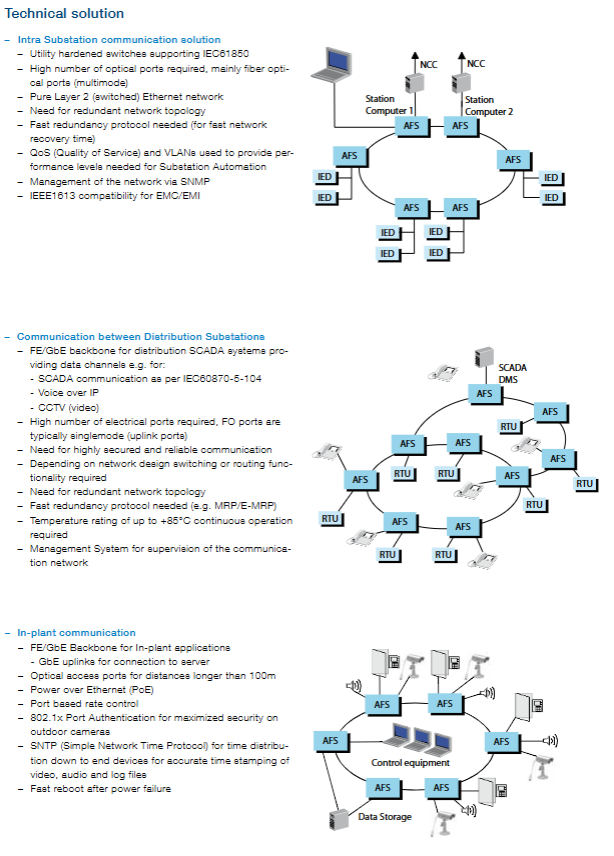
Three core application scenarios and solutions

Application scenario core requirement solution configuration

Substation automation low latency, high availability, IEC61850 compatibility, anti electromagnetic interference pure L2 switching network, redundant topology, multi-mode optical ports as the main, QoS/VLAN enabled, SNMP management supported, GOOSE message and sampling value transmission supported

Long distance transmission of power distribution communication, reliable transmission of SCADA data, multi service carrying FE/GbE backbone network, single-mode optical port (uplink), supporting IEC60870-5-104 protocol, redundant topology+MRP/E-MRP, compatible with VoIP and renewable energy data transmission

In plant communication with high bandwidth (CCTV), equipment power supply, time synchronization, high security GbE upstream connection server, PoE power supply (camera), 802.1x port authentication, SNTP time synchronization, port rate control, supporting CCTV, access control, and public address system communication

Security and management features

Security features: IEEE802.1x port authentication, SSH encryption, Radius centralized password management, multi-level user passwords, port disabling, SNMPv3 encryption authentication, VLAN isolation (IEEE802.1Q)

Management methods: SNMP V1/V2/V3, command-line interface (Telnet), web interface, port mirroring, RMON remote monitoring, LLDP topology auto discovery, SFP diagnosis, configuration recovery adapter (CRA), watchdog and rollback function

Alarm mechanism: Diagnostic LED indicator light, 2 sets of alarm contacts, local logs and Syslog reports

Customer Core Value

Power level adaptation: high EMC/EMI anti-interference ability, wide temperature working range, redundant power supply, suitable for harsh environments in substations

High availability: fanless design, high MTBF, fast switching of link failures, ensuring uninterrupted critical business operations

Flexible Expansion: Port density can be expanded (8-28), supporting FE/GbE, PoE, L3 routing (AFR677), and adapting to different scale requirements

Integrated solution: integrated into ABB’s power communication ecosystem, supporting multi business integration such as SCADA, IEC61850, voice, etc

Key issues

Question 1: What are the specific power level characteristics of ABB AFS series switches reflected in? Why can it adapt to the harsh environment of substations?

Answer: The power level characteristics are mainly reflected in three aspects: ① Environmental adaptation: supporting standard working temperature of 0-60 ℃, optional wide temperature range of -40 ℃ to 85 ℃, fanless design+optional normal coating, and can withstand extreme temperatures; ② Anti interference capability: certified by IEEE1613, compliant with EN61000-4 series (ESD 8kV contact/15kV air discharge, surge 2kV line to ground) and IEEE C37.90 series standards, resistant to strong electromagnetic interference; ③ Reliability design: Supports redundant power supply (AC/DC wide voltage input, such as AFS650 supporting 48-320VDC), fast protection mechanism (MRP/E-MRP, ring topology fast switching), high MTBF guarantee, avoiding single point failure. These characteristics enable it to directly adapt to harsh environments such as severe electromagnetic pollution, large temperature fluctuations, and high requirements for continuity in substations.

Question 2: What are the core differences between different models of ABB AFS series? How to choose the appropriate model based on the application scenario?

Answer: The core differences are concentrated in three dimensions: installation method, port configuration, and functional expansion. The selection logic is as follows:

Model Series Core Differences Adaptation Scenarios

AFS650/655 DIN rail installation, up to 10 ports, no L3 routing for small substations, distribution terminals, and distributed equipment communication within the factory (limited space, low port requirements)

AFS670/675 19 inch rack, modular design (up to 28 ports), supporting PoE for large-scale substation automation, requiring high port density distribution communication backbone network (multi device access, requiring PoE power supply for cameras/terminals)

AFS677/AFR677 19 inch rack, 16 GbE combo ports, AFR677 supports L3 routing (RIPv1/v2, OSPFv2) for cross regional power distribution communication and complex networks requiring routing functionality (multi subnet interconnection, backbone network hierarchical architecture)

Question 3: What are the key technical measures for ABB AFS series switches to ensure the reliability of critical business in the power industry, such as IEC61850 data transmission?

Answer: Key technical measures include: ① Fast protection mechanism: supporting MRP (Media Redundancy Protocol), E-MRP, and RSTP, which can achieve fast switching in case of link failure in ring topology, reducing the interruption time of IEC61850 GOOSE message and sampling value transmission; ② Network isolation and priority: Supports 4042 VLANs (255 at the same time) and 4 priority queues, isolates different services through IEEE802.1Q VLANs, ensures QoS guarantees priority transmission of IEC61850 critical data, and avoids bandwidth preemption; ③ Hardware redundancy: supports redundant power input to avoid equipment shutdown caused by power failure; ④ Management and monitoring: Real time monitoring of network status through SNMP V3, RMON, LLDP topology discovery, combined with alarm contacts and Syslog reports, to quickly locate faults; ⑤ Protocol compatibility: Native support for IEC61850 protocol ensures seamless integration with intelligent electronic devices (IEDs), reducing latency and fault risks caused by protocol conversion
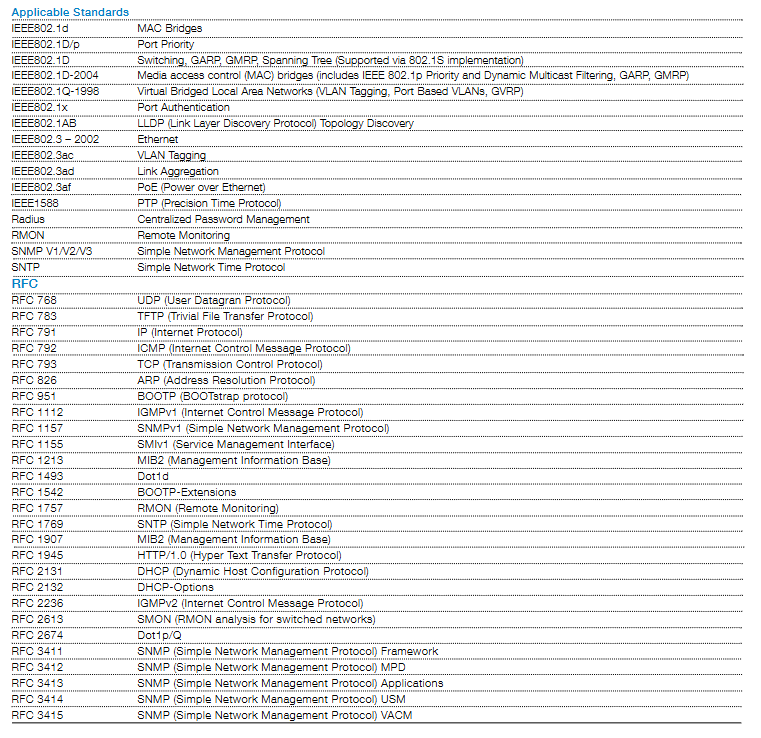
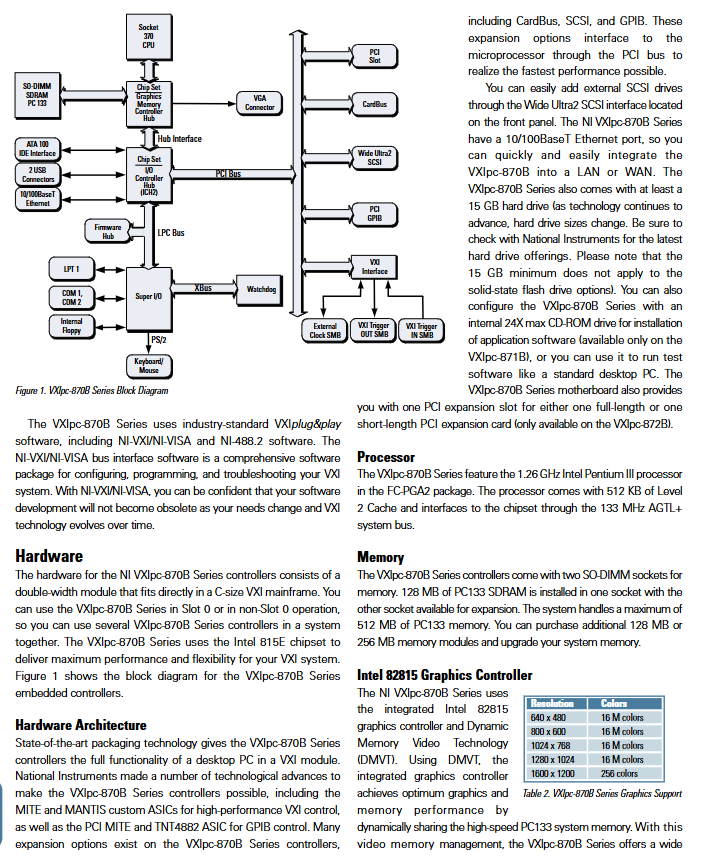
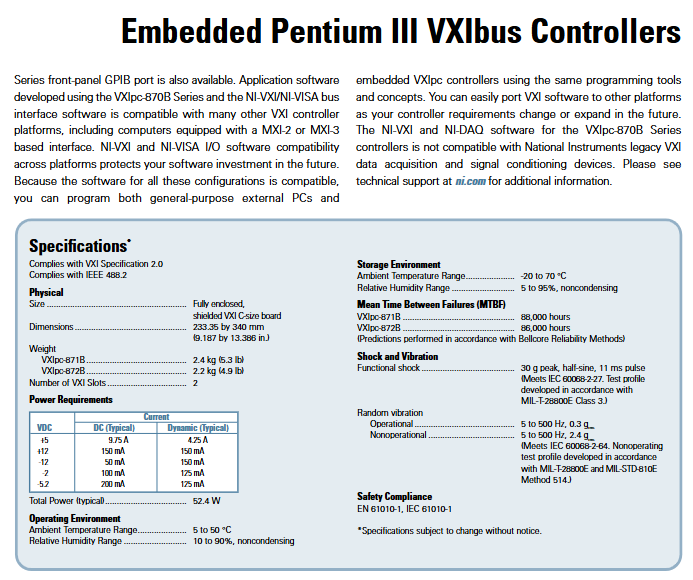
NI VXIpc-870B Series Embedded Pentium III VXIbus Controllers

Product core positioning

Product Name: NI VXIpc-870B Series Embedded Pentium III VXI Bus Controller

Core advantages: Combining desktop PC full functionality with VXI system specific control capabilities, sturdy structure, suitable for harsh environments, providing cost-effective VXI embedded control solutions

Model differentiation:

Model Core Differences Applicable Scenarios

Scenario where VXIpc-871B integrates 24X max CD-ROM drive and requires on-site installation/operation of application software

VXIpc-872B is equipped with one PCI expansion slot (supporting full-size/short size cards) for scenarios where third-party PCI peripherals need to be expanded

Key hardware configuration

Core Processing and Storage

Processor: Intel Pentium III 1.26 GHz (FC-PGA2 package, 512KB L2 cache, 133MHz AGTL+system bus)

Memory: 128MB PC133 SDRAM (2 SO-DIMM slots, upgradable up to 512MB, supports 128MB/256MB expansion modules)

Storage:

Basic configuration: Internal 1.44MB floppy disk drive+minimum 15GB hard disk (hard disk specifications are subject to technical updates, please consult the manufacturer)

Optional configurations: internal IDE solid state drive, front mounted pluggable ATA solid state drive (replacing hard drives, suitable for harsh environments)

Display and Interface

Display: Intel 82815 integrated graphics card (DMVT technology, dynamic shared system memory), supports the following resolutions and colors:

Maximum number of colors in resolution

640×480 16 million colors

800×600 with 16 million colors

1024×768 with 16 million colors

1280×1024 16 million colors

1600×1200 256 colors

Key interfaces:

Network: 10/100BaseT Ethernet (RJ45, auto negotiate rate)

Storage Expansion: Wide Ultra2 SCSI (LVD/SE mode, 40Mtransfers/s transfer rate, compatible with single ended devices)

Instrument control: GPIB (IEEE 488.2, 26 pin micro interface, supports HS488 protocol, speed up to 8Mbytes/s)

Other interfaces: 2 RS-232 serial ports, 1 IEEE 1284 parallel port, 2 PS/2 interfaces (keyboard/mouse), 2 USB 1.1 interfaces (only supported by Windows 2000), 2 PC Card slots (2 Type I/II or 1 Type III, only supported by Windows 2000)

VXI bus core functions

Address access: Customize ASIC through MITE/MANTIS, support multi window address mapping (3 user configurable windows), covering the entire VXI address space

Data transfer: MITE integrates 2 DMA controllers, supports block mode transfer, and frees up CPU resources

Slot 0 Function: Complete Slot 0 resource management (including MODID register, CLK10 clock source), supports automatic switching between Slot 0 and non Slot 0 (without jumper configuration)

Synchronization and triggering: Front end SMB interface (external CLK10 synchronization, 2 trigger I/O), supporting TTL/ECL trigger lines, event counting, pulse generation, etc

Interrupt handling: Supports all interrupt lines of VXI bus, configurable interrupt assertion and processing priority

Software and Compatibility

Supporting operating systems: Windows 2000, Windows NT, VxWorks, Linux 2.2/2.4 kernel (some features such as USB are only supported by Windows 2000)

Core software: NI-VXI/NI-VISA (compatible with VXIplug&play specifications, supporting various programming environments such as LabVIEW and Visual C++), NI-488.2 (GPIB device control)

Software advantages: Cross platform compatibility (supports MXI-2/3 interface PC), reusable software investment, supports PC Card startup (VxWorks/Linux system, requires BIOS configuration)

Physical and Environmental Specifications

Category detailed parameters

Physical dimensions 233.35 × 340mm (9.187 × 13.386 inches), C-size VXI card, 2 VXI slots

Weight VXIpc-871B: 2.4kg (5.3lb); VXIpc-872B:2.2kg(4.9lb)

Typical total power requirement is 52.4W (+5V: 9.75A;+12V: 150mA; -12V: 50mA, etc.)

Working environment temperature 5-50 ℃, humidity 10% -90% (non condensing)

Storage environment temperature -20-70 ℃, humidity 5% -95% (non condensing)

Reliability meets Bellcore reliability standards, with resistance to impact (30g peak) and vibration (0.3g rms for operation, 2.4g rms for non operation)

Safety certification EN 61010-1, IEC 61010-1

Ordering and Accessories

Basic model code:

Model configuration code

VXIpc-871B without operating system+hard drive 778295-00

VXIpc-871B Windows 2000+hard drive 778295-01

VXIpc-871B Windows NT 4.0+Hard Disk 778295-02

VXIpc-872B without operating system+hard drive 778296-00

VXIpc-872B Windows 2000+hard drive 778296-01

VXIpc-872B Windows NT 4.0+hard drive 778296-02

Optional accessories: Linux/VxWorks specific NI-VXI/NI-VISA software, memory expansion module, solid-state drive, USB CD-ROM drive (compatible only with VXIpc-872B)

Standard accessories: 6-inch parallel port adapter cable, 2-meter GPIB adapter cable, 8-inch serial port adapter cable

BENDER ISOMETER ®  IRDH265/365 series insulation monitoring equipment

Product Overview

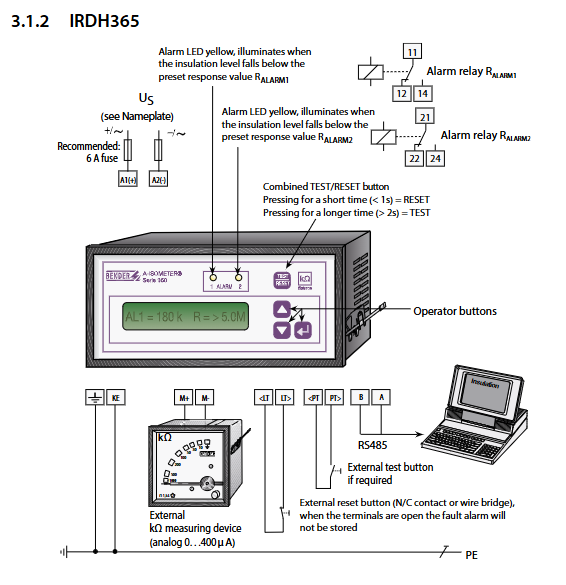
BENDER ISOMETER ®  The IRDH265/365 series is an insulation monitoring device developed by Bender, a German company, specifically for IT AC systems, IT AC systems with directly connected DC circuits, and IT DC systems (isolated power supplies). Its core mission is to monitor the insulation resistance status between system conductors and the earth (PE) in real time, and to provide timely warning of insulation faults through a graded alarm mechanism, ensuring the safe and stable operation of electrical systems under complex working conditions. This series of products, with patented measurement technology, flexible adaptability, and comprehensive functional configuration, are widely used in industrial scenarios containing rectifiers, converters, thyristor controlled DC drivers, and other components. They fully comply with multiple international universal standards and have high reliability and strong compatibility.

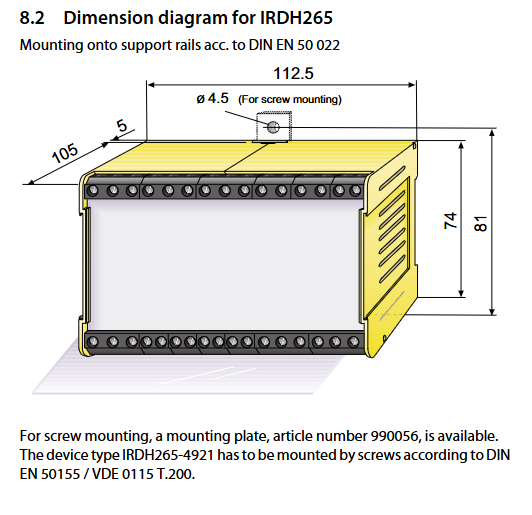
The series includes two core models: IRDH265 (standard plastic housing, supporting DIN rail installation or screw installation) and IRDH365 (embedded housing, 144x72mm size, compatible with panel embedded installation). The functional parameters of the two are the same, with only differences in installation methods and mechanical specifications, which can meet the needs of different installation scenarios.

Core adaptation range

(1) System type adaptation

Basic adaptation system: IT communication systems such as 3AC, 3 (N) AC, single-phase AC, etc; Pure IT DC system

Special adaptation system: IT AC system with direct connection to DC circuit (such as AC system with DC load including rectifier, converter, thyristor controlled DC driver, etc.)

Adaptation prerequisite: In the DC circuit directly connected to the AC system, the rectifier needs to carry a load current of>5… 10mA to ensure accurate monitoring of DC circuit insulation faults

(2) Voltage parameter specifications

Rated monitoring voltage: AC 0… 793V (frequency 50… 400Hz, reference to characteristic curve when frequency<50Hz); DC 0… 650V (slightly different sub series, such as -7 series DC maximum 750V, -8 series DC maximum 650V)

Extended monitoring voltage: It can be extended to higher levels through a dedicated coupling device, with specific adaptations as follows:

AGH204S-4: Suitable for AC 0… 1650V (without rectifier), AC 0… 1300V (with rectifier, DC maximum 1840V)

AGH520S: Suitable for AC 0… 7200V

AGH150W-4: Suitable for DC 0… 1760V

Power supply voltage requirements: Provide multi specification power supply adaptation to meet the power supply needs of different scenarios:

Power type, voltage range, applicable model examples

AC power supply 230V (50… 60Hz) IRDH265-4, IRDH365-4

AC power supply 90… 132V IRDH265-413, IRDH365-413

AC power supply 400V IRDH265-415, IRDH365-415

AC power supply 500V IRDH265-416, IRDH365-416

DC power supply 19.2… 84V IRDH265-422, IRDH365-422

DC power supply 77… 286V IRDH265-423, IRDH365-423

DC power supply 10.5… 80V IRDH265-R421, IRDH265-4921

Power protection: The power input terminal should be equipped with a short-circuit protection device according to the IEC 60364-4-473 standard, and it is recommended to use a 6A fuse

Core technology and functional characteristics

(1) Measurement principle (four levels optional to meet different system requirements)

AMP measurement principle (default): Bender’s patented “adaptive measurement pulse” technology superimposes a pulsating AC measurement voltage with a peak value of 27V (positive and negative pulse amplitudes are consistent), and the measurement period dynamically adjusts with the system’s leakage capacitance and insulation resistance. It is suitable for AC/DC hybrid systems, especially for complex scenarios containing a large number of DC components, with a maximum measurement current of 230 μ A.

DC measurement principle: Overlay 27V DC measurement voltage, only applicable to pure AC systems, insufficient sensitivity for DC insulation fault monitoring, not recommended for use in hybrid systems.

UG/AMP measurement principle: Passive asymmetric measurement (without DC measurement voltage), only applicable to pure DC systems. Fast response is achieved by detecting the DC current and residual voltage generated by L+/L – asymmetric faults. After the alarm is triggered, it automatically switches to the AMP principle to measure insulation resistance. AMP measurement is performed every hour to detect symmetric faults.

AMP/UG measurement principle: AMP measurement is combined with asymmetric measurement. The faults detected by AMP principle are fed back through ALARM2, while those detected by asymmetric measurement are fed back through ALARM1. It is suitable for scenarios that require differentiation of different fault types.

(2) Basic core functions

Insulation monitoring and graded alarm:

Dual level adjustable response values: -3 series 40k Ω/10k Ω, -4 series 180k Ω/40k Ω, -7 series 600k Ω/300k Ω, -8 series 1M Ω/500k Ω (all factory default, adjustable through menu, -3/-4 series adjustment range 10k Ω… 990k Ω), with a hysteresis of approximately 25%.

Fault type differentiation: Supports identification of AC faults and DC faults (including L+/L – single pole faults), and alarm triggering conditions can be set through the Setup 2 menu (only AC, only DC, both AC/DC triggered, etc.).

Alarm output: 2 conversion contact relays, supporting N/O (default) or N/C operation modes, rated contact voltage AC 250V/DC 300V, maximum switching current 5A, adjustable flashing function (1Hz pulse frequency).

Alarm indication: Two yellow alarm LEDs (ALARM1/ALARM2), corresponding to two levels of alarms, will light up intuitively when there is a fault.

Automatic adaptation and self-monitoring:

Leakage capacitance adaptation: The -3/-4 series can adapt to a maximum of 500 μ F, while the -7/-8 series can adapt to a maximum of 2 μ F. The equipment automatically adapts to changes in system leakage capacitance without affecting measurement accuracy.

Automatic self-test: The -3/-4 series automatically performs a self-test every 24 hours (with the alarm relay set to system fault alarm mode), triggered when the insulation resistance exceeds 20 times the maximum response value.

Manual self-test: Press and hold the TEST button (>2s) to start. When there are no faults, it displays “TEST OK R<1k Ω”, the alarm relay acts, and the LED lights up; When a fault is detected, it displays “TEST ALARM”. Press the RESET button (<1s) to clear the fault indication.

Connection monitoring: The -3/-4 series comes standard with a connection monitoring function that continuously monitors the connection status between the device and the IT system or PE. When there is a disconnection or high resistance, it displays “ALARM E-KE” (PE connection fault) or “ALARM L1-L3” (system connection fault), which can be turned off in the Setup 2 menu (recommended for new or small systems).

Display and operation:

Display configuration: LCD display screen, supporting the display of measurement values (unit k Ω/M Ω), response values, fault types (R=AC fault, R+=L+fault, R -=L – fault), menu parameters, etc.

Operation buttons: Both IRDH265/365 are equipped with function buttons (parameter adjustment, menu switching) and a combination TEST/RESET button (short press reset, long press test), supporting external test/reset buttons (cable length ≤ 10m).

Parameter storage: Set parameters to be stored in non-volatile memory (EEPROM) without loss during power failure; Short circuiting the LT terminal can store fault indications, and no faults are stored when the terminal is disconnected.

(3) Extended functions (configured through the Setup 2/Setup 3 menu)

Menu grading configuration:

Setup 1 (basic function): Set alarm response values, relay operation modes (N/O/N/C), password query, jump to Setup 2.

Setup 2 (Extended Function): Configure alarm fault types, coupling device parameters, connection monitoring switches, alarm flashing function, relay test switches, alarm time delay (1… 10s), maximum leakage capacitance matching, password activation and modification, restore factory settings, and view software versions.

Setup 3 (Measurement Principle): Select the measurement principle (AMP/DC/UG/AMP/AMP/UG) and set the DC fast response current level (0.1… 5mA).

Password Protection: Supports activating a two letter password to prevent unauthorized modification of parameters. Passwords can be set and reset in the Setup 2 menu.

System fault handling: When the LCD displays “TEST ALARM”, the device needs to be powered off for a moment before restarting. If the fault still exists, it is highly likely to be a fault of the device itself and requires maintenance.

Status word display: Press and hold the IRDH265 function key for ≥ 5 seconds to display the status word, which includes key configuration information such as relay mode, alarm function, connection monitoring status, measurement principle, etc.

(4) Interface and communication functions

RS-485 interface: No electrical isolation, compliant with EIA R5-485 standard, terminal A/B wiring, maximum transmission distance of 1200m, transmission protocol of 9600 Baud (1 start bit+8 data bits+1 stop bit), continuous transmission of measurement values, alarm status and other data blocks, cannot be interrupted by other bus members.

External indication interface: The M+/M – terminal supports external k Ω measuring instruments (0… 400 μ A analog output), and this interface has no electrical isolation. When connecting to the process control system, an additional isolation module (such as RK170) needs to be configured.

Mechanical specifications and environmental adaptability

(1) Mechanical specifications

Model shell type, installation method, panel opening size (mm), compatible wire specifications, protection level, weight

IRDH265 XM112 (halogen-free) DIN rail installation (DIN EN 50022) or screw installation (accessory 990056 required) – rigid conductor 0.2… 4mm ², flexible conductor 0.2… 2.5mm ² (compatible with AWG 24… 12) shell IP30, terminal IP20 approximately 825g

IRDH365 X300 (halogen-free) embedded installation 138 × 66 rigid conductor 0.2… 4mm ², flexible conductor 0.2… 2.5mm ² (compatible with AWG 24… 12) shell IP30, terminal IP20 approximately 1075g

Installation note: Only one active ISOMETER is allowed to be connected to each interconnected system in the IT system ®; Terminals E and KE need to be connected to PE through separate wires, and this connection cannot be disconnected during equipment operation; The installation distance between adjacent devices should be ≥ 10mm (ventilation gap should be reserved when the temperature is>40 ℃).

(2) Environment and anti-interference performance

Working temperature: -10…+55 ℃ (standard version), -15…+55 ℃ (some models), -25…+70 ℃ (T option version)

Storage temperature: -40…+70 ℃ (standard version), -45…+85 ℃ (T-option version), display screen function is only guaranteed above -40 ℃

Climate grade: IEC 60721-3-3 3K5 (no condensation, no icing)

Anti interference performance: compliant with EN 50082-2 (anti electromagnetic interference), EN 55011/CISPR11 (electromagnetic emission, Class A, Suitable for industrial scenarios)

Mechanical anti-interference: anti impact 15g/11ms (standard version), 30g/11ms (T-option version); Anti collision 40g/6ms; Anti vibration 10… 150Hz/0.15mm-2g (standard version), 1.6mm/10-25Hz+4g/25… 150Hz (T-option version)

Flame retardant rating: XM112 shell UL94V-0, X300 shell UL94V-1

BENDER ISOMETER ®  IRDH375 series Insulation Monitoring Equipment

Product Overview

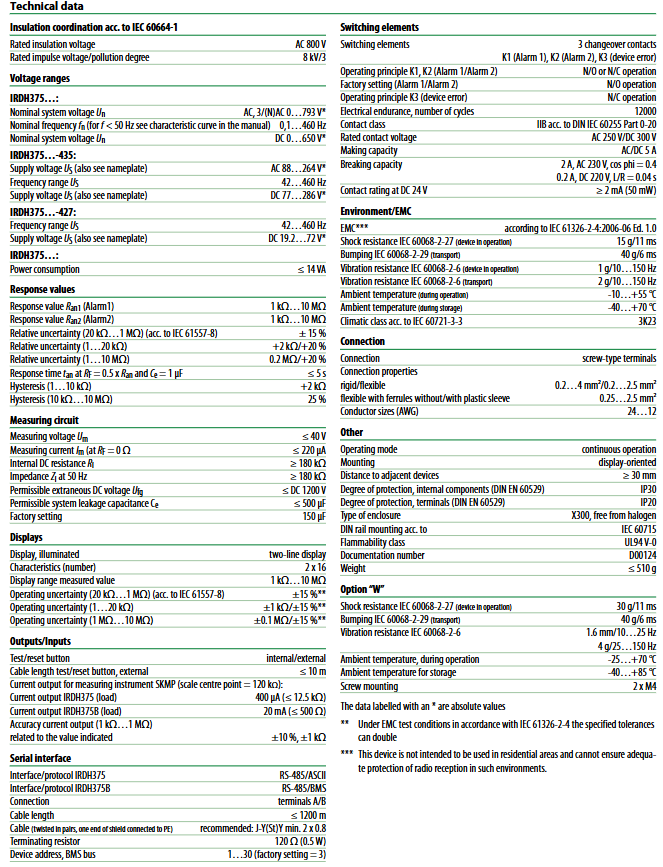
BENDER ISOMETER ®  The IRDH375 series is an insulation monitoring device developed by Bender, a German company, specifically for ungrounded alternating current (AC), mixed AC/DC, and direct current (DC) systems (i.e. IT systems). Its core mission is to monitor the insulation resistance status between the system conductor and the ground in real time, warn of insulation faults in a timely manner, and ensure the safe and stable operation of electrical systems. This series of products, with patented measurement technology, flexible adaptability, and comprehensive functional configuration, are widely used in various scenarios with strict electrical safety requirements, and fully comply with multiple international universal standards, possessing high reliability and compatibility.

Core adaptation range

(1) System type adaptation

Basic adaptation systems: AC system, DC system, AC/DC hybrid main circuit

Special adaptation system: AC/DC main circuit with direct connection to DC components (such as rectifiers, converters, thyristor controlled DC drivers); UPS system, battery system; Phase controlled heater; Installation scenarios for equipment with switch mode power supply; High leakage capacitance IT system; Coupling IT systems

(2) Voltage parameter specifications

Rated monitoring voltage: AC/AC-DC 0… 793V, DC 0… 650V

Extended monitoring voltage: By combining with a dedicated coupling device, it can be extended to higher voltage levels such as DC 0… 1760V, 3/(N)/AC 0… 7200V (50… 400Hz), etc

Power supply voltage requirements:

AC power supply: 88… 264V (frequency 42… 460Hz)

DC power supply: 77… 286V or 19.2… 72V (please refer to the equipment nameplate for details)

Power protection: requires power supply through a 6A fuse; Mandatory requirement to use 5A fuses for UL and CSA application scenarios

Core technology and functional characteristics

(1) Measurement technology

Adopting the patented AMPPlus measurement method, designed specifically for modern power supply systems, it can accurately respond to complex scenarios containing a large number of directly connected DC components and high system leakage capacitors, effectively solving the problem of inaccurate monitoring by traditional measurement methods in such scenarios, and ensuring the stability and reliability of insulation resistance monitoring.

(2) Basic functions

Insulation monitoring core: Real time monitoring system insulation resistance, supporting two independent adjustable response values (1k Ω… 10M Ω), can set warning threshold and alarm threshold separately, achieving graded warning

Automatic adaptation capability: Without manual intervention, the device can automatically adapt to system leakage capacitance (maximum allowable value ≤ 500 μ F) and adapt to changes in system parameters under different operating conditions

Self monitoring and self testing:

Continuous self-monitoring: Real time inspection of the device’s own working status, automatic triggering of system fault alarm in case of malfunction

Optional automatic self testing: supports manual self testing through the TEST button to verify device functionality and the connection status between the system and the earth

Display and operation:

Display configuration: Dual row backlit LCD display screen, supports switching between standard mode and menu mode, clearly displays insulation resistance value, device settings, fault information, etc

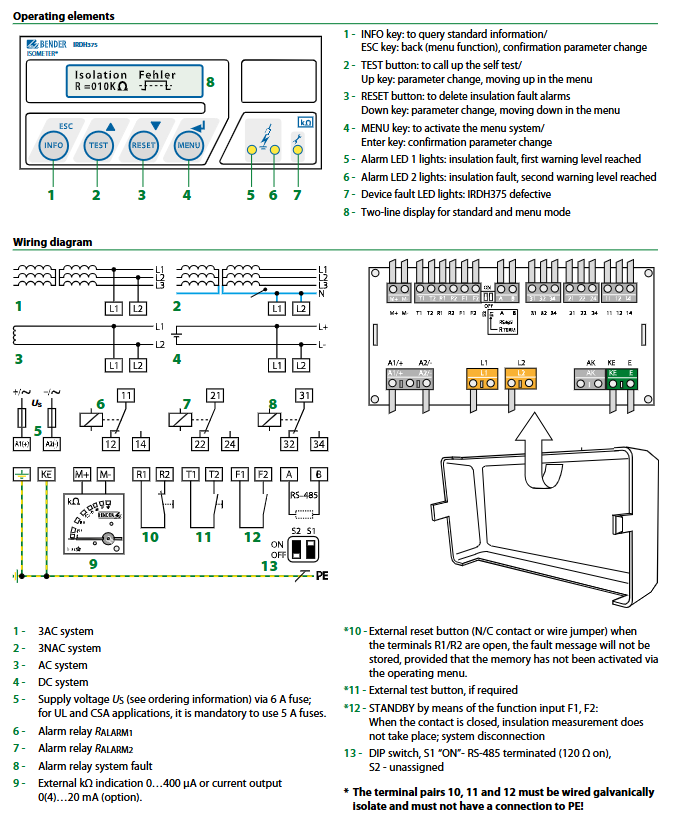
Operation buttons: equipped with four core buttons: INFO (query standard information), TEST (self-test), RESET (clear fault alarm), MENU (activate menu system), and support direction keys (up/down) and confirm key operation. Parameter configuration can be completed through panel buttons; Support external testing and reset buttons (cable length ≤ 10m)

Alarm function:

Alarm output: 2 independent alarm relays, both with passive conversion contacts, supporting N/O (normally open) or N/C (normally closed) operation modes; Additional configuration of system fault alarm relay (default N/C operation mode)

Alarm indication: 3 dedicated alarm LED lights, corresponding to “Level 1 Insulation Fault Warning”, “Level 2 Insulation Fault Alarm”, and “Equipment Self Fault”, providing intuitive feedback on the alarm level

Fault storage: It can store fault information and clear it through the RESET button or external reset button (when terminals R1/R2 are disconnected and the storage function is not activated through the operation menu, the fault information is not stored)

Extension interface:

Communication interface: RS-485 interface (supports ASCII protocol), transmission distance ≤ 1200m (recommended to use J-Y (St) Y 2 × 0.8mm ² twisted pair, with one end of the shielding layer connected to PE), supports communication with external systems

External indicator interface: Reserve an external k Ω indicator interface (output 0… 400 μ A signal), which can be connected to external measuring instruments to display insulation resistance values

Terminal design: adopting plug-in terminals, convenient wiring, and terminal protection level up to IP30

Other auxiliary functions:

INFO button: Press to query additional information such as system leakage capacitance, current device settings, etc

Standby function: Controlled through function input ports F1 and F2, the device enters standby mode when the contacts are closed, pausing insulation measurement and achieving system disconnection control

DIP switch configuration: When the S1 switch is in the “ON” state, the RS-485 interface enables a 120 Ω terminal resistor; S2 switch has not yet been assigned a function

(3) Advanced features of IRDH375B (added compared to the base model)

Historical record storage: Built in historical memory with real-time clock, which can record all alarm information and attach date and time stamps for easy fault tracing and analysis

Enhanced Communication Capability: Equipped with an electrically isolated RS-485 interface, supporting BMS protocol, capable of stable communication with other Bender devices, and adaptable to centralized control scenarios such as building management systems

Coupling system adaptation: Built in insulation monitoring device disconnect relay, supports multiple IRDH375B devices to work together in the coupling IT system, and ensures that only one device is active at any time by controlling input ports F1/F2 to avoid monitoring conflicts

Analog output: Added 0 (4)… 20mA current output, which can be used for external data acquisition devices to achieve remote transmission and recording of insulation resistance data

Key performance parameters

Specific parameter specifications for performance categories

When the insulation resistance R_F=0.5 x the set response value R_an and the system leakage capacitance C_e=1 μ F, the response time is ≤ 5s

Measurement accuracy 1k Ω… 1M Ω Range: ± 15% ± 1k Ω; 1k Ω… 10M Ω Range: ± 15% ± 0.1M Ω (compliant with IEC 61557-8 standard)

Electrical durability contact category 12000 IIB (compliant with DIN IEC 60255 Part 0-20); Rated contact voltage AC 250V/DC 300V

Contact capacity AC/DC 5A; 2A at AC 230V, cos φ=0.4; 0.2A at DC 220V, L/R=0.04s; minimum control current ≥ 2mA (50mW)

Environmental adaptability working temperature: -10…+55 ℃ (regular model), -25…+70 ℃ (Option-W model); Storage temperature: -40…+70 ℃ (regular version), -40…+85 ℃ (Option-W version); Climate grade: IEC 60721-3-3 3K23

Anti interference and mechanical performance electromagnetic compatibility (EMC): compliant with IEC 61326-2-4:2006-06 Ed.1.0 standard; Impact resistance: IEC 60068-2-27 (15g/11ms); Anti collision (transportation): IEC 60068-2-29 (40g/6ms); Vibration resistance: IEC 60068-2-6 (1g/10… 150Hz, transportation scenario 2g/10… 150Hz); Option-W enhances impact resistance (30g/11ms) and vibration resistance (1.6mm/10-25Hz, 4g/25… 150Hz) performance

Mechanical specification panel opening size: 138 × 68mm; installation method: DIN rail installation (in accordance with IEC 60715 standard) or screw installation (2 × M4); Shell type: X300 type, halogen-free material; Protection level: IP20 for equipment casing; Weight ≤ 510g; distance between adjacent equipment installations ≥ 30mm

Wiring specification terminal type: spiral terminal; Conductor adaptation: rigid conductor 0.2… 4mm ², flexible conductor (with/without plastic sleeve) 0.2… 2.5mm ²; Suitable for AWG wire gauge: 24… 12; Terminal pairs 10, 11, and 12 must be electrically isolated and must not be connected to PE

Operation and Display Instructions

(1) Operation button function

Core functions of buttons/operating components

INFO key to query standard information; Cooperate with menu operations to achieve function switching

Return to the previous level in ESC menu mode; Confirm parameter changes

Test button to start device self-test; As an up arrow key in menu mode, it is used for parameter changes and menu navigation

The RESET button clears the insulation fault alarm record; As the down arrow key in menu mode, it is used for parameter changes and menu navigation

MENU key activates the menu system; As a confirmation key in menu mode, confirm parameter changes

Alarm LED 1 lights up to indicate insulation fault, reaching the first level warning threshold

Alarm LED 2 lights up to indicate insulation fault, reaching the second level alarm threshold

Device fault LED lights up to indicate a device malfunction (IRDH375 malfunction)

Dual row display screen standard mode displays insulation resistance value and fault information; Menu mode displays parameter configuration interface

(2) Parameter configuration method

Support two parameter configuration methods: one is to operate through the dual row LCD display screen on the device panel in conjunction with functional buttons; The second is to connect to the external control system through the RS-485 interface for remote configuration (in accordance with the corresponding communication protocol). During the configuration process, changes can be confirmed through the ESC key or Enter key, and the operation logic is clear and easy to understand.

BENDER WR70x175S (P)… WR200x500S (P)

Product Overview

(1) Product positioning and core applications

WR70x175S (P)… WR200x500S (P) is an industrial grade rectangular measuring current transformer developed by BENDER in Germany. It is designed for current signal conversion and precise acquisition, and is used in conjunction with residual current monitoring systems and insulation fault location systems to achieve current monitoring and fault tracing in industrial electrical circuits. It is suitable for AC/DC hybrid power supply scenarios and can convert high or positioning currents on the primary side into assessable standard signals on the secondary side, providing accurate data support for backend monitoring equipment. It is widely used in industrial scenarios such as factory distribution systems, busbar systems, IT systems (ungrounded systems), etc.

(2) Core Features and Compliance Standards

1. Core Features

Dual scenario adaptation: compatible with RCM/RCMS series residual current monitoring systems, converting AC current signals; It can also be paired with EDS series insulation fault location system (IT system) to collect the positioning current generated by PGH positioning current injector or IRDH series insulation monitoring instrument.

Series differentiation design: divided into the S series without integrated shielding and the SP series with integrated shielding. The SP series is designed specifically for busbar systems with load currents ≥ 500A, which can avoid false triggering of backend devices caused by high load currents or surge currents.

High reliability: Equipped with a built-in secondary side overvoltage protection diode, it has strong resistance to impact and vibration, and is suitable for harsh industrial environments.

Flexible installation: Supports installation in any direction, adapts wires to multiple specifications, and meets different on-site wiring needs.

2. Compliance and Certification

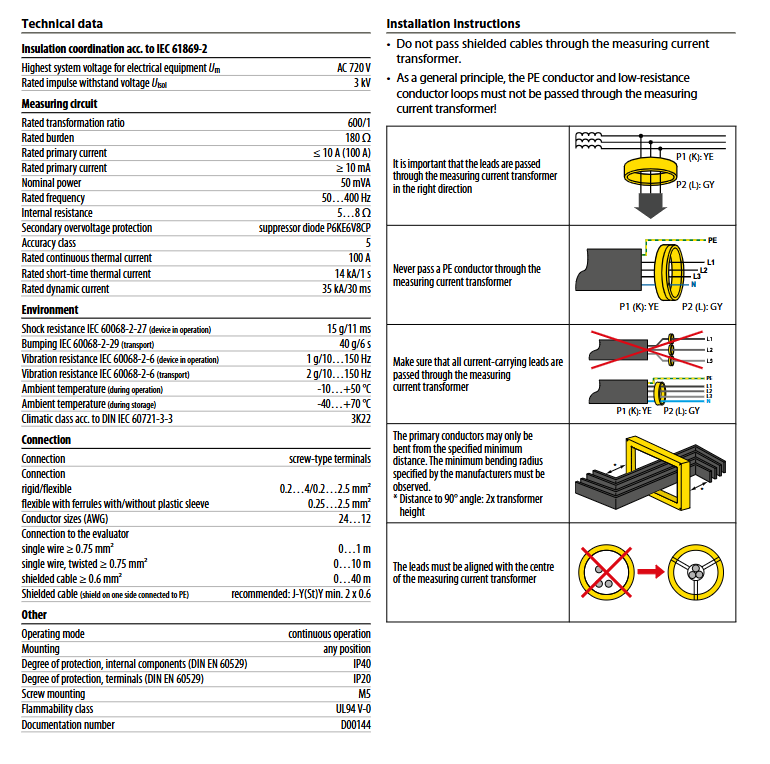
Following standards: DIN EN 60044-1 (General Technical Standard for Current Transformers), IEC 61869 (Power Transformer Standard), IEC 61869-2 (Insulation Coordination Standard), DIN IEC 60721-3-3 (Climate Rating Standard).

Safety level: The flame retardant rating of the shell reaches UL94 V-0, the internal component protection level is IP40, and the terminal protection level is IP20, effectively preventing solid foreign objects from entering and electrical safety risks.

Product classification and core parameters

(1) Product series and model differentiation

Series Core Features Applicable Scenarios Model Range

S series without integrated shielding, basic design for conventional industrial scenarios, circuits with load current<500A  WR70x175S、WR115x305S、WR150x350S、WR200x500S

SP series with integrated shielding, strong anti-interference ability, busbar system, circuit with load current ≥ 500A, high interference environment WR70x175SP, WR115x305SP, WR150x350SP, WR200x500SP

(2) Key electrical parameters

Category specific specification remarks

Maximum system voltage (Um) AC 720 V suitable for medium and high voltage industrial distribution systems

Rated impulse withstand voltage (Uisol) 3 kV meets industrial insulation coordination requirements

Rated transformation ratio 600:1 Fixed transformation ratio to ensure signal conversion consistency

Rated load 180 Ω matching backend monitoring/positioning equipment input impedance

Rated primary current minimum ≥ 10 mA, maximum ≤ 10 A (100 A) to cover small signal acquisition and high current monitoring requirements

Rated nominal power of 50 mVA ensures sufficient signal transmission power

Rated frequency 50… 400 Hz, suitable for industrial scenarios of power frequency and intermediate frequency

Internal resistance of 5… 8 Ω reduces signal transmission loss

Secondary side overvoltage protection suppression diode P6KE6V8CP prevents overvoltage damage to backend equipment

Accuracy level 5 meets the requirements of industrial current measurement error

Rated continuous thermal current of 100 A, stable long-term operation without overheating risk

Rated short-time thermoelectric current 14 kA/1 s withstand short-time short-circuit current surge

Rated dynamic current of 35 kA/30 ms to resist instantaneous dynamic current surge

(3) Physical dimensions and weight

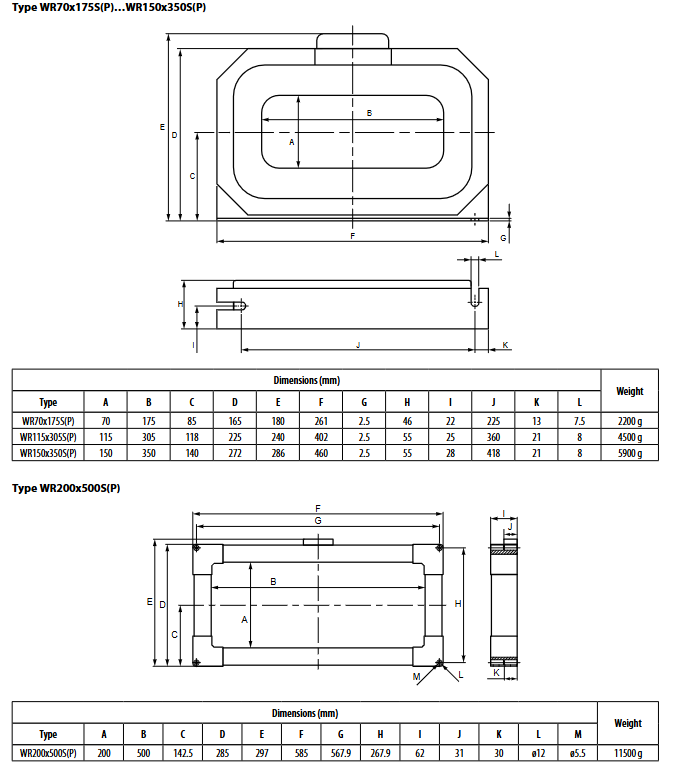
1. Size and weight of WR70x175S (P)~WR150x350S (P)

Model size (mm) Weight

A (internal width) B (internal height) C D E F G H I J K L

WR70x175S(P) 70 175 85 165 180 261 2.5 46 22 225 13 7.5 2200 g

WR115x305S(P) 115 305 118 225 240 402 2.5 55 25 360 21 8 4500 g

WR150x350S(P) 150 350 140 272 286 460 2.5 55 28 418 21 8 5900 g

2. WR200x500S (P) size and weight

Model size (mm) Weight

A (internal width) B (internal height) C D E F G H I J K L M

WR200x500S(P) 200 500 142.5 285 297 585 567.9 267.9 62 31 30 ø12 ø5.5 11500 g

Installation and wiring specifications

(1) Core installation requirements

Prohibited conductors to pass through:

It is strictly prohibited to pass shielded cables, PE conductors, and low resistance conductor circuits through transformers, otherwise interference signals may be introduced, leading to a decrease in measurement accuracy or misjudgment by backend equipment.

All current carrying wires must pass through the transformer completely without omission, ensuring comprehensive collection of current signals.

Wire threading direction and position:

The wire needs to be threaded in from the P1 (K end, yellow mark) side and out from the P2 (L end, gray mark) side. Incorrect direction can cause signal polarity reversal and affect data accuracy.

The wires need to be aligned with the center position of the transformer to avoid uneven magnetic field distribution caused by offset, further ensuring measurement accuracy.

Wire bending and spacing:

The bending of the primary side conductor must follow the minimum bending radius specified by the manufacturer, and the 90 ° bending distance must not be less than twice the height of the transformer to prevent insulation damage to the conductor and distortion of current distribution.

Installation and fixation:

Supports installation in any direction (horizontal, vertical, etc.), fixed on the installation surface with M5 screws to ensure a firm and secure installation without looseness, and to avoid vibration affecting performance during operation.

(2) Wiring and Connection Specifications

Conductor adaptation:

The terminal block is screw type and supports rigid conductors (0.2… 4mm ²), flexible conductors (0.2… 2.5mm ²), and flexible conductors with/without plastic collars (0.25… 2.5mm ²), compatible with AWG 24… 12 specification conductors.

Cable selection and distance:

Single core wire (≥ 0.75mm ²): maximum connection distance of 1m.

Twisted single core wire (≥ 0.75mm ²): maximum connection distance of 10m.

Shielded cable (≥ 0.6mm ²): maximum connection distance of 40m, recommended model J-Y (St) Y 2 × 0.6mm ², shielding layer needs to be connected to PE at one end to reduce electromagnetic interference.

Wiring precautions:

Before wiring, the power supply must be disconnected to ensure construction safety; Tighten the terminal screws after wiring to avoid signal distortion caused by poor contact.

Connected to backend devices (RCM/RCMS/EDS) through two-wire cables, S1 (k) and S2 (l) terminals correspond to device signal input interfaces.

Environmental adaptability and mechanical characteristics

(1) Environmental parameters

Category specific specifications

Working environment temperature -10 ℃…+50 ℃

Storage environment temperature -40 ℃…+70 ℃

Climate grade DIN IEC 60721-3-3 (3K22)

Impact resistance performance (in operation) 15 g/11 ms (IEC 60068-2-27)

Anti collision performance (during transportation) 40 g/6 ms (IEC 60068-2-29)

Vibration resistance performance (in operation) 1 g/10… 150 Hz (IEC 60068-2-6)

Vibration resistance performance (during transportation) 2 g/10… 150 Hz (IEC 60068-2-6)

(2) Mechanical characteristics

Shell material: flame retardant grade UL94 V-0, high temperature resistance, anti-aging, in line with industrial safety requirements.

Protection level: Internal components IP40 (preventing solid foreign objects with a diameter of ≥ 1mm from entering), terminals IP20 (preventing finger touch).

Operation mode: Continuous operation, uninterrupted collection of current signals, meeting the 24-hour uninterrupted production needs of industry.

Model specifications and ordering information

(1) Model and Order Number Correspondence Table

Model Internal dimensions (mm) Shielding characteristics Order number

WR70x175S 70 × 175 without B911738

WR115x305S 115 × 305 without B911739

WR150x350S 150 × 350 without B911740

WR200x500S 200 × 500 without B911763

WR70x175SP 70 × 175 integrated shielding B911790

WR115x305SP 115 × 305 integrated shielding B911791

WR150x350SP 150 × 350 integrated shielding B911792

WR200x500SP 200 × 500 integrated shielding B911793

(2) Selection suggestions

Selection based on load current: If the load current is ≥ 500A or applied to the busbar system, the SP series (with shielding) is preferred; For conventional load current scenarios, select the S series.

Select according to internal dimensions: Select the corresponding internal dimensions based on the number and thickness of the primary side conductors to ensure that the conductors can pass through the transformer smoothly and leave appropriate gaps.

Selection based on connection distance: When the connection distance exceeds 10m, shielded cables should be selected and matched with the wiring requirements of the corresponding transformer model.

Precautions and Maintenance Guidelines

(1) Precautions for use

It is strictly prohibited to dismantle the transformer casing or modify the internal circuit without authorization, otherwise it will damage the insulation performance and shielding structure, and lose the product warranty qualification.

Transformers need to be used in conjunction with compatible backend devices (RCM/RCMS/EDS) to avoid signal attenuation or equipment damage caused by load mismatch.

Installation and maintenance must be carried out by qualified electrical professionals, strictly following local electrical safety regulations.

(2) Key points of daily maintenance

Regular inspection: Check the installation and fixation of the transformer, whether the wiring terminals are loose, and whether the cable insulation layer is damaged every month. If any problems are found, they should be dealt with in a timely manner.

Environmental cleaning: Keep the surface of the transformer clean to avoid dust accumulation affecting heat dissipation or insulation performance.

Fault handling: If there is no signal input or signal abnormality in the backend equipment, it is necessary to sequentially check whether the cable connection, conductor direction, and transformer are damaged. If necessary, contact the manufacturer’s technical support.

image.png

BENDER IRDH575 Insulation Monitoring Equipment (IT System)

Product Overview

(1) Product positioning and core applications

IRDH575 is an industrial grade insulation monitoring and fault location control integrated equipment launched by BENDER in Germany. It is designed specifically for ungrounded (IT) systems and is used to monitor the ground insulation resistance of 3 (N) AC, AC/DC hybrid, and pure DC systems in real time, identify the risk of grounding faults in advance, and can be expanded into an accurate fault location system. It is suitable for industrial scenarios with sensitive loads such as frequency converters, thyristor controlled DC drives, PLCs, etc., such as factory power distribution systems, automated production lines, new energy equipment, etc. Through the dual functions of “monitoring and warning+precise positioning”, it ensures the electrical safety and continuous operation of IT systems, avoiding equipment damage or production interruption caused by grounding faults.

(2) Core Features and Compliance Standards

1. Core Features

Strong universality: It has a wide voltage range of adaptation (AC/DC 20… 575V low voltage type, 340… 760V high voltage type) and is compatible with multiple types of IT systems.

Accurate monitoring: The insulation resistance measurement range is 1k Ω… 10M Ω, supporting two-level alarm thresholds to distinguish between “potential risks” and “serious faults” in advance.

Positioning Expansion: Paired with EDS4 series positioning devices, it can cover up to 1080 circuits and accurately locate fault branches and sources.

Comprehensive functionality: It has multiple functions such as data storage, bidirectional communication, self-monitoring, and external device expansion, and is suitable for industrial centralized monitoring needs.

2. Compliance and Certification

Following standards: DIN EN 61557-8/9(VDE 0413-8/9)、IEC 61557-8/9、IEC 61326-2-4、ASTM F1669M-96(2007)、ASTM F1207M-96(2007)、DIN EN 60664-1/3(VDE 0110-1) Wait.

Certification qualifications: CE, UL/US LISTED certification, the shell adopts halogen-free design, and the flame retardant level reaches UL94 V-0, which meets environmental and safety requirements.

Core functions and operational features

(1) Insulation monitoring function

Core measurement mechanism

Measurement principle: Using the AMP measurement method, a weak test signal (measured voltage ≤ 40V, measured current ≤ 220 µ A) is injected into the system through a built-in measurement circuit to monitor the insulation resistance between the system conductor and ground. The measurement results are not affected by the system load current and rated voltage, and have strong stability.

Measurement range: 1k Ω… 10M Ω, covering the entire scene from low resistance faults (close to short circuits) to high resistance faults (slight insulation damage), and can identify faults in advance before leakage current occurs.

Measurement accuracy: The range error of 10k Ω… 10M Ω is 0%…+20%, and the range error of 1k Ω… 10k Ω is+2k Ω. The measurement data is reliable and provides accurate basis for fault diagnosis.

Hierarchical alarm mechanism

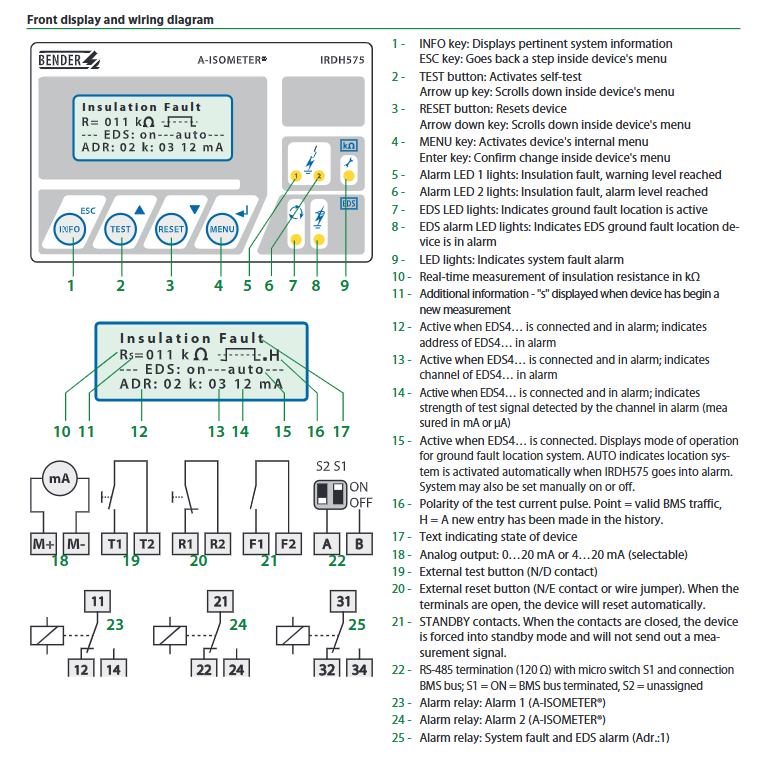
Alarm output: 3 switch contacts (SPDT), corresponding to first level alarm (K1, warning), second level alarm (K2, main alarm), equipment failure/EDS alarm (K3), supporting N/O (normally open) or N/C (normally closed) operation mode switching, factory default K1/K2 is N/O, K3 is N/C.

Alarm mode: Supports self-locking mode (manual reset after fault clearance) and non self-locking mode (automatic reset after fault clearance), which can be switched through menu settings and adapted to different fault handling processes.

Status indication: Alarm LED1 (first level alarm), Alarm LED2 (second level alarm), and equipment fault LED correspond to different alarm levels, providing intuitive feedback on the severity of the fault for quick on-site identification.

Self monitoring and testing

Self monitoring: Continuously monitor the grounding connection, line connection, and internal circuit status of the equipment itself. In case of abnormalities, trigger the K3 relay action and light up the equipment fault LED to avoid missed reports due to equipment failure.

Testing function: Supports internal/external testing buttons (N/O contacts), long press the TEST button to activate self-test, verify whether the alarm circuit, display system, and connection to the system/ground are normal, and ensure reliable device functionality.

Reset function: Internal/external reset button (N/C contact or jumper), short press the RESET button to clear the alarm memory. When the terminal is open and ISO-SETUP is set to Memory: off, insulation faults are not stored.

(2) Ground fault location function

System expansion configuration

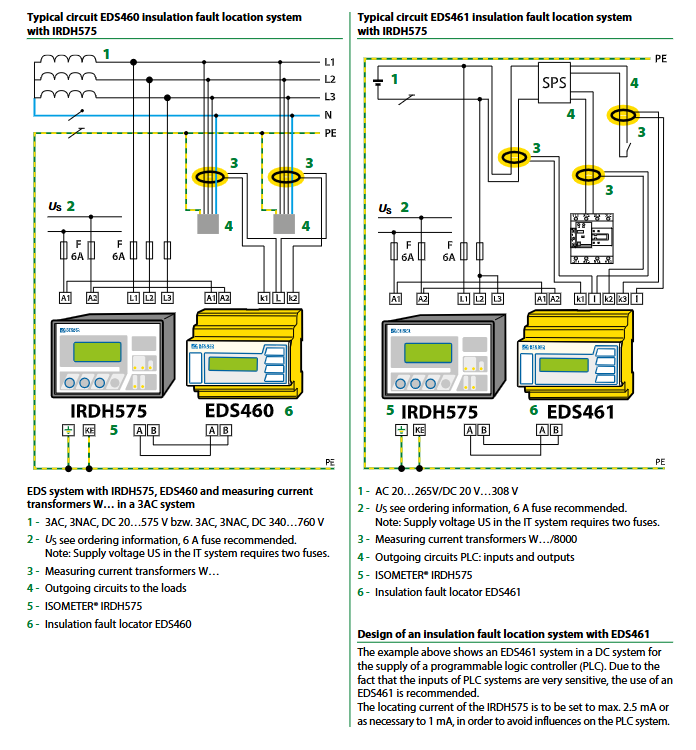
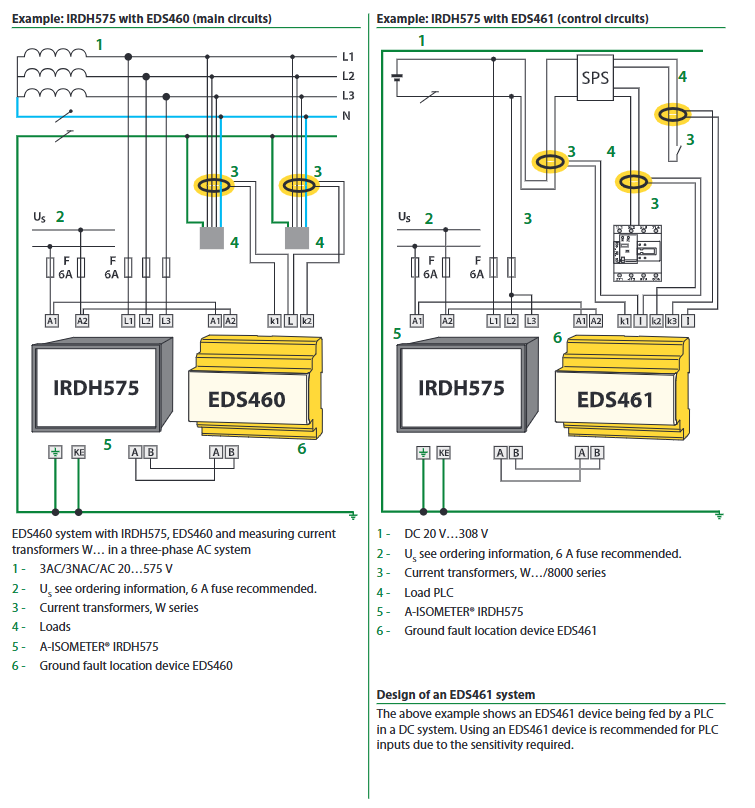
Core components: IRDH575 host+EDS460 (main circuit positioning device)/EDS461 (control circuit positioning device)+dedicated current transformer (W series adapted to main circuit, 8000 series adapted to control circuit), optional EDS3090/EDS3091 portable positioning system.

Scalability: Supports up to 90 EDS4 series devices for interconnection, with each EDS device capable of monitoring 12 circuits, covering a total of 1080 circuits, and adapting to the fault location needs of large industrial distribution systems.

Positioning workflow

Trigger method: After IRDH575 detects an insulation fault, it automatically starts the positioning process, or can be manually started through the menu, flexibly adapting to different on-site requirements.

Signal generation: IRDH575 generates pulse positioning current, the amplitude of which depends on the system voltage and the degree of insulation fault. In case of low resistance fault, the positioning current is automatically limited, and the current limit value can be set through the menu (maximum 50mA). The pulse period is 2s and the interval is 4s to avoid affecting the normal operation of the system.

Fault identification: The positioning current pulse starts from the host through live parts, travels along the shortest path to the fault point, and then returns to the host through the insulation fault point and PE line. The current transformer on the fault path collects the pulse signal, which is evaluated by EDS equipment.

The results show that when the positioning current exceeds the response value of the EDS device, the EDS local alarm LED lights up, indicating the faulty sub circuit. At the same time, the IRDH575 LCD synchronously displays the bus address, monitoring channel, and positioning current intensity (mA/µ A) of the faulty EDS device, achieving accurate fault positioning.

Portable troubleshooting: Optional EDS3090/EDS3091 portable positioning system can track pulse signals to the source of faults, suitable for complex wiring and concealed fault troubleshooting scenarios.

PLC control circuit adaptation

Due to the sensitivity of PLC input signals, EDS461 equipment is required for control circuit positioning, and the positioning current of IRDH575 should be set to a maximum of 2.5mA or 1mA to avoid interfering with the normal operation of the PLC.

(3) Data storage and communication functions

Data recording and querying

Storage capacity: Non volatile memory can store 99 alarm messages with date and timestamp, including fault type, insulation resistance value, occurrence time, EDS device address, etc. Data will not be lost after power failure, making it easy to trace and analyze faults.

Information query: Pressing the INFO key can quickly query system leakage capacitance, device parameter settings, alarm history, and other information without entering deep menus, making operation convenient.

communication interface

RS-485 interface (BMS protocol): Supports bidirectional data communication between devices, with a maximum cable length of 1200m. It is recommended to use shielded cable J-Y (ST) Y 2 × 0.6mm ² (single ended PE for shielding layer), equipped with a 120 Ω terminal resistor (controlled by micro switch S1 to enable/disable), to reduce signal attenuation and electromagnetic interference.

Protocol extension: Can connect to Bendel protocol converters, adapt to industrial protocols such as Ethernet, MODBUS, PROFIBUS, etc., and achieve interconnection with upper control systems such as PLC and DCS.

Analog output: 0/4… 20mA optional, load ≤ 500 Ω, can convert insulation resistance signal into standard analog quantity, connect to external instruments or centralized monitoring system, achieve remote real-time monitoring of insulation status.

(4) Operation and display functions

display system

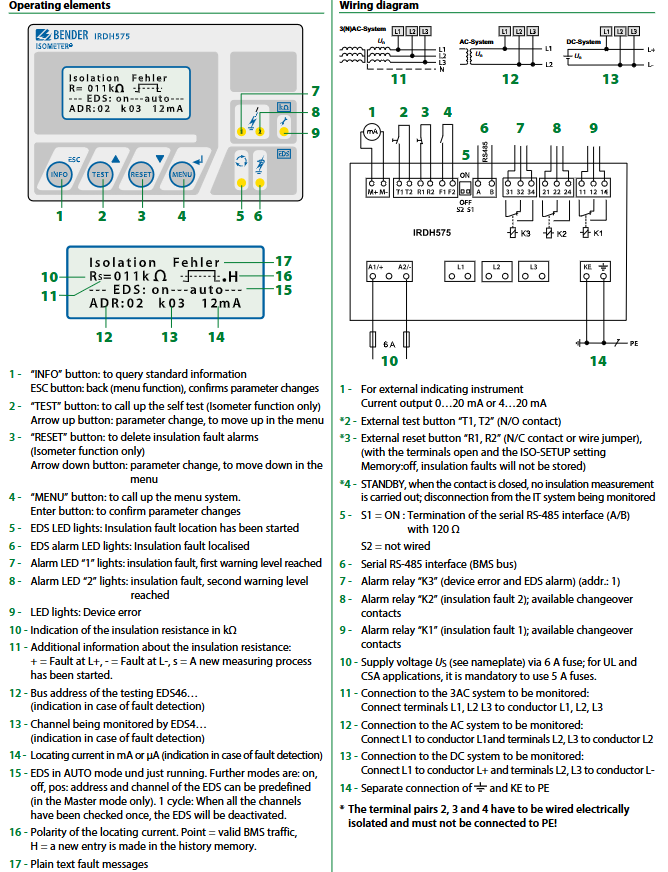
Backlit LCD screen: 4 × 16 character pure text display, character height 5mm, clear display, supports multilingual switching, real-time display of insulation resistance value (k Ω), system status, alarm information, EDS equipment status, etc.

Auxiliary display: “s” indicates that a new measurement is in progress, “+” indicates a fault on the L+side, and “-” indicates a fault on the L – side; EDS mode display (AUTO/ON/OFF/pos/1 cycle), POS mode can preset EDS address and channel (host mode only), EDS will automatically stop after detecting all channels in 1 cycle mode; Position current polarity indication (Point=active BMS communication, H=new historical record).

Operation buttons

Function keys: INFO (information query), MENU (menu call), ESC (return/confirm parameter modification), TEST (self-test), RESET (alarm reset).

Navigation keys: up/down arrow keys (menu scrolling, parameter adjustment), Enter key (confirm parameter modification).

Operation logic: Clear menu hierarchy, intuitive parameter settings, password protection support to prevent unauthorized personnel from tampering with settings.

Detailed technical parameters

(1) Electrical parameters

Category specific specifications

Monitoring system voltage low voltage type (B1 series): AC 20… 575V (3 (N) AC/single-phase, 50… 460Hz), DC 20… 575V

High voltage type (B2 series): AC 340… 760V (3 (N) AC/single-phase, 50… 460Hz), DC 340… 575V

Supply voltage AC 88… 264V (50… 460Hz), DC 77… 286V; UL/CSA applications mandate the use of 5A fuses, while 6A fuses are recommended for other scenarios; Two fuses are required for IT system power supply

Allow external DC voltage B1 series ≤ 810V, B2 series ≤ 1060V

Allow system leakage capacitance ≤ 150 (500) µ F

Relay parameters: rated contact voltage AC 250V/DC 300V, connection capacity AC/DC 5A, breaking capacity 2 A(AC 230V,cosφ=0.4)、0.2A(DC 220V,L/R=0.04s), Electrical lifespan of 12000 cycles, contact current (DC 24V) ≥ 2mA (50mW), contact level IIB (DIN IEC 60255-23)

Analog output 0/4… 20mA, load ≤ 500 Ω

Power consumption ≤ 14 VA

(2) Environmental and mechanical parameters

Category specific specifications

Working environment temperature -10 ℃…+55 ℃ (cannot operate continuously in 50mA positioning mode); The short-term working temperature can reach -25 ℃…+70 ℃

Storage environment temperature -40 ℃…+85 ℃

Climate grade DIN IEC 60721-3-3 (3K5)

Impact resistance performance during operation: 15g/11ms (IEC 60068-2-27); During transportation: 40g/6ms (IEC 60068-2-29); Option-W model: 30g/11ms

Vibration resistance performance during operation: 1g/10… 150Hz (IEC 60068-2-6); During transportation: 2g/10… 150Hz (IEC 60068-2-6); Option-W model: 1.6mm/10… 25Hz, 4g/25… 150Hz

Protection level: Internal components IP30, terminals IP20, door mounted IP40, optional IP42 (equipped with panel seals)

Installation method: Panel installation, hole size 138 × 90mm, installation direction is display facing outward, installation distance ≥ 30mm; optional DIN rail adapter (Art. No. B98060010)

Wire terminal screw terminal, supporting rigid conductors 0.2… 4mm ², flexible conductors 0.2… 2.5mm ², flexible conductors with/without plastic collars 0.25… 2.5mm ², compatible with AWG 24… 12 specification conductors

Shell and weight halogen-free flame-retardant shell, weight ≤ 900g

System installation and typical configuration

(1) Installation points

Power supply configuration: The power supply circuit is connected in series with corresponding specifications of fuses (5A for UL/CSA, 6A for others). The IT system power supply must be equipped with two fuses to ensure equipment overcurrent protection.

Grounding requirements: The equipment grounding terminal (KE) should be reliably grounded, and the RS-485 cable shielding layer should be single ended with PE to reduce electromagnetic interference; Terminal pairs 2, 3, and 4 require electrical isolation wiring and must not be connected to PE.

Wiring specifications: Measurement circuits and power cables should be laid separately to avoid cross interference; The wiring between EDS equipment and current transformers must follow polarity requirements to ensure accurate signal acquisition.

Environmental requirements: The installation location should be well ventilated, away from heat sources and strong electromagnetic interference sources, and meet the working temperature (-10…+55 ℃) and protection level requirements; The Option-W model has stronger shock and vibration resistance and is suitable for harsh environments.

(2) Typical application configuration

1. Main circuit monitoring and positioning system (AC/DC 20… 575V)

Configuration components: IRDH575B1-435+EDS460+W series current transformer+6A fuse.

Applicable scenarios: Factory three-phase main distribution circuit, motor control circuit, etc. Each EDS460 monitors 12 main circuit branches and supports cascading expansion of multiple EDS460.

Wiring method: The L1/L2/L3 terminals of the 3AC system are respectively connected to the L1/L2/L3 terminals of the equipment, the N line is connected as needed, and the KE terminal of the equipment is connected to PE; EDS460 communicates with IRDH575 through the AB terminal, and the current transformer is installed on the main circuit branch line.

2. Control circuit monitoring and positioning system (AC 20… 265V/DC 20… 308V)

Configuration components: IRDH575B1-435+EDS461+8000 series current transformer+6A fuse+PLC.

Applicable scenarios: PLC control circuits, DC instrument circuits, and other sensitive load circuits. EDS461 is designed to meet the high sensitivity requirements of control circuits and avoid interference from positioning currents on loads.

Wiring method: The L+terminal of the DC system is connected to the L1 terminal of the device, the L – terminal is connected to the L2/L3 terminal, and the KE terminal of the device is connected to the PE terminal. EDS461 communicates with IRDH575, and the current transformer is installed on the PLC input and output circuit line, with a positioning current set to 1… 2.5mA.

BENDER IRDH575 Series Digital Ground Fault Monitor

Product Overview

Product Name: IRDH575 Digital Ground Fault Monitor/Ground Fault Localization System Controller

Applicable systems: ungrounded (floating) AC/DC systems, including 3 (N) AC, AC/DC hybrid, pure DC systems, suitable for industrial scenarios with power conversion equipment such as rectifiers and frequency converters

Core value: By monitoring the insulation resistance of the system to ground, ground faults can be detected in advance (can be identified when there is no leakage current), which can be expanded into a ground fault location system to accurately locate the fault circuit and ensure the electrical safety of ungrounded systems

Core functions and features

(1) Fault detection and alarm

Insulation resistance monitoring: The core determines faults by measuring the insulation resistance of the system to the ground, with a response range of 1k Ω… 10M Ω. It supports two-level adjustable alarm thresholds (R_an1 warning, R_an2 main alarm) and can distinguish different risk levels.

Hierarchical alarm mechanism:

Dual independent alarm relays (K1, K2), supporting constant power on or constant power-off operation mode, default constant power-off at the factory.

Alarm mode: self-locking mode (manual reset required after fault clearance), non self-locking mode (automatic reset after fault clearance).

Self monitoring function: Continuously monitor the status of the device’s grounding connection and line connection, trigger the system fault alarm relay (K3) in case of abnormalities, and support EDS positioning device alarm linkage.

(2) Grounding fault location

Scalability: Equipped with positioning devices such as EDS460 (main circuit), EDS461 (control circuit), and dedicated current transformers, it can be expanded into a ground fault positioning system, supporting up to 90 EDS4 devices for interconnection. Each EDS device monitors 12 circuits, covering a total of 1080 circuits.

Positioning principle: After detecting a ground fault, IRDH575 sends a pulse test signal (pulse/interval=2s/4s), which returns to the host through the fault circuit. The fault EDS address, circuit number, and signal strength are synchronously displayed on the LCD and EDS equipment.

Portable extension: optional EDS30… portable positioning system, tracks pulse signals to the source of faults, suitable for mobile troubleshooting scenarios.

(3) Data Storage and Communication

Data recording: Non volatile memory can store 99 alarm messages with timestamps, facilitating fault tracing and analysis.

Communication interface:

RS-485 interface (BMS protocol), supports bidirectional communication between devices, can be connected to Bendel protocol converters, and is compatible with Ethernet, MODBUS, PROFIBUS and other protocols.

0/4… 20mA analog output (load ≤ 500 Ω), can be connected to upper control systems such as PLC and DCS to achieve centralized monitoring.

Operation and Display:

Display: Backlit LCD screen (4 × 16 characters, character height 5mm), real-time display of insulation resistance (1k Ω… 10M Ω), system status, EDS equipment information, etc.

Operation: Equipped with INFO (parameter query), MENU (menu settings), ESC (return), TEST (test), RESET (reset) buttons, supporting internal/external test/reset buttons (remote operation).

Detailed technical parameters

(1) Electrical parameters

Category specific specifications

Monitoring system voltage IRDH575B1-435: AC 20… 575V, DC 20… 575V; IRDH575B2-435:AC 340…760V、DC 340…575V

Supply voltage AC 88… 264V (50… 460Hz), DC 77… 286V

Power consumption ≤ 14 VA

Insulation resistance measurement response range: 1k Ω… 10M Ω; measurement accuracy: 10k Ω… 10M Ω is 0%…+20%, 1k Ω… 10k Ω is+2k Ω

Measurement voltage (U_m) ≤ 40 V

Measure current (I2) ≤ 220 µ A (when R_F=0 Ω)

Allow system leakage capacitance (C_e) ≤ 150 (500) µ F

Alarm relay with 3 conversion contacts (K1/K2/K3), rated voltage AC 250V/DC 300V, connection capacity 5A, breaking capacity 2A (AC 230V, cos φ=0.4)

Analog output 0/4… 20mA, load ≤ 500 Ω

(2) Environmental and mechanical parameters

Category specific specifications

Working environment temperature -10 ℃…+55 ℃

Storage environment temperature -40 ℃…+70 ℃

Climate grade DIN IEC 60721-3-3 (3K5)

Impact resistance performance during operation: 15g/11ms (IEC 60068-2-27); During transportation: 40g/6ms (IEC 60068-2-29)

Vibration resistance performance during operation: 1g/10… 150Hz; During transportation: 2g/10… 150Hz (IEC 60068-2-6)

Protection level: IP30 for internal components and IP20 for terminals (NEMA 1); IP40 (NEMA 1) for door installation

Installation method: Panel installation, hole size 138 × 90mm

Plug in screw terminals for wiring terminals, supporting rigid conductors of 0.2… 4mm ² and flexible conductors of 0.2… 2.5mm ²

Weight ≤ 900 g

(3) Communication parameters

Category specific specifications

Interface type RS-485 (BMS protocol)

Maximum cable length of 1200 meters

Recommended shielded cable J-Y (ST) Y 2 × 0.6mm ² (shielding layer single ended PE)

Terminal resistance of 120 Ω (0.5W), controlled by micro switch S1

System configuration and installation

(1) Typical system composition

Number of component functions/adaptation

IRDH575 host fault detection, alarm control, positioning system management 1 unit/independent system

Up to 90 EDS460 main circuit grounding fault location devices, each with 12 circuits

EDS461 control circuit grounding fault location equipment (adapted to PLC input) up to 90 units, with 12 circuits per unit

Current transformer signal acquisition, compatible with main circuit/control circuit and EDS equipment

EDS30… Portable grounding fault location system optional for mobile troubleshooting

(2) Installation points

It is recommended to connect 6A fuses in series for the power supply circuit, and two fuses are required for IT system power supply.

When wiring, it is necessary to ensure reliable grounding of the equipment. The shielding layer of the RS-485 cable should be connected to PE at one end, and the terminal resistance should be enabled as needed (for long-distance communication).

The installation location should be far away from strong electromagnetic interference sources, ensure good ventilation, and meet the requirements of working temperature and protection level.

Ordering and Accessories

Core models: IRDH575B1-435 (low voltage range), IRDH575B2-435 (high voltage range)

Supporting equipment: EDS460 (main circuit positioning), EDS461 (control circuit positioning), EDS3090/3091 (portable positioning), dedicated current transformers (W series/8000 series)

BENDER RCMA475LY AC/DC sensitive residual current monitor

Product Overview

RCMA475LY is an industrial grade AC/DC sensitive residual current monitor launched by BENDER in Germany, designed specifically for TN and TT systems (grounded power supply systems). Its core function is to monitor AC, DC, and pulsating DC currents in circuits, accurately identify DC fault currents or residual currents that are continuously greater than zero, and prevent safety risks such as electrical fires and electric shocks. Its unique Type B working characteristics make it particularly suitable for scenarios containing six pulse rectifiers, unidirectional rectification filtering loads, such as frequency converters, battery chargers, construction site variable frequency drive equipment, uninterruptible power supplies (UPS), etc. It is a key equipment for high reliability electrical safety monitoring in industrial production and civil buildings.

Core certification: Compliant with IEC/TR 60755 Type B standard, with EN 61543 and EN 61000-6-4 electromagnetic compatibility (EMC) certification, flame retardant rating of UL94V-0 for the shell, and protection level of IP30.

Core functions and features

(1) Monitoring and threshold control function

Dual level response threshold:

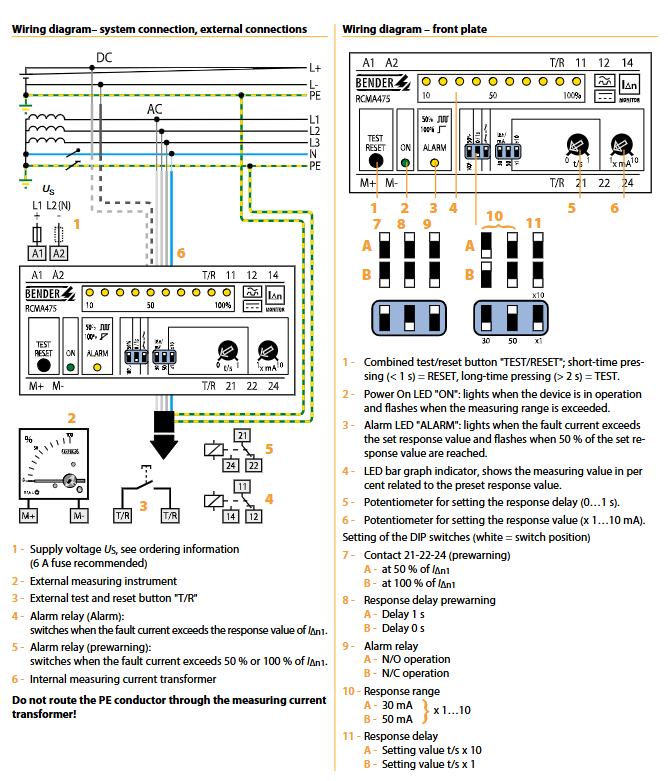
Alarm threshold (I Δ n1): 30… 500mA continuously adjustable, covering various monitoring requirements from low sensitivity to high sensitivity, with a frequency range of 0… 700Hz, suitable for the current characteristics of high-frequency rectifier loads.

Warning threshold (I Δ n2): Supports switching between two modes (set through DIP switch), with the option to select 50% or 100% of the alarm threshold, achieving a graded protection of “early warning+emergency alarm”, making it easy for users to distinguish risk levels and handle them in a timely manner.

Adjustable response delay:

Alarm delay: 0… 10s infinitely adjustable, set through the potentiometer on the front panel, divided into two levels: x1 (0… 1s) and x10 (0… 10s), which can avoid false alarms (such as instantaneous current fluctuations during motor start-up) according to the on-site load characteristics.

Warning delay: 0s or 1s optional (DIP switch switching), quickly responding to potential risks while considering system stability.

Precision measurement mechanism:

Measurement core: Built in ø 18mm inner diameter measuring current transformer, using electromagnetic induction principle to monitor residual current, measurement results are almost unaffected by system load current and rated voltage, with strong stability.

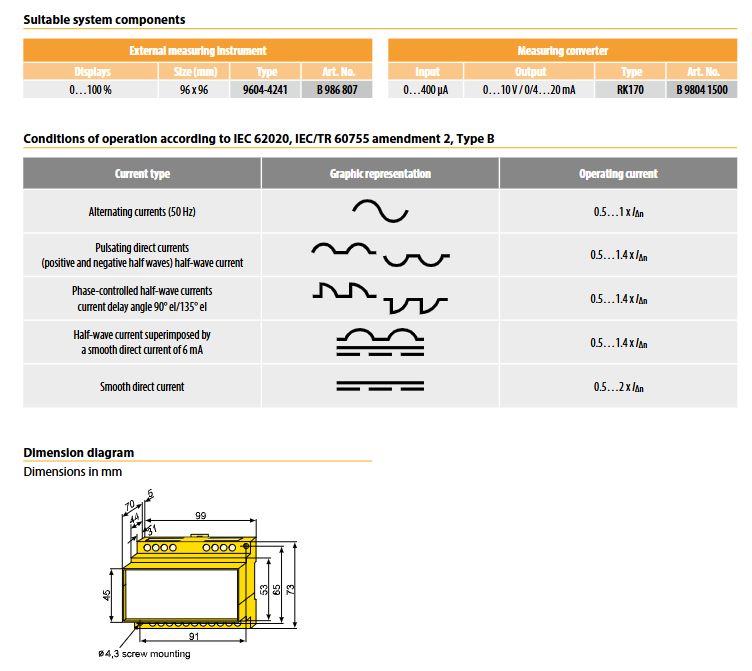
Current type adaptation: It can accurately monitor 50Hz AC current, smooth DC current, positive and negative half wave pulsating DC current, phase controlled half wave current (delay angle 90 ° el/135 ° el), and half wave current with 6mA smooth DC superimposed, suitable for complex load scenarios.

(2) Operation and display functions

Multi functional operation button:

Built in combination “TEST/RESET” button: short press (<1s) for reset function, used to clear fault memory; Long press (>2s) is the testing function to verify whether the device monitoring and alarm circuit is working properly.

External Expansion: Supports connecting external test/reset buttons, with no hard limit on cable length, suitable for remote operation scenarios (such as operating outside the control cabinet).

Visual display system:

Power On LED: When the device is running normally, it stays on and flashes when the measured value exceeds the set range, providing quick feedback on the device’s working status.

Alarm LED: It stays on when the alarm threshold is reached and flashes when the warning threshold is reached, visually distinguishing between warning and alarm states.

LED bar chart indicator: displays the proportion of measured residual current to the set threshold at a scale of 0… 100%, with a total of 10 levels. It visualizes the trend of current changes in real time, making it easy for on-site personnel to quickly determine the level of risk.

Fault memory function: The alarm status is automatically stored inside the device and will not be lost even if the power is cut off. It needs to be cleared through a reset operation for easy fault tracing and cause analysis.

(3) Output and extension functions

Dual independent alarm relay:

Configure 2 conversion contacts (1 normally closed+1 normally open), support N/O (normally open) or N/C (normally closed) operation mode switching (DIP switch setting), can link warning and alarm circuits separately (such as warning trigger indicator light, alarm cut-off main power supply), adapt to different control logic requirements.

Relay parameters: rated contact voltage 150V AC/DC, rated current 5A, making capacity 2A (AC 230V, cos φ=0.4), breaking capacity 0.2A (DC 220V, L/R=0.04s), electrical life up to 12000 cycles, high reliability.

External device expansion:

Support connecting external measuring instruments, the device provides 0… 400 µ A current source output (corresponding to 0… 100% residual current ratio), load resistance ≤ 12.5k Ω, and can be connected to industrial grade display instruments for centralized monitoring.

Transparent sealing cover design: The front panel is equipped with a sealable transparent cover to prevent misoperation or malicious tampering of parameters, suitable for installation needs in industrial sites and public areas.

Detailed technical parameters

(1) Electrical parameters

Insulation and voltage resistance:

Rated insulation voltage: AC 250V, in compliance with IEC 60664-1 insulation coordination standard.

Rated impulse withstand voltage: 4kV, pollution level 3, with strong resistance to power grid surges and interference.

Power supply specifications:

Supply voltage (by model): RCMA475LY(230V AC/DC)、RCMA475LY-13(90…132V AC/DC)、RCMA475LY-21(9.6…84V AC/DC)、RCMA475LY-23(77…286V AC/DC), The 230V model is suitable for industrial and civilian scenarios, while the other models are designed specifically for industrial applications and can be customized with other power supply voltage versions as needed.

Working range of power supply voltage: 0.85… 1.1 x rated power supply voltage, suitable for voltage fluctuations in the power grid.

Power supply frequency range: DC/50… 60Hz, universal AC/DC power supply, suitable for different power supply environments.

Equipment power consumption: ≤ 3.5VA, low-power design, reducing long-term operating costs.

Measurement accuracy and response characteristics:

Relative uncertainty of response value: ≤ 25%, small measurement error, high data reliability.

Lag characteristic: about 25% of the response value, avoiding frequent alarms caused by small fluctuations in current and improving system stability.

Response time: ≤ 70ms when the residual current is 1 times the alarm threshold (tv=0s); ≤ 40ms when the residual current is 5 times the alarm threshold (tv=0s), quickly respond to fault current and reduce safety risk exposure time.

(2) Environmental and mechanical parameters

Environmental adaptability:

Working environment temperature: -25…+70 ℃, can withstand severe cold and high temperature industrial environment.

Storage environment temperature: -40…+75 ℃, suitable for extreme temperature conditions of long-distance transportation and long-term storage.

Climate grade: DIN IEC 60721-3-3 (3K5), suitable for industrial scenarios with high dust and humidity.

Impact resistance: 15g/11ms during operation (IEC 60068-2-27), 40g/6ms during transportation (IEC 60068-2-29), vibration resistance: 1g/10… 150Hz during operation, 2g/10… 150Hz during transportation (IEC 60068-2-6), sturdy structure, strong resistance to harsh environments.

Mechanical structure:

Installation method: Supports screw installation (2 M4 screws, hole diameter 4.3mm) and DIN rail installation (compliant with IEC 60715 standard), can be embedded in standard distribution cabinets (compliant with DIN 43871 standard), and the installation position is not limited.

Shell specifications: Model X475, made of polycarbonate, with a flame retardant rating of UL94V-0, dimensions of 99mm × 91mm × 45mm (length × width × height), weight ≤ 350g, compact size, easy to install densely.

Protection level: The internal components and terminals have a protection level of IP30 (IEC 60529) to prevent solid foreign objects from entering.

(3) Wiring and connection parameters

Wiring terminals: Modular terminals are used, supporting rigid conductors (0.2… 4mm ²), flexible conductors (0.2… 2.5mm ²), and flexible conductors with/without plastic sleeves (0.25… 2.5mm ²), compatible with AWG 24… 12 specification conductors, with firm wiring and reliable contact.

Key wiring requirements:

The built-in measuring current transformer only passes through the phase line (L1, L2, etc.) and neutral line (N). PE conductors are strictly prohibited from passing through the transformer, otherwise it may cause measurement errors or equipment failure.

It is recommended to connect 6A fuses in series in the power supply circuit to protect the equipment from damage caused by power overcurrent.

External testing/reset buttons and external measuring instruments need to be connected to the corresponding terminals according to the wiring diagram to ensure stable signal transmission.

Working characteristics of different current types

RCMA475LY has strong adaptability to different types of fault currents, and the working current range (relative alarm threshold I Δ n) is as follows to ensure monitoring reliability in complex load scenarios:

Specific description of current type, working current range (relative to I Δ n), typical application scenarios

AC current 50Hz sine wave AC current 0.5… 1 × I Δ n for ordinary motors and lighting loads

Pulsating DC current positive and negative half wave pulsating DC (including half wave rectified current) 0.5… 1.4 × I Δ n single-phase rectified charger

Phase controlled half wave current delay angle of 90 ° el/135 ° el for phase controlled rectification current 0.5… 1.4 × I Δ n thyristor speed control equipment

Half wave current of mixed DC current combined with 6mA smooth DC, 0.5… 1.4 × I Δ n rectified load with filtering

Smooth DC current Pure DC fault current 0.5… 2 × I Δ n Battery powered equipment, DC-DC converter

Model specifications and ordering information

(1) Core model differentiation

Products are classified into models based on power supply voltage, and different models are suitable for different power supply scenarios. When ordering, it is necessary to clearly specify the model and order number:

Model, Supply Voltage Range, Applicable Scenarios, Order Number

RCMA475LY 230V AC/DC Industrial Application+Civil Building B 9404 2002

RCMA475LY-13 90… 132V AC/DC Industrial Application B 9404 2004

RCMA475LY-21 9.6… 84V AC/DC Industrial Application B 9404 2014

RCMA475LY-23 77… 286V AC/DC Industrial Application B 9404 2015

Note: Other power supply voltage versions can be customized according to users’ special needs. Please contact the manufacturer for confirmation.

(2) Recommended supporting components

To expand the functionality of the device, manufacturers provide dedicated supporting components that can be selected according to actual monitoring needs:

Component Name Function Description Model Order Number Key Parameters

External measuring instrument 0… 100% residual current ratio display 9604-4241 B 986 807 size 96 × 96mm, compatible with standard instrument panel installation

Measurement converter signal conversion (input → output) RK170 B 9804 1500 input 0… 400 µ A, output 0… 10V or 4… 20mA, compatible with PLC and DCS centralized monitoring systems

Installation and Operation Guide

(1) Installation points

Installation location: Choose an area with good ventilation, away from heat sources and strong electromagnetic interference sources, such as inside the distribution cabinet. The installation direction is not limited to ensure that the front panel is easy to operate and observe.

Wiring specifications: Strictly follow the wiring diagram to connect the power line, signal line, and load line. PE conductors must not pass through the built-in measuring current transformer. After wiring is completed, tighten the terminal screws to avoid loosening and poor contact.

Protective measures: The sealed transparent cover should be locked after the parameter settings are completed to prevent unauthorized personnel from tampering with the settings; Outdoor or dusty environments require additional protective covers to ensure a protection level of no less than IP30.

(2) Parameter setting steps

Threshold setting: Adjust the alarm threshold (30… 500mA) through the “x mA” potentiometer on the front panel. Rotate clockwise to increase and counterclockwise to decrease.

Mode switching: Set the warning ratio (50%/100% I Δ n1), warning delay (0s/1s), and relay mode (NO/NC) through DIP switches, with the white end of the switch indicating the effective position.

Delay setting: Adjust the alarm delay through the “t/s” potentiometer, switch the x1/x10 gear to select the delay range (0… 1s or 0… 10s).

Function test: Long press the “TEST/RESET” button (>2s) to start the test. The device should trigger the alarm relay action, and the LED bar graph should respond synchronously with the Alarm LED. After verifying that the device is functioning properly, short press to reset.

YOKOGAWA FIO I/O module with built-in safety barrier

Product Overview

Product Name: FIO I/O Module with Built in Safety Barrier

Applicable environment: Installed in Zone 2 or Division 2 areas, it can connect to on-site devices located in Zone 0, 1, or Division 1 areas

Compliance standards: Compliant with ISA S71.04 class G3, meeting ATEX and FM certification requirements (subject to corresponding certificate “special conditions”)

Environmental adaptability: working/storage temperature * * -20~70 ℃**

Isolation characteristics: The on-site interface and system have galvanic isolation, while there is no isolation between channels

Key note: When multiple channels are short circuited, all channels of the module will lose their intrinsic safety function

Module type and core technical specifications

Module type, model, core parameters, key specifications

Analog input module (isolated) ASI133 channels: 8 channels

Input signal: 4-20mA

Accuracy: ± 16 µ A

Input resistance (Power ON): 2-wire system 400-750 Ω, 4-wire system 485-925 Ω

Data update cycle: 10ms

Transmitter power supply: 16V DC or above (current limit 20mA), withstand voltage 1500V AC, maximum power consumption 5V 150mA/24V 450mA, weight ≈ 0.30kg, supports HART communication (- H model)

Analog output module (isolated) ASI533 channels: 8 channels

Output signal: 4-20mA

Accuracy: ± 48 µ A

Load resistance: 0-750 Ω at 20mA, 0-600 Ω at 23mA

Data update cycle: 10ms withstand voltage 1500V AC, maximum power consumption 5V 150mA/24V 350mA, weight ≈ 0.30kg, supports HART communication (- H model)

TC/mV input module (isolated) AST143 channels: 16 channels

Input signal: TC (8 types including B/E/J/K) mV(-100~150mV/-50~75mV)

Accuracy: TC ± 40 µ V, mV ± 80 µ V

Reference compensation accuracy: ± 1 ℃ (15-45 ℃) withstand voltage 1500V AC, maximum power consumption 5V 150mA/24V 80mA, weight ≈ 0.30kg, supports channel independent signal setting

RTD/BOT input module (isolated) ASR133 channels: 8 channels

Input signal: RTD (Pt/Ni series 2/3/4 wires), POT (3-wire 0-10k Ω)

Accuracy: Pt100 ± 150m Ω, POT ± 2 Ω

Measurement current: 150 µ A, withstand voltage 1500V AC, maximum power consumption 5V 150mA/24V 60mA, weight ≈ 0.30kg, supports channel independent type selection

Digital input module (isolated) ASD143 channel count: 16 channels

Input signal: NAMUR (IEC 60947-5-6) compatible

Response time: Status input 15ms, button input minimum ON detection 20ms, withstand voltage 1500V AC, maximum power consumption 5V 150mA/24V 110mA, weight ≈ 0.30kg

Digital output module (isolated) ASD533 channel count: 8 channels

Output signal: 12V (40mA), 26V (0mA)

Response time: 10ms withstand voltage 1500V AC, maximum power consumption 5V 150mA/24V 500mA, weight ≈ 0.30kg

Intrinsic safety parameters (ATEX/FM)

(1) ATEX core parameters (some key modules)

Module model configuration method Uo (V) Io (mA) Po (mW) Co (nF) Lo (mH)

ASI133-S00/H00 single configuration (2-wire) 27.8 84 584 2 18

ASI133-S00/H00 redundant configuration (2-wire) 27.8 93 647 1.2 14

ASI533-S00/H00 single configuration 27.8 86 598 1.8 17

AST143-S00 single configuration (1 channel) 16.8 7 30 240 725

ASD143-P00 single configuration 9.8 21 52 1100 107

(2) FM core parameters (general characteristics)

Universal voltage Voc: 27.8V (analog class), 16.8V (TC/mV class), 9.8V (digital input class)

Short circuit current Isc: 21-108.6mA (varies by module)

Allowable capacitance Ca: 2-1100nF, allowable inductance La: 0.42-1930mH

Installation and compatibility requirements

(1) Hardware compatibility

Compatible FCU (Field Control Unit): AFV30D-S41  11, AFV30S-S31-11, AFV30S-341  11

Compatible with ESB bus node units: ANB10D-4  1/3, ANB10S-3  1/3, ANB11D-2  3, etc. (a total of 12 models)

Power module requirements: Must be paired with PW481-11, PW482-11, or PW484-11 power modules

(2) Software and Engineering Requirements

Software requirement: VP6F1700 control function running on FCS (applicable to AFV30 , Vnet/IP, and FIO)

Engineering requirement: Support VP6E5100 standard builder function

(3) External connections and dimensions

Connection method: pressure clamping terminal (such as ATSA3 □, ATSS3 , etc., supporting redundant terminals)

Module size (unit: mm): Most modules such as ASI133/ASI533 are 130 (length) x 94 (width) x 32.8 (height), with a tolerance of ± 0.8mm (≤ 120mm size)

HART communication function (ASI133-H/ASI533-H models only)

(1) Core Features

Communication method: Communicate with transmitter/valve positioner, synchronously transmit 4-20mA analog signal and HART variable

Variable reading: Read HART variables through HART Command # 3, which can be used as input data for ordinary processes (% Z terminal)

Connection capability: up to 16 devices/modules, up to 5 devices per channel (multi station connection, only supports input devices)

(2) Communication specifications

Mode: Serial half duplex, start stop synchronization (1-bit start/8-bit data/odd parity/1-bit stop)

Standard: HART Protocol Revision 5.7 (compatible with 5/6/7 version devices)

Baud rate: 1200bps ± 1%, modulation method: binary phase continuous FSK (1=1200Hz, 0=2200Hz)

Data refresh cycle: 1 second per device (17 seconds per ESB bus connection for 16 devices)

Redundant configuration: Install 2 modules in adjacent slots (odd even slots), supporting dual redundant configuration

Model code and ordering

(1) Encoding rules (universal structure)

Encoding type meaning optional values

Main model module type identification ASI133 (analog input), ASI533 (analog output), AST143 (TC/mV input), etc

Suffix code 1 Function type – S (standard type), – H (with HART communication)

The suffix code 2/3 has a fixed code of 0

Option code terminal types/SA3S0 (analog input standard terminal),/SA3D0 (analog input redundant terminal), etc. (distinguished by module type)

(2) Ordering requirements

It is necessary to clearly specify the main model+suffix code+option code, for example: Analog input module with HART communication and standard terminals: ASI133-H00/SA3S0

YOKOGAWA YS100 series instrument

The YS100 series instruments (including YS150/YS170/YS131/YS135/YS136 models) support RS-485 (option code/A31) and DCS-LCS (option code/A32) communication functions. The former can be interconnected with multiple monitoring computers (up to 16 units, communication distance ≤ 1200m), while the latter can be connected to the Yokogawa CENTUM-XL/μ XL DCS system (up to 24 units/EFCS); The core communication parameters include baud rate of 1200-9600bps, half duplex mode, ASCII 8-bit encoding, support for data read and write (DG/DP commands), watchdog timer settings, and other functions. The parameters need to be configured through the front-end panel to adapt to the monitoring and operation requirements in industrial process control, while providing a comprehensive error handling mechanism and programming examples.

Core communication specifications

(1) RS-485 communication specifications

Category specific parameters

Communication interface RS-485 five signals: SD (A), SD (B), RD (A), RD (B), SG (signal ground)

Communication protocol without protocol (command response format), asynchronous operation

Transmission parameter baud rate: 1200/2400/4800/9600bps; Stop position: 1/2 position; Parity check: None/Odd/Even

Data format ASCII 8-bit encoding, single block structure, maximum block length of 220 bytes (including CR/LF)

Up to 16 instruments can be connected (multi station connection), with a communication distance of ≤ 1200m

Wiring requirements recommend shielded twisted pair cables (0.5-1.25mm ²), supporting 2-wire/4-wire wiring, with 120 Ω± 1% terminal resistors at both ends

(2) DCS-LCS Communication Specification

Category specific parameters

Adaptation System Yokogawa Distributed Control System (CENTUM-XL, μ XL)

The connection method is to connect the LCS circuit communication card to the DCS on-site control unit

The maximum connection capacity is 8 instruments/LCS cards, 3 LCS cards/MFCU, 24 instruments/MFCU, and 120 instruments/EFCS

Wiring requirements: KS4 cable (maximum length 100m), SCCD shielded twisted pair cable

The core function of YS100 is registered as an internal instrument of DCS, which can be monitored, operated, and parameter set through the DCS operator station

Installation and parameter configuration

(1) Terminal allocation

Terminal number RS-485 communication function DCS-LCS communication function

14 Signal Ground (SG) LCS+, LCS-

Send Data A (SD (A))-

16 Send Data B (SD (B))-

17 Receive Data A (RD (A))-

18 Receive Data B (RD (B))-

FG (GND) shielding layer shielding layer

(2) Parameter configuration (front-end panel CONFIG1 menu)

Configuration item function description default value optional range

SET configuration enable/disable INHB INHB (disable), ENBL (enable)

COMM communication function display -485 (RS-485), LCS (DCS-LCS)

COMWR communication write enable ENBL ENBL (allowed), INHB (prohibited)

ADRS RS-485 instrument address 1-16

STBIT RS-485 stop bits 1, 2

PAR RS-485 parity check NO NO, ODD odd, EVENT even

BPS RS-485 baud rates 1200, 2400, 4800, 9600bps

(3) Computer mode settings

Mode Type Applicable Model Function Description

SPC mode YS150/YS170 monitoring system sends set values

DDC mode YS150/YS170 monitoring system sends operation signals

Switch between backup mode YS150/YS170 in case of monitoring system failure (BUA automatic/BUM manual)

Communication functions and commands

(1) RS-485 core command

Example of Command Function Format

DG (Data Reading) reads instrument parameters (PV/SV/MV, etc.) and sends: DG 02 03 PV1 SV1 MV1 [CR] [LF]; Response: DG 02 03 50.0 30.0 65.5 [CR] [LF]

DP (Data Write) sets instrument parameters (alarm values/set values, etc.) and sends: DP 02 03 PH1 98.0 PL1 5.0 [CR] [LF]; Response: DP 02 03 98.0 5.0 [CR] [LF]

Set timeout time in WDT (watchdog setting) DDC/SPC mode and send: WDT 01 0060 [CR] [LF]; Response: WDT 01 0060 [CR] [LF]

(2) Communication data type (core commonly used)

Data Type Name Applicable Model Range Read/Write Permissions

PV1/PV2 process variable series -6.3~106.3% read-only

SV1/SV2 set values YS150/YS170/YS135-6.3~106.3% can be written (specific mode)

MV1/MV2 operation variables YS150/YS170/YS136-6.3~106.3% writable (specific mode)

PH1/PL1 high and low limit alarm set values for the entire series -6.3~106.3% can be written

PRCA process alarm status series 8-bit binary (0=normal/1=fault) read-only

LS1/LS2 operating modes YS150/YS170 MAN/OUT/CAS/SPC/DDC can be written

(3) DCS-LCS communication correspondence

YS100 DCS Instrument Model Core Monitored Parameters

YS150 SLPC PV, SV, MV, P (proportional band), I (integral time), D (derivative time)

YS170 SLPC PV、SV、MV、 Program control parameters, alarm status

YS135 SMST-111 PV、SV、 High and low limit alarm setting values

YS136 SMST-121 PV、MV、 Upper and lower limits of manipulated variables

Error Handling and Programming Examples

(1) Common types of errors and their handling

Measures for handling error type phenomena

Communication parameters do not match, instrument does not respond, unified computer and instrument baud rate, parity check and other parameters

Address error: The instrument is unresponsive. Please confirm the instrument address (1-16) to avoid duplicate allocation

The response message is too long and returns an error code @ 100. Reduce the amount of data read in a single attempt and ensure that the message is ≤ 220 bytes

Return the corresponding error code for syntax errors (such as @ 011=invalid command). Check the command format, parameter names, and data format

(2) Programming Example

Provide an IBM-PC BASIC program example for reading data from YS100 instrument PV1, SV1, and MV1 at address 01. The core steps include port configuration, command sending, response receiving, and display.

User Program Example (YS170 Proportional Controller)

Proportional control is achieved through DCS-LCS communication, using BS (corresponding to P1 parameter) to set the proportional coefficient, X2 as the cascaded input value, Y4/Y5 as the communication register feedback intermediate calculation result, and finally outputting CSV1 as the set value to drive the control loop.

Search for products

Back to Top
Product has been added to your cart