
Call us 24/7uaedcs@163.com
Welcome to the official website of CNIACS Automation Technology Co., Ltd!
Call us 24/7uaedcs@163.com

Foxboro Evo ™  Standard 200 Series Baseplates

Core positioning and subsystem roles

The standard 200 series substrate is Foxboro Evo ™ The core functions of the “hardware connection center” of the system include:

Module carrying and positioning: providing standardized slots for adaptation Field Control Processor(FCP)、Field Device Controller(FDC)、Field Communications Module(FCM)、Fieldbus Module(FBM) Waiting for multiple types of modules to achieve modular layout;

Signal and power distribution: Built in 2 Mbps HDLC redundant serial bus (Module Fieldbus), responsible for data exchange between modules; Simultaneously provide 24V DC redundant power interface to provide stable power supply for all mounted modules;

Redundancy and Scalability Support: Compatible with module level redundancy (such as FCP/FDC redundancy pairs), and supports online addition of substrates (requiring redundant buses) to meet system expansion requirements;

Compatibility Connection: Downward compatible with 100 Series FBM (requiring 268 Kbps fieldbus), upward compatible with Foxboro Evo control network, achieving smooth transition between old and new systems.

Classification and core functions of substrates

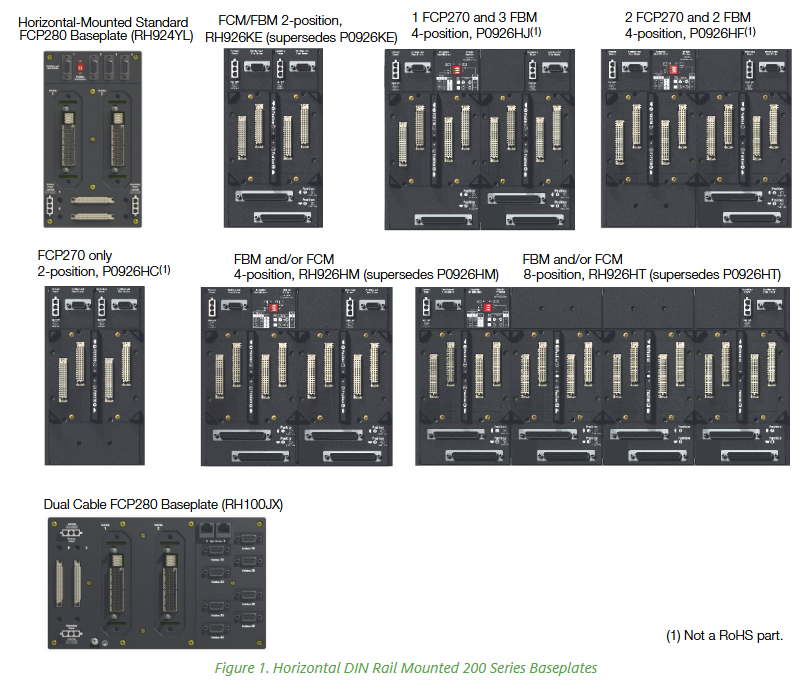
According to the number of slots (2/4/8), installation direction (horizontal/vertical), and supported module types, Standard 200 series substrates can be divided into multiple categories. The core functions and adaptation scenarios of each category are shown in the table below:

Substrate type, slot number, installation direction, support module/core function, typical model/substitution relationship, adaptation scenario

FCP280 dedicated substrate 2 horizontal/vertical – single module or redundant for FCP280;

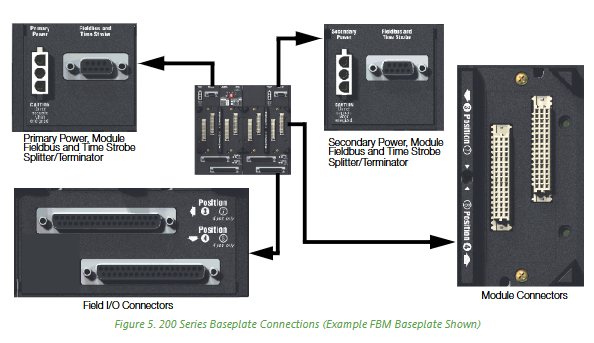
-Supports 4 HDLC fieldbus ports (port 1 can be terminated through DIP switch, ports 2-4 have built-in termination);

-Optional dual cable version (independent A/B bus interface+time synchronization input) RH924YL (standard), RH100JX (dual cable);

Replacing the old CP60 related substrate requires high reliability control for medium to large-scale systems (such as chemical and electrical)

FDC280 dedicated substrate 2 vertical (horizontal orientation needs to be maintained) – single module or redundant pair FDC280;

-Support Ethernet/serial interface (for connecting field devices);

-Horizontal DIN rail installation is required to meet the classification certification RH101KF (unique model) for scenarios where FBM is not needed to directly connect on-site equipment (such as small control units)

FCP270 dedicated substrate 2 horizontal/vertical – single module or redundant for FCP270;

-Reserve installation space for fiber optic splitters/combiners;

-Hardwired address (substrate 0, no ID dialing) P0926HC (horizontal), P0926HW (vertical);

Non RoHS component small and medium-sized system upgrade (replacing old controllers)

FEM100 dedicated substrate 2 vertical – redundant pair for FEM100;

-Expand the number of FBMs supported by FCP270 (up to 4 expansion fieldbuses, each supporting 32 200 Series FBMs) P0973CG (non RoHS), RH924RT (replaces old model) FCP270 system I/O expansion

FBI specific substrate 2 vertical – FBI200/FBI100 redundant pair;

-FBI200 substrate with baud rate selection DIP switch;

-No need for hard wired address (no ID dialing) P0923LR (FBI100, non RoHS), RH924RT (FBI200) fieldbus isolation/filtering (anti-interference requirement scenario)

FCM/FBM universal substrate 2/4/8 horizontal/vertical -2 bits: single module/redundant pair FCM, or 2 FBMs (hard wired address 0, no ID dip code);

-4/8 bits: 4/8 FBMs or 2 FCMs+2 FBMs (including ID dialing, supporting substrate grouping) 2 bits: RH926KE (horizontal), RH926KH (vertical);

4-digit: RH926HM (replacing P0926HM);

8-bit: RH926HT (replacing P0926HT) pure I/O expansion or FCM+FBM combination scenario

FCP270+FEM100 hybrid substrate 4 vertical -2 redundant FCP270+2 redundant FEM100;

-No ID dialing, relying on FCP270 expansion port management P0973CN (non RoHS) FCP270 system for large-scale I/O expansion (such as multi device clusters)

FCP270+FBM hybrid substrate 4 horizontal/vertical -2 redundant FCP270+2 FBM (including ID dialing);

-Or 1 FCP270+3 FBM (non redundant) P0926HJ (1 FCP270+3 FBM), P0926HF (2 FCP270+2 FBM);

Non RoHS component small system (control+I/O integration, no redundancy requirements)
Key technical characteristics

(1) Module identification and address configuration

The substrate implements the mapping between modules and system software through the * * “Letterbug” string * * (6 bits), and the Letterbug generation rules for different modules are different:

FBM (with FCM): composed of “FCM’s first 4 Letterbug+substrate ID (dial setting)+module physical position (1-8)”;

FBM (with FCP280/FCP270): composed of “custom first 4 digits (not duplicated with FCP)+substrate ID (non FCP280 substrate dialing)+module position+FCP expansion port number (hexadecimal for FEM100 scenario)”;

FCP280/FDC280: Set “Soft Letterbug” through the module panel buttons;

FCP270/FCM100E: Set “Soft Letterbug” through the I/A Series Letterbug configuration tool.

(2) Redundancy and scalability

Module redundancy rules:

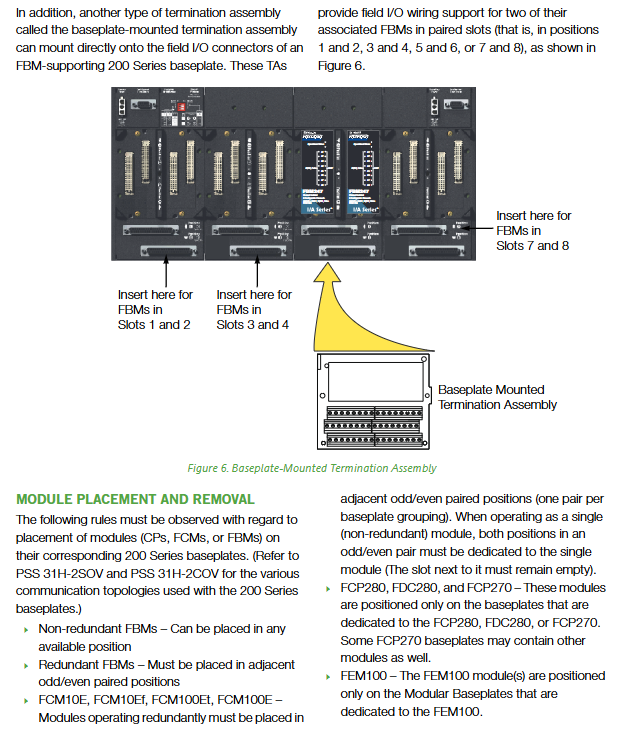
Redundant FBM/FCM should be installed in adjacent odd/even slot pairs (such as positions 1-2 and 3-4);

Non redundant FCM needs to occupy a pair of slots (adjacent slots are vacant);

FCP/FDC/FEM/FBI redundancy requires the use of a dedicated 2-digit substrate.

Online Expansion:

The system needs to have A/B redundant buses and split the bus signals through a “fieldbus splitter/terminator” (such as RH926KW);

When adding a new substrate, there is no need to interrupt the system operation, only the redundant cables need to be connected to the power supply.

(3) Signal and Communication Specifications

Specification category parameter details

Fieldbus type -200 Series module: 2 Mbps HDLC redundant serial bus (shielded twisted pair);

-100 Series module: 268 Kbps bus (dual axis cable)

Maximum communication distance -200 Series FBM (FBI200): 305 m (2 Mbps);

– 100 Series FBM(FBI200):1830 m(268 Kbps);

-FCP280 directly connected to 100 Series FBM: 915 meters

Time synchronization supports optional GPS time synchronization input (requires splitter/terminator, such as RH924ZQ(FCP280)、RH926KZ(FCM100E/FCP270))

The bus cable between signal isolation substrates is shielded twisted pair to reduce electromagnetic interference (EMI)
Detailed explanation of technical specifications

(1) Electrical and Environmental Specifications

Specification category parameter details

Power requirements – Input voltage: 24 V DC (redundant);

-Cable length: 0.4 m (16 inches) to 2.1 m (7 feet)

Environmental adaptability (working) – Temperature: -20~+60 ° C (-4~+140 ° F);

-Humidity: 5% to 95% (without condensation);

-Altitude: -300 to+3000 meters;

-Pollution level: G3 level (harsh environment, compliant with ISA S71.04)

Environmental adaptability (storage) – Temperature: -40~+70 ° C (-40~+158 ° F);

-Altitude: -300 to+12000 meters

Compliance Certification – EMC: Compliant with EN61326:2013 Class A emission/industrial immunity (EU Directive 2014/30/EU);

-Safety: UL/UL-C Class I Div 2 (Groups A-D, T4)、ATEX Ex nA IIC T4 Gc;

-Classification: ABS/French BV certification (EC31, except for some models);

-Environmental Protection: Compliant with RoHS 2011/65/EU (non RoHS model labeling)

(2) Physical and installation specifications

Specification category parameter details

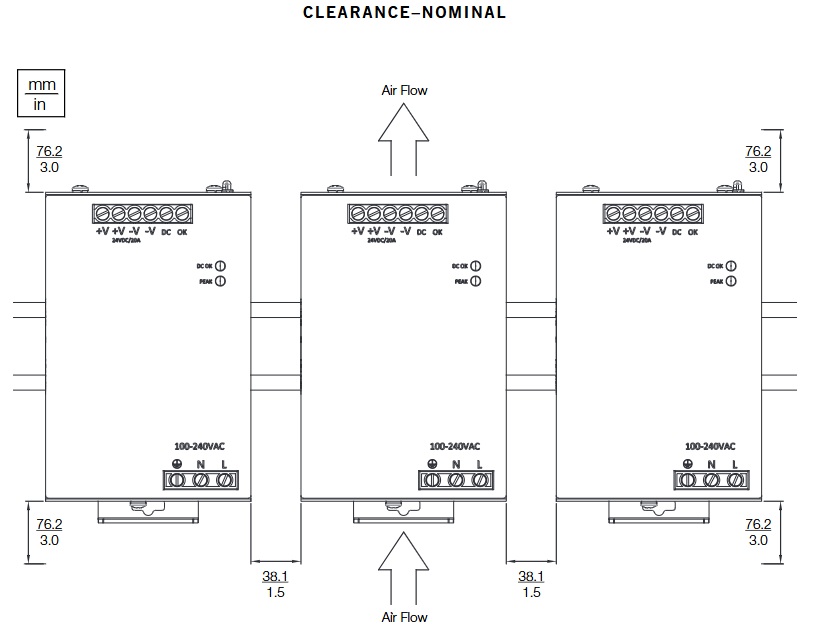
Installation method – DIN rail: compatible with horizontal/vertical installation (keeping the substrate in a horizontal position);

-Cabinet installation: 19 inch rack (requires P0930AS installation kit, depth 25.4mm)

Weight (excluding modules) -2-position substrate: approximately 0.5 kg (1.1 lb);

-8-bit substrate: maximum 0.91 kg (2.0 lb)

Key dimensions (example) -2-digit vertical substrate: height 120.3 mm, width 240.0 mm;

-8-bit horizontal substrate: length 453.0 mm, height 216.0 mm (including optional terminal components)

Materials and Protection – Shell: PC+ABS (UL94 V0 flame retardant);

-Rail fasteners: made of steel (quantity varies with substrate size);

-Color: Black

Key points for installation and maintenance

(1) Module installation rules

Redundant module layout:

Redundant FBM/FCM needs to occupy adjacent odd/even slot pairs (such as 1-2, 3-4 bits);

FCP/FDC/FEM/FBI redundancy requires the use of a dedicated 2-position substrate and cannot be mixed with other modules.

Non redundant module limitation:

Non redundant FCM needs to occupy a pair of slots (adjacent slots are vacant);

FBM can be installed in any vacant slot (matching substrate support type).

(2) Key accessories and connections

Accessory type, function, typical model

Fieldbus splitter/terminator – Termination bus signal: RH916RB (replacing P0916RB);

-Split A/B bus+time synchronization: RH926KW (non FCP280), RH924ZJ (FCP280 port 1);

-Connect 100 Series FBM: RH926LC (replacing P0926LC) RH916RB, RH926KW, RH928CV (FCP280 extension)

Connect the power cable between the FPS series power supply (such as FPS480-24) and the substrate:

– RH100DZ(0.6 m)、RH100EA(1.0 m) RH100DZ、RH100EA、RH100EB(2.1 m)

Substrate installation kit 19 inch rack installation: including bracket and fasteners P0930AS

(3) Maintain convenience

Hot swappable support: FCP, FEM, FCM, FBI, FBM can all be plugged and unplugged online without disconnecting field cables, power supplies, or communication buses;

Fault diagnosis: Clearly labeled connector functions (power/fieldbus/I/O) on the substrate, combined with module LED indicator lights (such as power and communication status), can quickly locate faults;

Online expansion: Under the redundant bus architecture, when adding FBM support substrates, only A/B bus splitters need to be connected without shutting down.

Related reference documents and support

Document type Document number/name Core purpose

Subsystem Overview PSS 31H-2SOV (Standard 200 Series), PSS 31H-2COV (Compact 200 Series) System Architecture and Substrate Matching Rules

Module specifications PSS 31H-1FCP280 (FCP280), PSS 31H-2FDC280 (FDC280) module and substrate adaptation details

User Guide B0400FA (Standard and Compact 200 Series Subsystem User’s Guide) Installation, Wiring, and Troubleshooting Steps

Substrate configuration for hazardous area applications of PSS 31H-2Y12 (ISTA-BP Intrinsic Safety Terminal Substrate) related to intrinsic safety

Foxboro I/A Series Compact 200 16 Slot Horizontal Substrate

Core positioning and subsystem roles

The Compact 200 16 slot horizontal substrate is the “hardware backbone” of the Foxboro I/A Series Compact 200 I/O subsystem, with core functions including:

Module support: Provides 16 standard slots for installing Compact 200 series I/O modules (such as analog input/output modules, digital modules, HART communication modules, etc., as previously summarized for FBM218 module);

Signal and power distribution: The internal bus is used to achieve signal interaction between the substrate and various I/O modules, power supply, and communication connection between the modules and the higher-level controller;

Redundancy support: compatible with module level redundancy configurations (such as dual module redundancy), providing hardware foundation for high reliability of I/O subsystems;

Environmental adaptation: Adapt to harsh industrial environments such as dust, vibration, and wide temperature ranges to ensure stable operation of the I/O subsystem.

Structural design and installation characteristics

(1) Physical Structure and Dimensions

Exterior design: Adopting a horizontal layout, the overall structure is made of metal material frame (balancing strength and electromagnetic shielding), with slot markings (1-16) on the surface for easy module positioning and installation;

Key dimensions (refer to Compact 200 series standards):

Length: Approximately 483mm (19 inches, compatible with standard 19 inch cabinet installation);

Height: Approximately 130mm (5.12 inches);

Depth: Approximately 150mm (5.9 inches, including protruding connector);

Weight: Approximately 1.8kg (excluding modules), lightweight design facilitates cabinet assembly.

(2) Installation method and compatibility

Cabinet installation:

Support installation of 19 inch standard industrial cabinets, requiring a dedicated installation bracket (optional accessory), with a reserved installation depth of ≥ 200mm (including module insertion and removal space);

Compatible with “horizontal installation” (default), the installation angle can be adjusted through the adapter (please refer to the system installation guide);

DIN rail installation:

Supports installation with 35mm standard DIN rail (EN 60715 specification), which needs to be fixed with rail buckles, suitable for on-site scenarios without 19 inch cabinets (such as small control cabinets);

Module installation requirements:

Slot compatibility: All 16 slots support all I/O modules of the Compact 200 series, with no signal type restrictions (analog, digital, and communication modules can be mixed for installation);

Redundant module layout: If configuring redundant I/O modules (such as dual FBM218), they need to be installed in adjacent slots (such as slots 3 and 4, 5 and 6), and the first redundant module needs to be located in an odd numbered slot to ensure normal redundant communication and power switching functions.

Core functions and technical features

(1) Power distribution and redundancy support

Power input and distribution:

Supports dual 24V DC redundant power input (requires external redundant power module), with an allowable voltage fluctuation range of+5%/-10% (i.e. 21.6V DC -25.2V DC);

Internally integrated power distribution circuit, stably distributing redundant power to 16 slot I/O modules, with a maximum power supply current of ≥ 1A per module (meeting the power consumption requirements of most Compact 200 modules);

Power protection: Built in overcurrent protection (does not affect the power supply of other modules in case of single channel overcurrent), reverse connection protection (prevents the positive and negative poles of the power supply from reversing and damaging the substrate);

Redundant switching capability:

When the main power supply fails, the backup power supply can seamlessly switch within ≤ 10ms, ensuring that the I/O module has no power interruption and guaranteeing continuous acquisition/output of process signals;

Supporting “module level redundancy” power supply collaboration, redundant modules share the substrate power bus to avoid redundancy failure caused by single power supply failure.

(2) Signal bus and communication connection

Internal signal bus:

Integrate the “control signal bus” and “status monitoring bus”: The control signal bus is used to transmit real-time data (such as 4-20mA analog and digital switch values) between the I/O module and the higher-level controller; The status monitoring bus is used to upload diagnostic information such as module faults and power status;

Bus speed: Control signal transmission rate ≥ 1Mbps, meeting the real-time requirements of industrial processes (delay ≤ 10ms);

Isolation design: Galvanic isolation (isolation voltage ≥ 500V AC/1 minute) is implemented between the signal bus and the power bus to prevent power interference from affecting signal transmission;

External communication interface:

A dedicated “controller connection port” (usually a multi pin industrial connector) is installed on the back of the substrate, which is connected to Foxboro I/A Series controllers (such as Evo controllers) through dedicated cables to achieve overall linkage between subsystems and control systems;

Support redundant communication links (with the cooperation of the controller). When the main communication link fails, the backup link will automatically switch to ensure that data is not lost.

(3) Fault diagnosis and maintenance convenience

Status indication:

The front of the substrate is equipped with LED indicator lights, including a “power status light” (main/backup power, green constant light indicates normal, red flashing indicates fault), a “bus status light” (yellow constant light indicates normal, off indicates bus interruption), and a “module fault summary light” (red light indicates any slot module fault), which facilitate quick judgment of the system status;

Module hot plug support:

All 16 slots support “hot swappable” (the module itself needs to have a hot swappable design). When replacing the I/O module, there is no need to disconnect the power supply or communication cable of the substrate. Simply unlock the module buckle to plug and unplug, reducing maintenance downtime;

Fault isolation:

A single slot is equipped with an independent fault isolation circuit. When a certain I/O module fails, the substrate automatically cuts off the abnormal signal between the slot and the bus to prevent the fault from spreading to other modules or higher-level controllers.

(4) Environmental protection and durability

Anti pollution capability: meets the G3 level (harsh) environmental requirements of ISA standard S71.04, can withstand industrial dust, oil and gas, corrosive gases (such as hydrogen sulfide), and the substrate surface is coated with anti-corrosion coating (such as epoxy resin) to extend its service life;

Resistance to vibration and impact:

Vibration protection: Within the frequency range of 5-500Hz, it can withstand a sine vibration of 7.5m/S ² (0.75g), meeting the installation requirements near vibration sources such as pumps and compressors;

Impact protection: capable of withstanding a 15g (half sine wave, duration of 11ms) impact, suitable for the impact environment of industrial equipment transportation and on-site installation;

Temperature adaptability: Operating temperature range -20 ° C to+60 ° C, storage temperature range -40 ° C to+85 ° C, suitable for most industrial scenarios (such as chemical workshops, outdoor control cabinets).

Detailed explanation of technical specifications

(1) Electrical specifications

Specification category parameter details

Power input voltage: 24V DC (redundant dual input); Voltage fluctuation range:+5%/-10%; Maximum input current: 10A (total power consumption varies with the number of modules)

Maximum output current of a single slot for power distribution: 1A; power bus voltage drop: ≤ 0.5V (at full load)

Signal bus type: differential signal bus; Transmission rate: ≥ 1Mbps; Signal delay: ≤ 10ms

Isolation performance power signal isolation: 500V AC/1 minute; Slot isolation: 600V AC/1 minute

Overcurrent protection single slot overcurrent protection threshold: 1.5A (self resetting, automatically restoring power supply after troubleshooting)

(2) Mechanical and Environmental Specifications

Specification category parameter details

Dimensions and Length: 483mm (19 inches); Height: 130mm; Depth: 150mm; Weight: Approximately 1.8kg (excluding modules)

Installation method: 19 inch cabinet installation (requires bracket), 35mm DIN rail installation (EN 60715)

Working temperature -20 ° C to+60 ° C (non condensing)

Storage temperature -40 ° C to+85 ° C (non condensing)

Working humidity 5% -95% RH (non condensing, temperature ≤ 40 ° C)

Anti vibration of 5-500Hz, 7.5m/S ² (0.75g), in compliance with IEC 60068-2-6 standard

15g shock resistance (half sine wave, 11ms), in compliance with IEC 60068-2-27 standard

(3) Compliance certification

Electromagnetic compatibility (EMC): complies with the EU EMC Directive (2014/30/EU), meets the Class A emission requirements (industrial environment electromagnetic radiation control) and industrial immunity level (anti-static discharge, radio frequency interference, electrical fast transient pulse group) of EN 61326-1:2013 standard;

Security certification:

UL/UL-C certification: suitable for hazardous environments with Class I A-D groups, Zone 2, T4 temperature codes (requires Foxboro I/A Series certified controllers and modules);

ATEX certification: Ex nA IIC T4 Ga, suitable for Zone 2 hazardous environments (such as chemical explosion risk areas);

IECEx certification: compliant with IEC 60079-15 standard, supporting global hazardous area applications;

Environmental compliance: Compliant with the EU RoHS Directive (2011/65/EU), restricting the use of harmful substances such as lead, mercury, cadmium, etc;

Marine certification: Some models have been certified by American Bureau of Shipping (ABS) and Bureau Veritas, meeting the environmental and safety requirements of marine environments such as ship power systems and offshore oil platforms.

image.png

Supporting components and reference documents

(1) Key supporting components

Component type, model/specification, core function

The redundant power module is compatible with the Compact 200 series (such as relevant RH models) to provide dual 24V DC redundant power input for the substrate, ensuring power reliability

Installation bracket 19 inch cabinet specific bracket is used for the fixed installation of substrates inside the 19 inch cabinet, ensuring installation stability

Controller connection cable dedicated multi-core industrial cable connection substrate and Foxboro I/A Series controller to achieve data and control signal transmission

Terminal components (TA) such as RH926SP (previously compatible with FBM218) are connected to the I/O modules on the substrate through cables, providing wiring interfaces for field devices

(2) Reference Documents

Document Number/Reference Number Document Name Core Content

31H2C480B4 Compact 200 Series 16 Slot Horizontal Substrate Product Specification Table Detailed Technical Parameters, Installation Dimensions, Electrical Characteristics, Certification Information of Substrate

Overview of PSS 31H-2COV Compact 200 Series I/O Subsystem: Overall Architecture of Subsystem, Matching Rules of Substrate and Module, Redundancy Configuration Scheme

B0400FA standard and Compact 200 series subsystem user guide: substrate installation steps, module insertion and removal operations, fault diagnosis process, daily maintenance precautions

PSS 31H-2C218 FBM218 module product specification sheet (previously summarized document) Detailed specifications of the substrate compatibility module to assist in confirming the compatibility between the module and the substrate

Differences from other Compact 200 substrates (supplementary explanation)

The Compact 200 series substrate includes multiple specifications (such as slot number and installation method), and the core differences between the 16 slot horizontal substrate (related to 31H2C480B4) and other models are as follows:

Comparison dimension: 16 slot horizontal substrate (in this document), 8 slot horizontal substrate (in the same series), vertical substrate (in the same series)

16 slots (supporting more modules, suitable for large I/O subsystems) 8 slots (suitable for small and medium-sized subsystems, saving space) 12 slots (vertical layout, suitable for narrow cabinet scenarios)

Installation method: 19 inch cabinet+DIN rail 19 inch cabinet+DIN rail Only DIN rail (vertical installation, saving horizontal space)

Maximum module power consumption supports total power consumption ≤ 16A (calculated based on a single module 1A), supports total power consumption ≤ 8A, supports total power consumption ≤ 12A

Typical Application Scenarios: Centralized I/O Stations in Large Chemical and Power Systems, Distributed I/O Stations in Small and Medium sized Production Lines, and Space Constrained Sites (such as Outdoor Small Control Cabinets)

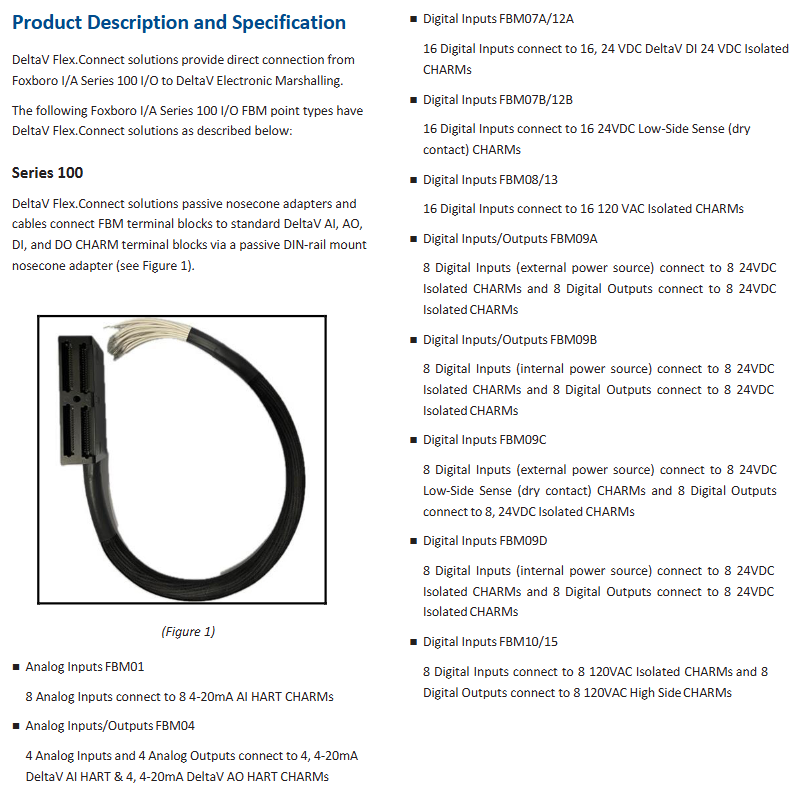
DeltaV ™  Flex Connect Solutions for Foxboro ™  I/A Series 100 I/O

Core positioning and value

The FlexConnect solution is a modular and scalable connection solution for Foxboro I/A Series 100 I/O systems. Its core value lies in breaking the limitations of traditional I/O systems’ fixed cabinet installation. Through remote/distributed connection capabilities, flexible topology configuration, and high reliability design, it adapts to the complex installation environment and diverse equipment access requirements of industrial sites (such as chemical, petroleum, power, etc.), simplifies wiring, reduces installation costs, and improves the overall maintainability and fault resistance of the system.

System architecture and core components

The FlexConnect solution adopts a layered architecture of “main controller remote I/O unit field device”, with core components including remote I/O modules, communication links, terminal components, and supporting accessories. The functions and collaborative relationships of each part are as follows:

(1) Core components and functions

Component type, key model/specification, core function

The remote I/O module supports Foxboro I/A Series 100 I/O signal types (such as analog input/output, digital input/output, HART communication, etc.) 1. Local acquisition/output of field device signals (such as 4-20mA, discrete signals);

2. Implement signal isolation and anti-interference processing;

3. Bidirectional transmission of data with the main controller through a communication link.

The communication link supports redundant/non redundant Ethernet and dedicated industrial bus to ensure high-speed and stable data transmission between the main controller and remote I/O modules;

2. Redundant link design avoids communication interruptions caused by single point failures.

Terminal Assembly (TA) is a specialized terminal module that adapts to different signal types. 1. It provides physical wiring interfaces between field devices and remote I/O modules;

2. Support cable fixation and anti loosening design, suitable for different wire diameters (such as 0.2-4mm ² wires).

Power module 24V DC redundant power supply 1. Provides stable power supply for remote I/O modules and terminal components;

2. Redundant design ensures seamless switching in case of power interruption, ensuring the continuous operation of the module.

The protective casing meets the IP rating (such as IP65/IP67). 1. It protects remote I/O modules and terminal components from on-site dust, water vapor, and corrosive gases;

2. Suitable for installation in outdoor or harsh industrial environments.

(2) Topology configuration flexibility

Distributed deployment: Remote I/O units can be installed near field devices (such as equipment side or field cabinets), significantly reducing the length of cables from field devices to I/O modules (traditional solutions require cables to be pulled to the central cabinet, while FlexConnect can reduce wiring by more than 50%).

Multiple topology support: Supports various communication topologies such as star, bus, and ring, and can be flexibly selected according to the distribution density and distance of on-site devices (such as ring topology is suitable for long-distance and multi node scenarios, improving communication redundancy).

Mixed signal access: A single remote I/O unit can simultaneously access multiple types of signals such as analog, digital, and HART, without the need for separate cabinets for different signals, simplifying the system architecture.

Core functions and technical features

(1) High reliability and fault redundancy

Communication redundancy: Supports dual Ethernet links or redundant industrial buses. In the event of a main link failure, the backup link can automatically switch within milliseconds (<100ms) without data loss, ensuring process control continuity.

Power redundancy: The remote I/O unit adopts dual 24V DC power input. When a single power supply fails, the other power supply seamlessly takes over to avoid signal interruption caused by module power failure.

Module level isolation:

Galvanic isolation is implemented between each I/O channel and between channels and module logic circuits (with an isolation voltage of up to 600V AC/1 minute) to prevent module damage caused by on-site signal interference or grounding loops.

The analog channel supports independent current limitation (such as a maximum of 25mA) to avoid the impact of load short circuits on the module.

Fault diagnosis and alarm:

The module has built-in real-time diagnostic function, which can monitor channel faults, communication abnormalities, power supply voltage fluctuations and other issues, and upload alarm information to the main controller through the communication link.

Support local LED indicator light alarms (such as normal power supply, communication status, channel failure), making it easy for on-site maintenance personnel to quickly locate problems.

(2) HART communication compatibility and support for smart devices

HART protocol integration: All analog I/O modules support the HART protocol (compatible with HART 5/6/7 versions) and can overlay digital communication on 4-20mA analog signals to achieve:

Remote reading of diagnostic information, range settings, and calibration data from smart devices such as HART transmitters;

Remote configuration and calibration of on-site HART devices through the main controller, without the need for on-site operation.

HART data processing: Supports HART universal instructions, conventional operation instructions, and device specific instructions. The main controller can receive multiple digital messages from each HART device per second, meeting real-time monitoring and control requirements.

(3) Installation and maintenance convenience

Modular design:

The remote I/O module and terminal components adopt a modular structure and support “hot plugging” (some models). When replacing the module, there is no need to disconnect the on-site wiring or interrupt the system operation, reducing maintenance downtime.

The module size is compact (such as height ≤ 150mm, width ≤ 30mm), and can be installed on DIN rails or small cabinets, suitable for on-site environments with limited space.

Simplified wiring:

Remote deployment reduces the long-distance wiring of on-site equipment to the central cabinet, lowering cable costs and construction difficulties;

The terminal component supports the “one in, multiple out” wiring method, which can simultaneously connect multiple on-site devices of the same type, simplifying the wiring logic.

Configuration tool support:

Compatible with Foxboro I/A Series system configuration software (such as FoxDraw, Control Builder), remote I/O module channel parameters (such as range, alarm threshold, fault safety action) can be configured remotely through the software without on-site debugging.

(4) Environmental adaptability

Protection level: When the remote I/O unit is paired with a dedicated protective casing, the protection level can reach IP65/IP67, and it can be directly installed outdoors or in dusty, humid, and corrosive environments (such as chemical workshops and refinery sites).

Temperature and humidity range:

Working temperature: -20 ° C to+60 ° C (some models support a wide temperature range of -40 ° C to+70 ° C);

Working humidity: 5% -95% (non condensing), suitable for high humidity industrial environments;

Anti vibration performance: Within the frequency range of 5-500Hz, it operates stably under a vibration intensity of 7.5m/S ² (0.75g), meeting the requirements of industrial site vibration environment.

Detailed explanation of technical specifications

(1) Electrical and Communication Specifications

Specification category parameter details

Power requirement input voltage: 24V DC (allowable fluctuation range:+5%/-10%);

Maximum power consumption: Single module ≤ 8W, redundant configuration ≤ 16W.

Communication rate Ethernet link: 10/100Mbps adaptive;

Industrial bus: Depending on the bus type, it can reach 1Mbps (such as Profibus DP).

Signal type supports analog input (AI): 4-20mA, 1-5V;

Analog output (AO): 4-20mA;

Digital input (DI): dry contact, 24V DC wet contact;

Digital Output (DO): Relay output, 24V DC transistor output.

HART performance baud rate: 1200bps (half duplex);

Support message types: general instructions, general operation instructions, device specific instructions;

Data verification: 32-bit CRC verification to ensure communication accuracy.

Isolation performance between channels: 600V AC/1 minute;

Channel and ground isolation: 600V AC/1 minute;

Power and logic isolation: 500V AC/1 minute.

(2) Environmental and mechanical specifications

Specification category parameter details

Working temperature standard type: -20 ° C to+60 ° C;

Wide temperature range: -40 ° C to+70 ° C.

Storage temperature -40 ° C to+85 ° C (non condensing).

Working humidity 5% -95% RH (without condensation, temperature ≤ 40 ° C).

Protection level module bare machine: IP20 (to be installed in the cabinet);

Equipped with protective casing: IP65/IP67 (can be installed outdoors).

Installation method: DIN rail installation (compatible with 35mm standard rail);

Fixed installation of cabinet screws.

Module size (example) height: 130mm (5.12 inches);

Width: 25mm (0.98 inches);

Depth: 150mm (5.9 inches);

Weight: Approximately 200g (7.05 ounces).

(3) Compliance certification

Electromagnetic compatibility (EMC): Complies with the EU EMC Directive (2014/30/EU), meets the Class A emission requirements and industrial immunity levels (anti-static, radio frequency interference, electrical fast transient pulse group, etc.) of EN 61326-1:2013 standard.

Security certification:

UL/UL-C certification: suitable for hazardous environments with Class I A-D groups, Zone 2, T4 temperature codes (with designated Foxboro I/A Series controllers);

ATEX certification: Ex nA IIC T4 Ga, suitable for Zone 2 hazardous environments;

IECEx certification: Compliant with IEC 60079-15 standard, suitable for global hazardous area applications.

Environmental compliance: Compliant with the EU RoHS Directive (2011/65/EU), restricting the use of harmful substances such as lead, mercury, cadmium, etc;

Marine certification: Some models have been certified by American Bureau of Shipping (ABS) and Bureau Veritas, and are suitable for marine environments such as ship power systems and offshore platforms.

Application scenarios and supporting documents

(1) Typical application scenarios

The FlexConnect solution is mainly suitable for industrial process automation scenarios of Foxboro I/A Series 100 I/O systems, especially for the following needs:

In scenarios where on-site equipment is dispersed, such as large chemical parks and refineries, where equipment is distributed over a wide area, remote I/O deployment can reduce long-distance wiring costs;

Adverse environmental scenarios: such as outdoor storage tank areas, high temperature/high humidity workshops, modules with IP65/IP67 protective enclosures can be directly installed without the need for additional protective cabinets;

High reliability requirements scenarios: such as power systems, oil platforms, redundant communication and power supply design to ensure uninterrupted process control;

Intelligent device intensive scenarios: such as process industries equipped with a large number of HART transmitters, the solution can efficiently integrate HART digital communication to achieve remote management of intelligent devices.

(2) Key reference documents

Document Number Document Name Core Content

PSS EN 67866 FlexConnect Solutions Product Data Sheet Overview, Core Component Specifications, Technical Parameters, Certification Information;

Foxboro I/A Series 100 I/O User Guide Foxboro I/A Series 100 I/O User Guide 100 I/O System Basic Operations, Module Configuration Methods, Fault Diagnosis Process;

FlexConnect Installation Manual: Installation steps, wiring specifications, and debugging guidelines for remote I/O modules, terminal components, and protective enclosures;

HART Communication Guide for Foxboro I/A Series Foxboro I/A Series HART Communication Guide: Steps for HART Device Access Configuration, Data Reading, and Remote Calibration Operations.

Core differences from traditional I/O solutions

Comparison Dimension FlexConnect Solution Traditional Foxboro I/A Series 100 I/O Solution

Deployment method: remote/distributed deployment, centralized deployment near on-site equipment, all cables need to be pulled to the central cabinet

Reduce wiring costs by more than 50%, reduce cable and construction costs for long-distance wiring, which is costly and complex to construct

The maintenance efficiency module supports hot plugging, local LED alarms, and quick fault location. It requires opening the central cabinet for maintenance, and fault diagnosis relies on controller data

Environmental adaptability supports IP65/IP67 protection and is suitable for harsh/outdoor environments. It relies on central cabinet protection and cannot be directly exposed to harsh environments

Redundancy capability: Communication and power dual redundancy, with millisecond level fault switching. Only some core modules support redundancy, and communication redundancy requires additional configuration

Foxboro Evo ™  FBM218 module

Core functions and features

(1) Output channel and signal support

Channel configuration: It has 8 isolated output channels, and each channel can flexibly choose two output modes: one is a standard 4-20mA analog output signal, and the other is to superimpose a digital HART frequency shift keying (FSK) signal on the 4-20mA analog output signal, which can be compatible with both standard 4-20mA devices and HART devices.

Communication capability: Each output channel is equipped with a dedicated FSK modem, which can achieve bidirectional digital communication with HART field devices, support HART universal commands, and ensure the connection between field devices and Foxboro Evo ™ Stable integration of the system; The system can receive 2 digital messages per second from each field device, and also supports HART universal, regular operation, and device specific instructions (excluding burst communication mode), which need to be implemented through an intelligent field device configurator (IFDC).

(2) Redundancy Design and Reliability

Module redundancy: Adopting module to module redundancy design, redundancy is achieved at the fieldbus module (FBM) level, requiring the use of redundant adapters (RH101AY). In the redundant configuration, one module serves as the “Master” and the other as the “Tracker”, sharing a common terminal component (TA), greatly improving subsystem availability.

Fault response: if a module fault is detected, the output of the fault module will immediately drop to 0mA, and the corresponding channel of the normal module will be automatically connected to provide the correct current for the output current circuit to avoid on-site signal interruption; Supports multiple output safety configurable options, including fail safe actions (hold/fallback), analog output fail safe fallback data (set by channel, requiring 0mA output), fieldbus fail safe enable and delay time, and 0mA output setting can also reduce the risk of “high fault current”.

Maintenance convenience: when replacing any module, it is not necessary to disconnect the field equipment terminal wiring, power supply or communication cable, nor will it affect the field signal of another module; The module is installed on the Compact 200 series substrate and only requires two screws for fixation, making disassembly and replacement operations easy.

(3) Electrical protection and isolation

Isolation performance: Galvanic isolation (including photoelectric isolation and transformer isolation) is achieved between all output channels, channels and ground, and channels and module logic, and can withstand 600V AC voltage (1 minute) without damage (note: not designed for long-term connection to this voltage level).

Power and load protection: Each channel is equipped with an independent isolated power supply, with an output current design limit of about 25mA. Even if the output field-effect transistor is short circuited, the maximum current is only 100mA. During normal operation, the module outputs a constant current to a load of 0-750 Ω to ensure equipment safety.

Design and Installation

(1) Compact and durable design

Appearance and Material: The module width is narrower than the standard 200 series FBM, and it adopts a sturdy acrylonitrile butadiene styrene (ABS) material shell to effectively protect the internal circuit; Compatible with a dedicated casing that can meet the G3 level (harsh) environmental protection requirements defined in ISA standard S71.04.

Size and Weight: The module has a height of 130mm (5.12 inches), a width of 25mm (0.98 inches), a depth of 150mm (including substrate connectors, 5.9 inches), and a weight of approximately 185g (6.5 ounces). Its compact size makes it easy to install in limited space scenarios.

(2) Installation configuration

Module installation: It needs to be installed on a Compact 200 series 16 slot horizontal substrate, which can be installed on a horizontal DIN rail or a 19 inch rack through an installation kit; Redundant modules need to be installed adjacent to the substrate, and the first module should be located in an odd numbered slot (such as slot 3 and 4), connected to the same terminal component through a redundant adapter.

Terminal Assembly (TA): TA is installed on DIN rails and compatible with various DIN rail specifications such as 32mm (1.26 inches) and 35mm (1.38 inches); We offer two types of wiring: compression type and ring type. Compression type supports solid/multi strand wires of 0.2-4mm ² (24-12 AWG), while ring type supports connectors of # 6 specification (0.5-4mm ²/22-12 AWG); TA material is polyamide (PA), with weights of approximately 181g (compression type) and 249g (ring wiring type), respectively.

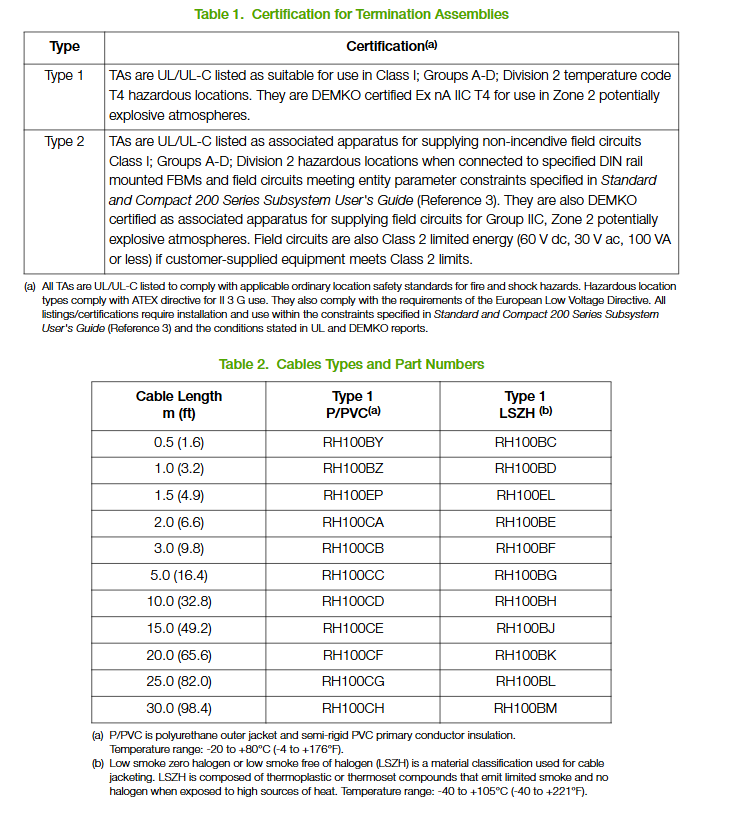
Cable requirements: Terminal cables support polyurethane or low smoke halogen-free (LSZH) materials, with a maximum length of 30m (98 feet); The module end is a 37 pin D-type miniature connector, and the TA end is a 25 pin D-type miniature connector. The specific model needs to refer to Table 2 (such as the 0.5m polyurethane cable model RH100BY).

Technical specifications

(1) Functional specifications

Category parameter details

HART device compatibility supports instruments that comply with HART version 5, 6, and 7 specifications

Communication method: point-to-point, master-slave, asynchronous, half duplex, baud rate of 1200

Error detection byte level check, message level 32-bit CRC check

Analog output accuracy within 4-20mA range, ± 0.05% span (including linear error)

Output change rate can reach 20mA within 60 milliseconds

Resolution 13 bits

The maximum transmission distance complies with the HART FSK physical layer specification HCF_SPEC-54 (revised 8.1), with a maximum distance of 3030m (10000 feet). If an intrinsic safety barrier is used, the distance will be shortened
The power supply requires redundant 24V DC input, with a permissible voltage fluctuation range of+5%/-10%; Maximum power consumption 8W, maximum heat dissipation 4W

Calibration requirement module and terminal components do not require calibration

(2) Environmental specifications

Environmental condition module parameters Terminal component (PA material) parameters

Working temperature -20 to+60 ° C (-4 to+140 ° F) -20 to+70 ° C (-4 to+158 ° F)

Working humidity 5% -95% (non condensing) 5% -95% (non condensing)

Working altitude -300 to+3000m (-1000 to+10000 feet) -300 to+3000m (-1000 to+10000 feet)

Storage temperature -40 to+85 ° C (-40 to+185 ° F) -40 to+85 ° C (-40 to+185 ° F)

Storage humidity 5% -95% (non condensing) 5% -95% (non condensing)

Storage altitude -300 to+12000m (-1000 to+40000 feet) -300 to+12000m (-1000 to+40000 feet)

The anti pollution level meets the G3 level (harsh) environmental requirements of ISA standard S71.04 (based on EIA standard 364-65 level III exposure test) and meets the G3 level (harsh) environmental requirements of ISA standard S71.04 (based on EIA standard 364-65 level III exposure test)

Anti vibration performance within the frequency range of 5-500Hz, 7.5m/S ² (0.75g) within the frequency range of 5-500Hz, 7.5m/S ² (0.75g)

(3) Compliance certification

Electromagnetic compatibility (EMC): compliant with the EU EMC Directive (2004/108/EC, before April 20, 2016); 2014/30/EU, After April 20, 2016, it meets the EN61326-1:2013 Class A emission and industrial immunity level.

Environmental compliance: Compliant with the EU RoHS Directive 2011/65/EU.

Safety certification: UL/UL-C certification, suitable for hazardous environments with Class I A-D groups, Zone 2, T4 temperature codes (requires connection to designated Foxboro Evo processor modules); The communication circuit complies with the Class 2 circuit requirements of Article 725 of the National Electrical Code (NFPA 70) in the United States and Article 16 of the Electrical Code (CSA C22.1) in Canada; Compliant with the EU Low Voltage Directive (2006/95/EC, before April 20, 2016); 2014/35/EU, After April 20, 2016, DEMKO certified Ex nA IIC T4 according to the Explosion proof Directive (ATEX) and applicable to Zone 2 hazardous environments.

**Marine Certification * *: Obtained type approval from the American Bureau of Shipping (ABS) and ship certification from the Bureau Veritas, meeting the environmental category EC31.

Related documents and component information

(1) Reference Documents

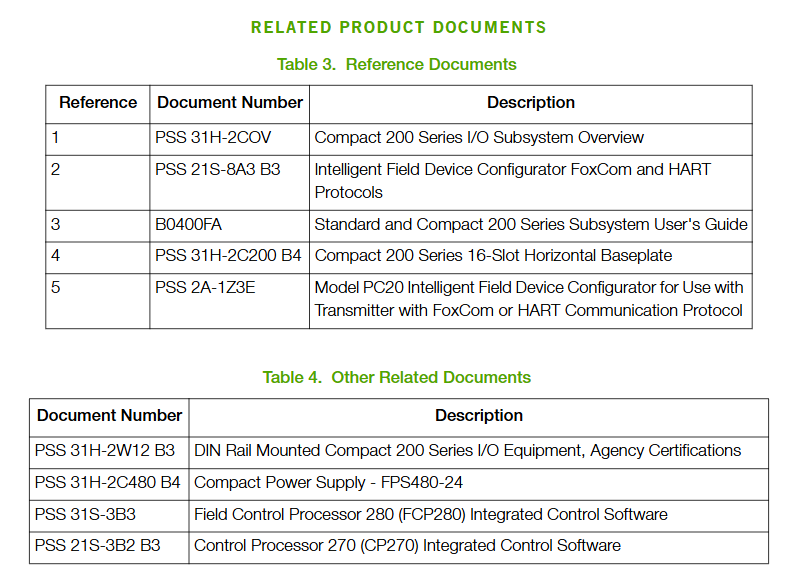
Reference Number Document Number Document Description

Overview of PSS 31H-2COV Compact 200 Series I/O Subsystem

PSS 21S-8A3 B3 Intelligent Field Device Configurator FoxCom and HART Protocol

B0400FA Standard and Compact 200 Series Subsystem User Guide

4 PSS 31H-2C200 B4 Compact 200 series 16 slot horizontal substrate

5 PSS 2A-1Z3E PC20 Intelligent Field Device Configurator (applicable to FoxCom or HART protocol transmitters)

(2) Key component model

FBM218 module: RH101AE

Redundant adapter: RH101AY

Terminal Component (TA): RH926SP (replacing old models P0926SP, P0917XV), certified as Type 1 (UL/UL-C Class I A-D Group 2 T4, DEMKO Ex nA IIC T4 Zone 2)

Terminal cables: divided into two materials: polyurethane (P/PVC, -20 to+80 ° C) and LSZH (-40 to+105 ° C), with different lengths corresponding to different models. For example, the 0.5m polyurethane cable is RH100BY, and the 0.5m LSZH cable is RH100BC (see document table 2 for the complete model list).

Yokogawa OpreX ™  STARDOM FCN-RTU Remote Terminal Unit

Product core positioning and applicable scenarios

1. Core functional positioning

FCN-RTU, as a remote monitoring unit of Yokogawa STARDOM series, integrates four core capabilities of “remote data acquisition, distributed control, multi protocol communication, and low-power operation and maintenance”, filling the gap of traditional RTUs in complex control and system compatibility. The specific functions cover:

Data acquisition: Supports analog (4-20mA, RTD/TC temperature), digital (24V DC switch signal), and pulse (flow counting, speed) acquisition, with a measurement accuracy of ± 0.1% FS, and supports channel level fault diagnosis (such as disconnection and short circuit detection);

Remote control: equipped with basic logic control (interlock protection, sequence control) and PID regulation functions, it can independently achieve localized control of remote stations (such as pump station pressure regulation, valve start stop), reducing dependence on the central system;

Narrow bandwidth adaptation: Supports narrow bandwidth communication such as GPRS/4G/LTE, satellite, microwave, etc. The data transmission adopts the “incremental upload+compression protocol” to reduce data consumption (such as compressing a single data upload to less than 1KB);

High reliability design: Key components (CPU, power supply, communication module) support redundant configuration, wide temperature range (-40~+70 ℃), anti-corrosion (G3 coating optional), anti vibration (5g/10-500Hz), suitable for unmanned harsh outdoor environments.

2. Typical Applicable Scenarios

Oil and gas industry: Station monitoring of long-distance oil and gas pipelines (such as oil pumps, valves, pressure transmitters), supporting interconnection with Yokogawa CENTUM VP DCS or SCADA systems to achieve leak detection and remote start stop;

In the field of new energy: monitoring of box transformers and combiner boxes in wind farms/photovoltaic power plants, uploading data on power generation, temperature, voltage, etc. through 4G/LTE, supporting on-site reactive power compensation control;

Water treatment and pipeline network: Pressure pump stations and flow meter monitoring for urban water supply pipelines, or remote aeration tank level regulation for sewage treatment plants, adapted to the low-power operation needs of remote sites;

Industrial distributed sites: cross plant equipment monitoring (such as tank farms in chemical plants and mineral processing equipment in mines), achieving centralized management of multiple sites through fiber optic or wireless bridging.

image.png

Key technical specifications and performance parameters

1. Hardware core specifications

Category core parameters (universal model, specific module slightly different)

CPU module model: F3CU01 (single CPU)/F3CU02 (redundant CPU); Processor: ARM Cortex-A9 dual core 1GHz; Memory: 1GB DDR3 RAM+4GB eMMC flash memory

Power module input: 12-48V DC (wide voltage adaptation, supports solar charging+battery backup); Output: 5V DC 3A (system power supply)+24V DC 2A (field device power supply), doubling the total output when configured redundantly

I/O module type analog input (AI): 4-20mA/1-5V (8-channel, isolated), RTD (platinum resistance, 8-channel), TC (thermocouple, 8-channel);

Analog output (AO): 4-20mA (4-channel, isolated);

Digital I/O (DI/DO): 24V DC 32 channel (DI)/16 channel (DO, relay output);

Pulse input: frequency 0-1kHz (4-channel, used for flow counting)

Expansion capability supports connecting remote I/O modules through RS-485 or dedicated expansion bus, with a maximum of 256 I/O points supported by a single RTU; Can cascade 8 expansion units, with a maximum transmission distance of 1km (twisted pair)/5km (fiber optic)

2. Communication and control performance

Communication interface:

Wireless communication: optional GPRS/4G/LTE modules (supporting dual card redundancy), satellite communication modules (such as Inmarsat BGAN);

Wired communication: 1 channel of 10/100Mbps Ethernet (supporting redundancy), 2 channels of RS-485 (Modbus RTU), 1 channel of RS-232 (debugging/local communication);

Protocol support: Modbus RTU/TCP, DNP3.0 (cascade/master), IEC 60870-5-101/104, MQTT (Internet of Things platform docking), supporting Yokogawa proprietary protocol (STARDOM Link).

Control performance: The control cycle is adjustable from 10ms-1s and supports 8 priority tasks; Built in PID control block (supporting automatic/manual switching, disturbance free switching), logic control block (such as AND/OR/NOT, delay), can achieve complex interlocking through programming.

3. Environmental and compliance characteristics

Environmental adaptability: working temperature -40~+70 ℃ (wide temperature), storage temperature -40~+85 ℃; Relative humidity of 5%~95% (non condensing, supporting condensing environment); Anti vibration level 5g (10-500Hz, IEC 60068-2-6), anti impact level 50g (1ms, IEC 60068-2-27);

Protection and certification: The enclosure protection level is IP40 (standard)/IP65 (outdoor type, optional), supporting G3 anti-corrosion coating (EN ISO 12944-5); Compliant with CE, UL 508, ATEX Zone 2 (Ex nA IIC T4), IECEx certification, suitable for hazardous areas and outdoor scenes.

System architecture and extension logic

1. Hardware architecture and redundancy design

FCN-RTU adopts a layered architecture of “main unit+expansion unit+remote I/O”, balancing flexibility and reliability:

Main unit: including CPU module, power module, basic I/O module and communication module, supporting DIN rail installation (size: 140 × 100 × 220mm, weight about 2.5kg), suitable for small control cabinets or outdoor cabinets;

Expansion Unit: Connected to the main unit via RS-485 or fiber optic cables, providing additional I/O interfaces (such as AI/AO/DI/DO modules). A single main unit can cascade up to 8 expansion units, suitable for centralized monitoring of multiple devices;

Redundant configuration: The CPU, power supply, and wireless communication module can be redundant with a redundancy switching time of less than 100ms. The communication link supports “wireless+wired” dual backup (such as 4G and fiber optic redundancy) to avoid disconnection caused by a single link failure.

2. Typical System Topology Example

plaintext

[Center SCADA/DCS] ←→ [Communication Network (4G/Satellite/Fiber Optic)] ←→ [FCN-RTU Main Unit (Redundant CPU+Power Supply)]

↓ (RS-485/fiber optic)

[Extension Unit 1 (AI/TC Module)] ←→ [Pipeline Pressure/Temperature Sensor]

[Expansion Unit 2 (DI/DO Module)] ← → [Pump Station Motor/Valve actuator]

[Expansion Unit 3 (Pulse Module)] ←→ [Flow Meter (Pulse Output)]

Engineering development and operation characteristics

1. Programming and configuration tools

FCN-RTU is equipped with Yokogawa STARDOM Engineering Tool kit, which complies with IEC 61131-3 standard and reduces the development threshold:

Control Designer: a control program development tool that supports FBD (Function Block Diagram), LD (Ladder Diagram), and ST (Structured Text) programming, and provides industry-specific function block libraries (such as oil and gas pipeline leak detection blocks and flow accumulation blocks);

System Configurator: a hardware configuration and communication parameter setting tool that visualizes the mapping of logical I/O and physical modules. It supports one click configuration of communication protocol parameters (such as DNP3.0) without the need to manually write drivers;

Offline Simulator: an offline simulation tool that can simulate on-site signals (such as pressure fluctuations and valve failures) on a PC, verify the correctness of control logic, and shorten on-site debugging time.

2. Operations and diagnostic capabilities

Low power operation and maintenance: supports “sleep wake” mode (such as sleep when there is no data, timed wake-up upload), and can achieve continuous 72 hour operation without sunlight in the scenario of solar+battery power supply;

Status monitoring and alarm: The main unit is equipped with an LCD display screen (128 × 64 pixels) and LED indicator lights, which display the real-time operating status (power, communication, I/O faults); Support local button operation (fixed value modification, log query), or export fault logs through USB interface;

Remote operation and maintenance: Remote diagnosis can be achieved through a web interface or Yokogawa PRM (Plant Resource Manager) system, supporting I/O channel calibration, firmware online upgrade, configuration file backup/recovery, and reducing on-site operation and maintenance frequency.

Key modules and selection information

1. Core module model and function

Module Type Model Example Core Functions

CPU module F3CU01 single CPU configuration, 1 Ethernet+2 RS-485, supports Modbus/DNP3 protocol

F3CU02 redundant CPU configuration, 2 Ethernet (redundant)+2 RS-485, suitable for high reliability scenarios

Power module F3PU01 12-48V DC input, single output (5V+24V), supports battery charging management

F3PU02 redundant power module, dual independent outputs, supports fault self detection

Analog input module F3AI08 8-channel 4-20mA input, channel isolation, accuracy ± 0.1% FS, supports HART protocol (optional)

F3AR08 8-channel RTD input (platinum resistance 100 Ω), supporting wire breakage detection and cold end compensation

Communication module F3CM4G 4G/LTE wireless module, dual card redundancy, supports global frequency bands (1.8/2.1GHz)

F3CMSAT satellite communication module, compatible with Inmarsat BGAN network, supports communication in remote areas without base stations

Expansion module F3EX01 expansion bus interface module, realizing RS-485/fiber optic connection between the main unit and the expansion unit

2. Key dimensions for selection

I/O requirements: Determine the number of AI/AO/DI/DO points based on the type of on-site equipment (sensors/actuators), and select the number of basic I/O modules and expansion units for the main unit;

Communication environment: Satellite communication module is selected for areas without base stations, 4G/LTE module is selected for areas with mobile signals (dual card redundancy priority), and fiber optic+wireless backup is optional for fixed stations;

Environmental conditions: Choose IP65 protection and G3 coating for outdoor or harsh environments, support wide temperature range (-40 ℃) for low-temperature scenarios, and select ATEX certified models for hazardous areas;

Reliability requirements: Key stations (such as oil and gas pipelines) are equipped with CPU, power, and communication redundancy, while non key stations (such as ordinary pump stations) can be configured separately to reduce costs.

Yokogawa STARDOM FCN-500 Autonomous Controller

Product core positioning and applicable scenarios

1. Core functional positioning

FCN-500 is a multifunctional autonomous controller launched by Yokogawa, integrating the four core capabilities of “control, measurement, communication, and diagnosis”. It aims to replace traditional PLCs and discrete control devices, and achieve centralized management of distributed processes. Its specific functions cover:

Process control: supports continuous control (PID regulation, ratio control), sequential control (logical interlocking, step control), and adapts to complex industrial processes (such as temperature control of chemical reaction vessels and pressure regulation of oil and gas pipelines);

Data acquisition and measurement: Real time acquisition of analog quantities (4-20mA, RTD/TC temperature signals), digital quantities (24V DC switch signals), and pulse quantities (frequency/pulse counting), with a measurement accuracy of ± 0.1% FS, meeting industrial grade metrology requirements;

Multi protocol communication: compatible with mainstream industrial buses such as FOUNDATION Fieldbus, HART, Modbus, PROFIBUS-DP, CANopen, etc., supporting interconnection with Yokogawa CENTUM VP DCS, ProSafe RS safety systems, and third-party SCADA (such as Schneider and Siemens systems);

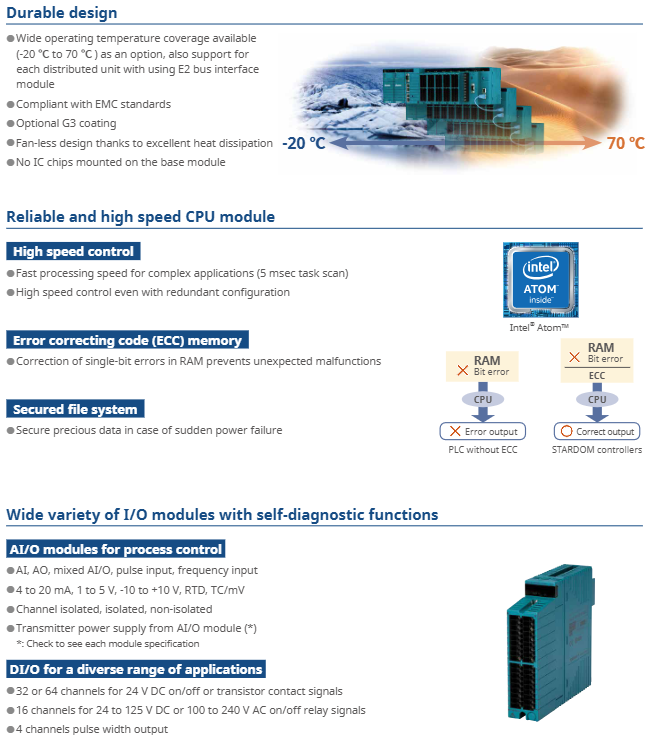
High reliability design: Key components (CPU, power supply, communication bus) support redundant configuration, module hot plugging, wide temperature environment adaptation (-20~+70 ℃ optional), meeting the uninterrupted operation requirements of industrial sites.

2. Typical Applicable Scenarios

Petrochemical industry: used for reactor and distillation tower control in refining equipment, supporting linkage with HART intelligent valve positioner and Fieldbus analyzer to achieve precise adjustment of process parameters;

Energy industry: Suitable for monitoring of combiner boxes in wind and photovoltaic power plants, or logical control of auxiliary equipment (such as feedwater pumps and fans) in thermal power plants, supporting narrow bandwidth communication such as GPRS/satellite;

Water treatment and environmental protection: As the control unit for aeration tanks and sedimentation tanks in sewage treatment plants, it integrates flow calculation (AGA standard), liquid level regulation functions, and supports data exchange with online water quality monitoring instruments;

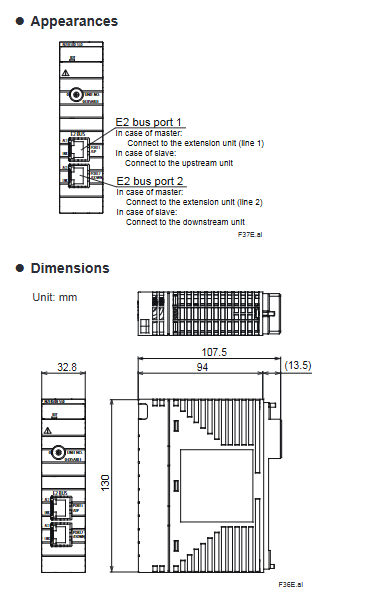
Distributed industrial scenario: suitable for cross regional pipeline network monitoring (such as natural gas long-distance pipelines), extending remote I/O through E2 bus to achieve centralized management of distributed units within 800 meters.

Key technical specifications and performance parameters

1. Hardware core specifications

Category core parameters (universal model, specific module slightly different)

CPU module model: NFCP501 (2-channel Ethernet)/NFCP502 (4-channel Ethernet); Processor: Atom E3815 1.46 GHz; Memory: 256 MB ECC RAM (error correcting)+1 GB flash memory

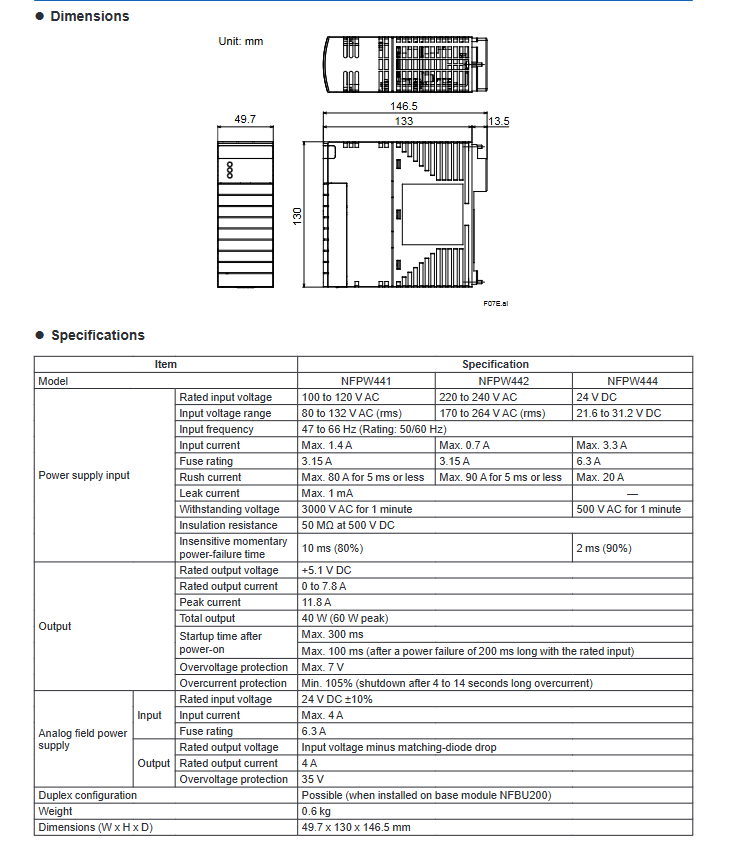
Power module input: 100-120V AC/220-240V AC/24V DC; Output: 5.1V DC 7.8A (system power supply)+24V DC 4A (field equipment power supply), supporting redundant configuration

I/O module type analog input (AI): 4-20mA, 1-5V, RTD (platinum resistance), TC (thermocouple), 8-16 channels, channel isolation/non isolation optional;

Analog output (AO): 4-20mA, -10~+10V, 4-16 channels;

Digital I/O (DI/DO): 24V DC 32-64 channels, relay output (24-125V DC/100-240V AC) 16 channels

Expansion capability supports E2 bus expansion of 8 remote I/O units, with a maximum transmission distance of 800 meters per line (fiber optic expansion can reach 5 kilometers); A single controller can support up to 79 I/O modules

2. Control and communication performance

Control cycle: minimum 5ms task scan, supports 16 priority tasks, meets fast response scenarios (such as motor start stop interlock);

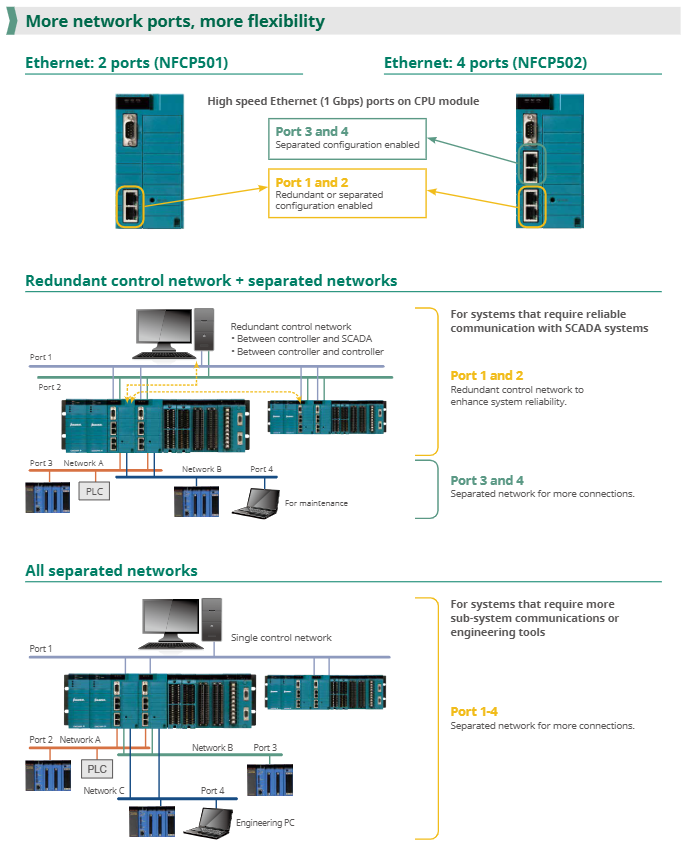
Communication interface: Standard configuration includes 2/4 1Gbps Ethernet (supporting redundant/independent network configuration), 1 RS-232/485 (Modbus RTU), and optional FOUNDATION Fieldbus/PROFIBUS-DP communication module;

Protocol support:

Upper computer: OPC DA 2.05a, DNP3, Modbus TCP;

Fieldbus: FOUNDATION Fieldbus (31.25 kbps), HART 7.0, PROFIBUS-DP (12Mbps);

Time synchronization: SNTP client/server ensures distributed unit time consistency.

3. Environmental and compliance characteristics

Environmental adaptability: Operating temperature range of 0-55 ℃ (standard)/-20~+70 ℃ (wide temperature range optional); Relative humidity ranging from 5% to 95% (without condensation); Anti vibration level 5g (10-500Hz, IEC 60068-2-6);

Protection and certification: The module shell has a protection level of IP20 (installed inside the cabinet) and supports G3 anti-corrosion coating (optional); Compliant with CE, UL 508, ATEX Zone 2 (some models) certification, suitable for hazardous areas.

System configuration and expansion logic

1. Hardware architecture and redundancy design

FCN-500 adopts a distributed architecture of “control unit+expansion unit”, with key components supporting redundant configuration to ensure high system availability:

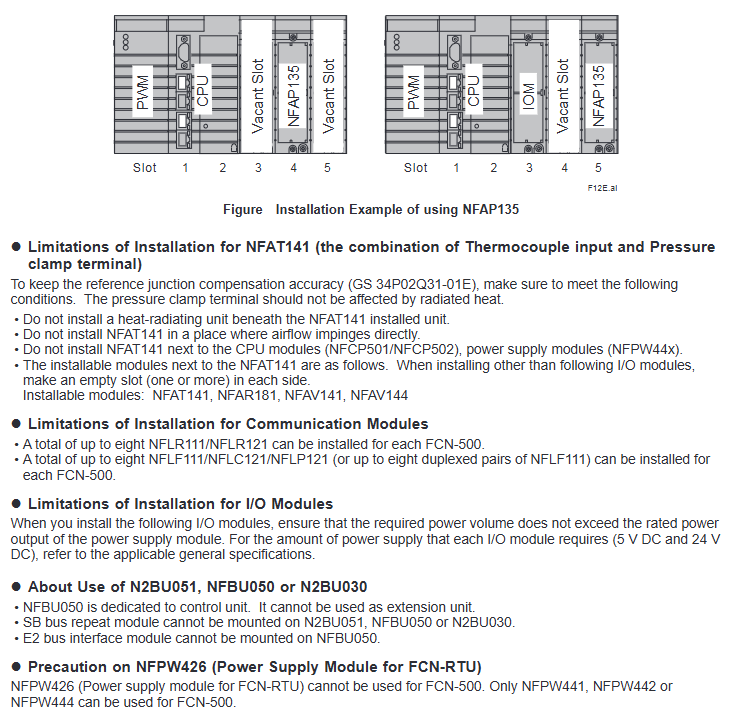
Control unit: including CPU module, power module, basic I/O module, supporting 19 inch rack installation or DIN rail installation, providing three types of bases: long (NFBU200, up to 8 modules), short (NFBU050, up to 3 modules), and compact (N2BU030, 1 module), suitable for different installation spaces;

Expansion unit: Connected to the control unit through the E2 bus, each control unit can expand up to 8 expansion units, supporting mixed base configuration (long+short) to achieve flexible expansion of I/O points;

Redundant configuration: CPU, power supply, E2 bus, and Ethernet can all be redundant, with a redundancy switching time of less than 100ms to ensure seamless switching in case of faults.

2. Typical System Topology Example

plaintext

[Upper System] ← Ethernet (Modbus TCP) → [FCN-500 Control Unit (Redundant CPU+Power Supply)]

↓ (E2 bus)

[Extension Unit 1 (AI/AO module)] ←→ [On site sensors/actuators]

[Expansion Unit 2 (DI/DO Module)] ←→ [Valve/Pump Control Circuit]

[Expansion Unit 3 (Fieldbus Module)] ←→ [HART/Fieldbus Smart Devices]

Engineering development and operation characteristics

1. Programming and configuration tools

FCN-500 comes with Yokogawa Engineering Tool Kit, supporting IEC 61131-3 standard programming language to reduce development difficulty:

Logic Designer: a control program development tool that supports five languages: FBD (Function Block Diagram), LD (Ladder Diagram), ST (Structured Text), SFC (Sequential Function Diagram), and IL (Instruction List). It provides drag and drop programming and template libraries (such as PID control blocks and flow calculation blocks);

Resource Configurator: a hardware configuration tool that maps logical I/O to physical modules, supports IP address and communication protocol parameter settings, and does not require manual driver writing;

Simulator function: Supports hardware free debugging, can simulate control logic and I/O signals on a PC, and shorten the on-site debugging cycle.

2. Operations and diagnostic capabilities

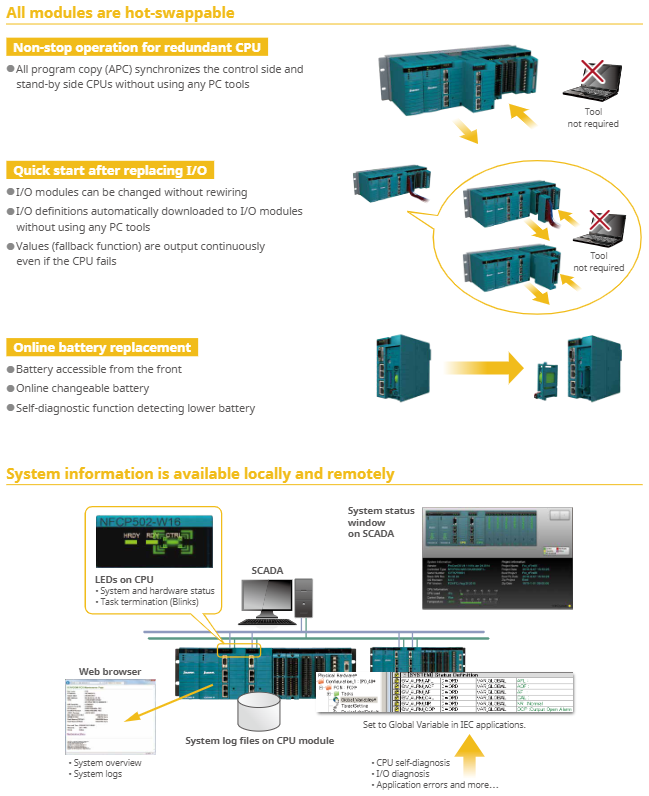
Module hot plugging: All I/O modules and power modules support online replacement, and the configuration is automatically loaded after replacement without the need for system shutdown;

Status monitoring: The CPU module comes with an LCD display screen and LED indicator lights, which display the system status (running/faulty) and I/O module health in real time; Support exporting logs (fault records, operation records) through SD card without the need to connect to a PC;

Remote operation and maintenance: Remote diagnosis can be achieved through Web HMI or Yokogawa PRM (Plant Resource Manager) system, supporting I/O channel fault location, module firmware online upgrade, and reducing on-site maintenance costs.

Key modules and selection information

1. Core module model and function

Module Type Model Example Core Functions

CPU module NFCP501 (2 Ethernet ports) with 2 Gigabit Ethernet channels, supporting Modbus/DNP3 protocols, with optional single/redundant configurations

NFCP502 (4 Ethernet ports) 4 Gigabit Ethernet channels, supporting independent network partitioning (such as control network+operation and maintenance network)

Power module NFPW441 (100-120V AC) system power supply (5.1V DC)+on-site power supply (24V DC), supports redundancy

NFPW444 (24V DC) DC input power supply, suitable for industrial 24V DC bus power supply scenarios

Analog input module NFAI135 (8 channels) 4-20mA input, channel isolation, accuracy ± 0.1% FS, supports HART protocol

NFAR181 (12 channel) RTD input (platinum resistance 100 Ω/1000 Ω), supports wire breakage detection

Digital output module NFDV551 (32 channels) 24V DC output, channel isolation, supports fail safe output (Fallback)

NFDR541 (16 channel) relay output (24-125V DC/100-240V AC), suitable for high-power loads (such as motor contactors)

Communication module NFLF111 (4-port) FOUNDATION Fieldbus communication, supporting 16 devices per port

NFLP121 (1 port) PROFIBUS-DP master station, supporting 123 slave devices

Expansion bus module N2EB100 E2 bus interface module, realizing the connection between control unit and expansion unit, supporting redundancy

2. Key dimensions for selection

Control scale: Select the base type (long/short/compact) and the number of expansion units based on the number of I/O points. A single system can support up to 79 I/O modules;

Environmental requirements: Standard temperature modules (0-55 ℃) are selected for conventional environments, wide temperature models (-20~+70 ℃) are selected for low/high temperature scenarios, and G3 coating is optional for corrosive environments;

Communication protocol: Select the communication module based on the type of on-site equipment (such as selecting NFAI135 AI module for HART devices and NFLF111 module for Fieldbus devices);

Reliability requirements: For critical scenarios (such as chemical reaction control), CPU, power supply, and E2 bus redundancy should be configured. For non critical scenarios (such as regular monitoring), menu configuration is available.

image.png

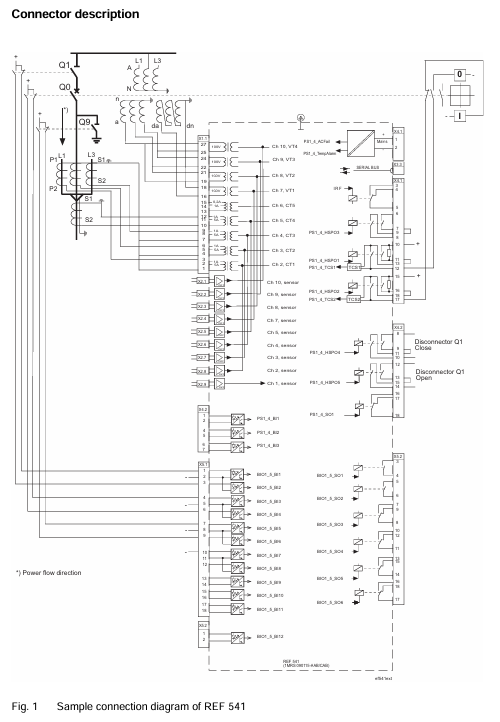
ABB REF54 series relay protection device

This document is a technical document released by ABB for the REF54 series relay protection devices (presumably protection devices for medium and low voltage distribution systems, such as REF541, REF542, etc.). The core revolves around the functional characteristics, technical specifications, configuration logic, and application scenarios of the devices, aiming to guide electrical engineers in selecting devices, setting parameters, installing, debugging, and operating to ensure reliable protection of transformers, busbars, feeders, and other equipment in distribution networks (such as industrial plants, commercial buildings, and power distribution stations), in compliance with international relay protection standards such as IEC 60255.

Product core positioning and applicable scenarios

1. Core functional positioning

The REF54 series is a multifunctional digital relay protection device launched by ABB, integrating the four core functions of “protection, control, measurement, and communication”. It can replace traditional discrete protection relays and measurement instruments, achieve comprehensive monitoring and rapid response to faults of distribution equipment, and cover specific functions:

Protection function: Provides overcurrent protection (inverse time limit/definite time limit), overload protection, ground fault protection, short circuit protection, undervoltage/overvoltage protection, etc. for different protected objects (transformers, feeders, busbars), supports protection setting grading (adapted to different operating conditions).

Control function: Supports local/remote operation (such as circuit breaker opening and closing, constant value switching), has operation locking logic (to prevent misoperation), and can be connected to external control signals (such as PLC, SCADA system instructions).

Measurement function: Real time collection of electrical parameters, including three-phase current, voltage, power (active/reactive), power factor, and electrical energy (cumulative/instantaneous), with a measurement accuracy of 0.2 level (compliant with IEC 60688 standard).

Event recording: Automatically record fault events (fault type, occurrence time, fault time parameters), operation records (opening and closing operations, constant value modification), storage capacity supports ≥ 1000 events, facilitating fault traceability and operation and maintenance analysis.

2. Typical Applicable Scenarios

Industrial power distribution: used for the protection of factory workshop power distribution circuits and motor control circuits, adapted to high load, multi start stop industrial environments, and supporting linkage with ABB AC500 and other PLC systems;

Commercial and civil buildings: As feeder protection devices for office buildings and residential distribution stations, they achieve overload and short circuit protection for lighting, air conditioning, and other loads;

Power distribution network: used for low-voltage protection of transformers in 10kV/0.4kV distribution stations, in conjunction with ABB SCADA system to achieve remote monitoring and unmanned operation.

Key technical specifications and performance parameters

1. Electrical and protective characteristics

Category core specifications (general reference, specific models may vary slightly)

Input parameter current input: 5A/1A (standard CT secondary current); Voltage input: 100V/220V (PT secondary voltage, line voltage/phase voltage optional); Frequency: 50/60Hz (automatic recognition)

Protection range for overcurrent protection: 0.1-10Ie (Ie is the rated current); Overload protection: 0.5-1.5Ie; Ground fault protection: 0.05-5Ie; Action time limit: 0.01-300s

Measurement accuracy current/voltage: ± 0.2%; Power/electric energy: ± 0.5%; Frequency: ± 0.01Hz

Trip outlet 2-4 sets of normally open/normally closed relay contacts (rated load: 5A@250VAC /30VDC), Support self checking of trip circuit (to avoid contact adhesion causing misoperation)

2. Communication and interface characteristics

Communication interface: Standard configuration includes 1 RS485 (supporting Modbus RTU protocol), optional 1 Ethernet (Ethernet/IP or Modbus TCP), supporting interconnection with upper computer (such as ABB MicroSCADA system), HMI or third-party control system to achieve data upload and remote control;

Local interface: Equipped with an LCD display screen (128 × 64 pixels, supporting Chinese/English display), 4 operation buttons (for setting settings and event queries), and some models come with a USB interface (for data export and firmware upgrade).

3. Environmental and compliance characteristics

Environmental adaptability: working temperature -25~+70 ℃ (wide temperature design), storage temperature -40~+85 ℃; Relative humidity ranging from 5% to 95% (without condensation); Anti vibration level 5g (10-500Hz, compliant with IEC 60068-2-6), suitable for complex environments inside distribution cabinets;

Compliance certification: Complies with IEC 60255 (General Standard for Relay Protection Devices), IEC 61000-6-2 (Electromagnetic Immunity for Industrial Environments), CE certification, UL 508 certification, and some models have passed ATEX Zone 2 explosion-proof certification (applicable to distribution in hazardous areas).

Configuration and operation points

1. Protection of fixed value configuration logic

The device supports configuring settings according to the “protection group” to meet different operating mode requirements (such as “normal operation”, “maintenance mode”, “backup power on/off”). The core configuration steps are as follows:

Enter the “Fixed Value Settings” menu (requires administrator privileges, password protection);

Select the type of protection object (such as “feeder protection” or “transformer protection”), and the system will automatically load the default protection logic template;

Adjust specific settings (such as overcurrent settings and action time limits), support real-time preview of the effective range of settings (to avoid exceeding the device’s allowable values);

Save the set value and activate it (some models require restarting the device or manually switching the protection group), and automatically record the set value modification event after activation.

2. Installation and wiring specifications

Installation method: Using standard DIN rail installation (35mm rail), compact size (width x height x depth about 90 x 140 x 180mm), suitable for installation inside 19 inch distribution cabinet doors or cabinets, with a reserved installation spacing of ≥ 50mm (for heat dissipation);

Wiring requirements:

Current circuit: Attention should be paid to the polarity of the CT secondary side wiring (“P1” in “P2” out) to avoid reverse connection and protection misoperation;

Voltage circuit: PT wiring needs to distinguish between line voltage (such as Uab, Ubc) and phase voltage (such as Ua, Ub, Uc) to ensure correct measurement and protection logic;

Communication circuit: RS485 uses shielded twisted pair cables (shielded layer single ended grounding), Ethernet uses CAT5e or above network cables, and the distance between strong current cables is ≥ 100mm to reduce interference.

Maintenance and troubleshooting

1. Regular maintenance plan

Daily inspection (daily/weekly): Check the LCD display screen to confirm that there are no fault alarms (such as “CT disconnection” or “PT voltage loss”); Check the status of the indicator lights (green power light on, flashing running light is normal);

Regular maintenance (monthly/quarterly): Clean the surface dust of the device (wipe with a dry dust-free cloth); Check the tightness of the wiring terminals (to avoid looseness and poor contact); Export event records and measurement data through the upper computer, analyze equipment operation trends;

Annual maintenance: Testing the accuracy of protection settings (using relay protection testers to simulate fault signals and verify the correctness of actions); Check the tripping outlet relay contacts (measure the continuity of the contacts with a multimeter); Upgrade device firmware (download the latest version from ABB’s official website and upgrade via USB or Ethernet).

2. Common faults and solutions

Possible causes and solutions for the fault phenomenon

The power light is not on, the power supply is not powered, the power module is faulty, and the wiring is loose. Check the output of the 220V/110V DC power supply; Re plug and unplug the power supply wiring; Replace the power module

The protection device refuses to operate and the protection setting is incorrect, the CT/PT wiring is reversed, and the tripping circuit fault occurs. Re check the protection setting (such as whether the overcurrent setting is lower than the fault current); Check CT/PT polarity; Test the tripping outlet relay (simulate the tripping signal with a tester)

Communication interruption (with upper computer), communication line failure, IP address conflict, protocol mismatch, replacement of communication line; Reconfigure RS485 address/IP address (to avoid conflicts); Confirm that the communication protocol is consistent (such as Modbus RTU slave address)

Display the “CT disconnection” alarm for CT circuit open circuit, CT fault, and internal sampling circuit fault. Check the CT secondary side wiring (whether it is open circuit); Measure the CT circuit resistance with a multimeter (normally ≤ 5 Ω); Contact ABB for after-sales inspection of the sampling circuit of the device

image.png

Honeywell Safety Manager(Release 162)

This manual is the authoritative hardware guide for Honeywell Safety Manager Safety Instrumented Systems (SIS), applicable to industrial process safety control scenarios such as chemical, petroleum, energy, etc. The core objective is to guide engineers in completing system installation, configuration, maintenance, and troubleshooting, ensuring that the system meets SIL 1-3 safety integrity requirements and complies with international safety standards such as IEC 61508 and IEC 61511.

Basic information and security compliance in the manual

(1) Manual positioning and target audience

Core positioning: Covering the technical specifications, installation process, and maintenance methods of the entire hardware components of Safety Manager, it is the core reference for system design, debugging, and operation;

Target audience: Hardware engineers, on-site operation and maintenance personnel, system integrators, who need to have a basic understanding of PLC, industrial safety standards (such as IEC 61508), and Windows system operation ability.

(2) Safety Compliance and Certification

Safety standards: comply with IEC 61508 (functional safety), IEC 61511 (process industry SIS), ISO 13849-1 (mechanical safety), UL 508 (industrial control equipment), etc;

Hazardous Area Certification: ATEX, IECEx (Ex nA IIC T4, applicable to Zone 2 areas), FM 3611 (Class I/II Division 2 hazardous areas, such as chemical explosive environments);

Environmental Protection and Electromagnetic Compatibility: Compliant with RoHS Directive (Halogen Free Design) and EN 61000-6-2 (Electromagnetic Immunity in Industrial Environments), ensuring stable operation in complex industrial environments.

System hardware composition and core modules

The Safety Manager hardware system adopts a three-layer architecture of “cabinet chassis module”, with core components including cabinet, controller chassis, IO chassis, power module, control processor module, input/output module, etc. The functions and technical parameters of each component are as follows:

(1) Cabinet: Physical carrier of the system

Standard configuration: Based on Rittal TS 8 series cabinets, default protection level IP20, optional IP54 upgrade; Including cooling fans (such as FANWR-24R, 24V DC with status feedback), thermostats (monitoring cabinet temperature to avoid module overheating), grounding bars (ensuring equipment grounding resistance ≤ 4 Ω), lighting fixtures (easy to maintain);

Key parameters: dimensions (such as 80 × 60 × 200cm, 80 × 80 × 200cm), weight (full load ≤ 550kg), operating temperature (-5~70 ℃, remote cabinet -40~70 ℃).

(2) Chassis: Module Installation and Signal Transmission Core

Divided into controller chassis (CPCHAS series) and IO chassis (IOCHAS series), supporting redundant/non redundant configurations to meet different safety level requirements:

Chassis type, model example, core functions, key specifications

Controller chassis CPCHAS-0001 is equipped with a control processor module to achieve system logic operations. It supports 1-2 Control processors, with a height of 4HE and a standard size of 19 inches

Non redundant IO chassis IOCHAS-0001S is equipped with non redundant IO modules, supporting 18 IO modules connected to on-site sensors/actuators, powered by 5V-R (redundant 5V)

Redundant IO chassis IOCHAS-0001R is equipped with redundant IO modules to improve system fault tolerance. It supports 9 pairs of redundant IO modules and a dual IO bus design

(3) Power Supplies: System Stable Power Supply Guarantee

Provide multiple types of power modules, supporting AC-DC conversion and redundant power supply, to meet different voltage requirements (24V/48V/60V/110V/120V DC). The core models and parameters are as follows:

Power supply model, output specifications, core characteristics, applicable scenarios

PSUNI2424 24V DC/24A, 600W dual overvoltage protection (SIL3 compatible), core controller power supply for operating temperature of -40~70 ℃

PSU-UNI2450U 25-28V DC/43-48A UL 508 certification, 100ms power-off hold, supports parallel expansion and high load IO module cluster power supply

FEEDER-24R 24V DC/63A redundant design, with status feedback relay, overcurrent protection redundant system main power feeder

(4) Control Processor Modules: The System’s Brain

QPP-0002 (Quad Processor Pack): Core computing module, dual processors running synchronously, with Flash/RAM storage (battery backup, BKM-0001 module provides battery), supports Watchdog function (monitoring program execution time, memory errors), meets SIL3 requirements;

USI-0002 (Universal Safety Interface): Communication module, providing 2 channels of 10/100M Ethernet and 2 channels of universal serial communication (RS232/485), supporting interconnection with systems such as Expert PKS, with hardware firewall function;

BKM-0001 (Battery and Key Switch Module): A battery and key switch module that includes 2 lithium batteries (backup RAM data, approximately 3 months of battery life), a reset key (clear fault logs), and a forced enable key (allow IO signal forcing).

(5) I/O Modules: Field Signal Interaction

Input module: supports digital/analog signal acquisition, with fault self detection function, core models such as SDI-1624 (24V DC 16 channel digital input), SAI-1620m (16 channel analog input, 0-4V), SDI-1608 (16 channel digital input with ground fault monitoring);

Output module: supports safe digital/analog output, with short-circuit protection, core models such as SDO-0824 (24V DC 8-channel digital output), SAO-0220m (2-channel analog output, 4-20mA);

Converter module: such as BSAI-0420mI (converts 4-20mA to 0-2V, compatible with SAI-0410 module), to achieve matching between on-site signals and module inputs.

Key processes for system installation and maintenance

(1) Hardware Installation Specification

Cabinet installation: Horizontal/vertical installation should meet the requirement of heat dissipation gap (such as reserving 100mm above and below the fan), and grounding should be independent (protective ground and signal ground should be separated);

Module installation: IO modules need to press the “Key Coding” corresponding slot (such as SDI-1624 corresponding to A5/C5 hole positions) to avoid damage caused by incorrect insertion; Redundant modules need to be installed in pairs to ensure synchronous communication;

Cable connection: System interconnection cables (SIC) and communication cables (such as CCI-HSE-01 Ethernet cables) should be wired according to pin definitions to avoid reverse polarity (such as 24V DC power supply “+” connected to pin d8, “0V” connected to pin d10).

(2) Regular maintenance plan

Daily maintenance (daily/weekly): Check the LED indicator light (green normal, red fault), fan operation status, and cable joint tightness; Backup historical data (to USB drive/server);

Regular maintenance (monthly/quarterly): clean the cabinet filter (to avoid dust blockage causing overheating), test the power supply voltage (fluctuation should be ≤± 5%), and measure the cable insulation resistance (≥ 10M Ω);

Annual maintenance: Full module calibration (using original calibration tools such as 9100 calibrator), battery replacement (BKM-0001 module lithium battery replaced every 5 years), firmware upgrade (downloading the latest version from GE Digital official website).

(3) Troubleshooting and Solutions

Based on the “internal system exception” error mentioned in the Nexinstrument document, supplement the general troubleshooting logic of Safety Manager, and organize common troubleshooting solutions in the manual:

Possible causes and solutions for fault phenomena

System error “internal exception”: 1. Control processor program crashes; 2. Power supply voltage fluctuations; 3. Module communication interruption: 1. Check the QPP-0002 module’s Status LED (red indicates hardware failure and needs to be reset or replaced); 2. Use a multimeter to measure the 24V DC power supply (within the range of 20.4-31.2V); 3. Check the communication light of USI-0002 module (Tx/Rx light does not light up, network cable needs to be unplugged again)

IO module has no signal input 1. Sensor failure; 2. Cable breakage; 3. Module calibration expired. 1. Replace sensor for testing; 2. Use a multimeter to measure the continuity of the cable (such as the signal at pin d12 of SDI-1624 module); 3. Recalibrate the module (refer to SAI-1620m calibration process)

Power module alarm (red light on) 1. Overvoltage/undervoltage; 2. Fan malfunction; 3. Overload 1. Check the input voltage (e.g. PSU-UNI2450U input needs to be between 93-253V AC); 2. Check the fan speed (FANWR-24R speed should be ≥ 1500 RPM); 3. Reduce the number of parallel modules to avoid overloading

Communication interruption (with upper computer): 1. IP address conflict; 2. Protocol mismatch; 3. Network cable failure: 1. Reconfigure the USI-0002 module IP (to avoid conflicts with Expert PKS); 2. Confirm the communication protocol (such as Modbus TCP); 3. Replace the network cable and test the link (using a cable tester)

System configuration and expansion

Model coding rules: The hardware model includes a prefix (FS – non coated, FC – coated, FA – explosion-proof), module type (such as SDI-1624), and suffix (version number, such as V1.1), for example, “FC-SDI-1624” represents a coated 24V DC 16 channel digital input module;

Scalability: Supports adding IO channels through IO expansion modules (such as IO-0002), improving power supply reliability through redundant power supplies (such as RUSPSU-R), and achieving on-site signal terminal switching through FTA modules (such as IOTA-R24).

Emerson PR6423 8mm eddy current sensor

The Emerson PR6423 8mm eddy current sensor is a non-contact industrial sensor designed specifically for key rotating machinery such as steam turbines, gas turbines, water turbines, compressors, gearboxes, pumps, and fans. Its core function is to accurately measure the radial/axial dynamic displacement, position, eccentricity, and speed of the shaft, providing reliable data support for equipment status monitoring and fault warning. It is suitable for high-precision monitoring of rotating machinery in the field of industrial automation.

Core performance parameters

1. Measurement ability

Linear measurement range: 2mm (80 mil), initial air gap (installation reference gap) is 0.5mm (20 mil), ensuring stable data collection within the common displacement range of rotating machinery.

Incremental Scale Factor (ISF): Compliant with ISO standards, 8V/mm (203.2mV/mil), with an error of ± 5% within the temperature range of 0-45 ° C (32-113 ° F), ensuring measurement accuracy under different operating conditions.

Linearity deviation: Within the temperature range of 0-45 ° C (32-113 ° F), the deviation from the best fitted line is ± 0.025mm (± 1 mil), indicating excellent data linearity and reducing measurement errors.

Measurement target requirements: The minimum shaft diameter is 25mm (0.79 inches), and the default target material is 42CrMo4 (corresponding to AISI/SAE 4140) ferromagnetic steel. Other materials can be customized as needed.

2. Environmental and protective characteristics

Protection level: IP66 (compliant with IEC 60529 standard), can effectively prevent dust, strong water spray, and adapt to complex environments in industrial sites.

Temperature adaptability:

Sensor (including 1-meter cable): Operating temperature -35~+180 ° C (-31~356 ° F), resistant to high temperature conditions;

Cable and connector: Operating temperature -35~+150 ° C (-31~302 ° F), matching the overall temperature resistance range of the sensor.

Material selection:

Sensor probe: PEEK polyetheretherketone (resistant to high temperature and chemical corrosion);

Shell: stainless steel (high-strength, rust resistant);

Cable: polytetrafluoroethylene (PTFE, high and low temperature resistance, good insulation);

Connector: Nickel plated brass (low contact resistance, anti-oxidation).

Weight: The sensor (including a 1-meter cable) weighs approximately 100 grams (3.53 ounces), and its lightweight design makes it easy to install on mechanical structures with limited space.

Compliance certification and adaptation to hazardous areas

1. General compliance

CE certification: Complies with the 2014/30/EU (EN 61326-1, Electromagnetic Compatibility), 2014/34/EU (ATEX Explosion proof), 2011/65/EU (RoHS Environmental Protection) directives, and meets European market access requirements.

Basic explosion-proof standards: comply with ATEX and IEC Ex EN 60079-0 (General Requirements for Equipment) and EN 60079-11 (Intrinsic Safety Equipment) standards, providing basic protection for use in hazardous areas.

2. Hazardous area certification (requires cooperation with converters)

The classification of hazardous areas for sensors depends on the accompanying converter (refer to the converter document for details), and their own temperature classification is as follows:

Explosion proof type, temperature rating, upper limit of ambient temperature (Ta)

Intrinsic safety (ia) T6 ≤ 64 ° C

T4 ≤114°C

T3 ≤160°C

No spark (nA) T6 ≤ 64 ° C

T4 ≤114°C

T3 ≤160°C

Structural dimensions and installation design

1. Two installation types

The sensor offers two structures: standard installation (PR6423/xxx xxx) and reverse installation (PR6423/xxxR xxx). The core size parameters are as follows:

Installation type Key dimensions (mm/inch)

Standard Installation – Shell Thread: M10 × 1 or 3/8-24UNF

-Wrench size: M10 thread with SW 11mm, 3/8-24UNF with SW 7/16 inch

-Standard cable diameter: 2.8mm (0.110 inches), minimum bending radius 25mm (0.984 inches)

-Armored cable diameter: 6mm (0.236 inches), minimum bending radius 35mm (1.378 inches)

The threads, wrenches, and cable sizes for reverse installation and standard installation are the same, with only the installation direction and shell layout different, to meet the installation space requirements of specific mechanical structures

2. Cables and connectors

Cable configuration: An adapter plug can be optionally selected after a 1-meter cable, with a cable length tolerance of 0~+10%, and supports customization of different lengths (such as 8.0m, 9.0m, 10.0m, etc.).

Connector type: The default configuration is a 11.0mm (0.433 inch) diameter Lemo male connector, or an open cable end (without connector) can be selected to meet the interface requirements of different monitoring systems.

Model selection and special versions

1. Standard model selection (core parameter combination)

Is the diameter of the probe casing threaded with armor cable model

8mm M10 × 1 No PR6423/00

It’s PR6423/01

Yes (reverse installation, requires adapter plug) PR6423/03*

3/8 “-24 UNF No PR6423/10

It’s PR6423/11

Yes (reverse installation, requires adapter plug) PR6423/13*

*Note: Models with “*” are only suitable for reverse installation with adapter plugs, and reverse installation without adapter plugs is not optional.

2. Special version (PR6423/xxx xxx RAD)

Specially designed for radiation environments, there are differences between technical parameters and standard versions:

Material adjustment: The probe material is changed to epoxy resin, the cable is changed to polyolefin, and the shell is made of stainless steel with EPDM O-ring seal to improve radiation resistance.

Temperature and radiation tolerance: The working temperature drops to -35~+80 ° C (-31~176 ° F); The anti radiation dose of the sensor (including 1-meter cable) reaches 80 Mrad, and the anti radiation dose of the extension cable and converter reaches 0.1 Mrad; At a radiation intensity of 0.5Sv/h, the calculated lifespan is 18.26 years in a neutron radiation environment and 183 years in a beta or gamma radiation environment.

Certification restriction: Non hazardous area certification, only applicable to ordinary radiation environments.

Optional accessories

Model Product Description Purpose

EZ 1600 probe bracket fixes the sensor to ensure precise installation position

MPT 064 metal protective tube protects sensors and cables against mechanical damage

Kongsberg Maritime Seatex DARPS Transponder

Kongsberg Maritime’s Seatex DARPS Transponder is a new generation relative GPS (RGPS) positioning system responder developed based on advanced GPS technology. Its core function is to provide high reliability and precision relative position reference for offshore operation scenarios, such as ship and platform/FPSO loading and unloading operations. Through integrated design and intelligent communication protocols, it adapts to the multi device collaborative positioning requirements in extreme offshore environments.

Core positioning and technological advantages of the product

1. Core application scenarios

Specially designed for offshore operations that require precise relative positioning, with a focus on addressing:

Position monitoring during loading, unloading, and supply operations between ships and fixed platforms (such as FPSOs and offshore drilling platforms);

The relative positioning of multiple ships working together in the same area to avoid operational risks caused by collisions or positional deviations.

2. Key technological advantages

Mature technology accumulation: Kongsberg Seatex has over ten years of experience in the development of GPS maritime tracking systems. The responder integrates continuous iteration of technical experience with the latest GPS developments to ensure positioning stability.

Highly integrated: All electronic components, GPS antennas, and UHF antennas are integrated into a single physical unit, requiring only one power cord to connect and automatically start when powered on, greatly simplifying installation and maintenance.

Anti harsh environment capability: Made of polyethylene shell, electronic components are designed for harsh marine environments, with a protection level of IP68 (able to withstand short-term immersion in 10 meters of water depth), suitable for offshore conditions such as salt spray, humidity, and vibration.

Multi device collaboration capability: Based on the Time Division Multiple Access (TDMA) protocol, it supports up to 24 ships sharing the same UHF frequency, with an update rate as fast as 2 seconds per time, meeting the requirements of multi ship synchronous operations.

Core functions and working principles

1. Relative positioning workflow

Data collection: The responder has a built-in GPS receiver that captures L1 C/A code and carrier phase signals, while also having anti multipath interference function to reduce signal attenuation and ensure the accuracy of the original data.

Data transmission: GPS raw data and responder status parameters are transmitted to the DARPS 100 host system on board via a UHF wireless link (bidirectional communication); If the ship sends RTCM correction data, the responder can output DGPS positioning results, further improving accuracy.

Position calculation: After receiving data, the DARPS 100 system on board accurately calculates the relative position between the ship and the responder (and corresponding platform); A single responder can communicate with multiple ships equipped with DARPS 100 simultaneously, achieving collaborative positioning among multiple ships.

2. Core functional highlights

High precision positioning: Based on L1 C/A code measurement technology, combined with anti multipath interference design, it ensures relative positioning accuracy and meets the strict requirements for position error in offshore operations.

Intelligent data verification: By using reliable data protocols to detect and eliminate erroneous data, invalid results can be avoided from affecting RGPS operations, ensuring reliable positioning.

Remote configuration and monitoring: Key parameters of the responder (such as UHF frequency, GPS update rate, TDMA time slot) can be remotely modified through the DARPS 100 control unit or handheld controller on board, and all status parameters (such as power supply, signal strength, working mode) can be monitored in real time to prevent sudden failures.

Flexible frequency selection: Provides two UHF frequency bands (450-470MHz standard band, 868-870MHz optional band), with easily adjustable frequencies within the band to adapt to radio spectrum planning in different sea areas.

Detailed explanation of technical specifications

1. General and GPS parameters

Category specific specifications

General characteristic appearance: polyethylene cylindrical (with mounting bracket adapter); Update rate: up to 1Hz; Protection level: IP68 (10 meter water depth)

Number of GPS performance channels: 12 channels (supporting L1 C/A code and carrier phase measurement); Core function: multi-path interference suppression

2. UHF radio parameters

Parameter specifications

Frequency range standard: 450-470MHz; Optional: 868-870MHz (Synthetic Bidirectional Radio)

Channel spacing of 25KHz

Transmitting power 0.5W

Data transmission rate 9600 bps

Communication distance (line of sight) typically 15-20 kilometers

3. Interface (I/O) and Control

Serial interface: 3 serial I/O lines, maximum baud rate 19200 bps; Support remote configuration of baud rate, TDMA time slot number, UHF radio mode, and GPS update rate.

Control mode: Supports remote reset commands and status message polling; Can connect to handheld terminals for local status viewing and control; Multiple connector options are available (please contact Seatex for detailed information).

4. Physical and environmental characteristics

Physical parameter specifications, environmental adaptability specifications

Size (diameter x height) 150mm x 800mm Operating temperature -10 ° C~+55 ° C

Weight 4.5 kg Storage Temperature -30 ° C~+70 ° C

Power requirement: nominal 9-32V DC, power consumption of 6.5W, humidity tolerance, suitable for high humidity offshore environment

image.png

Search for products

Back to Top
Product has been added to your cart