
Call us 24/7uaedcs@163.com
Welcome to the official website of CNIACS Automation Technology Co., Ltd!
Call us 24/7uaedcs@163.com

Bently  3500/20 Rack Interface Module

Module Overview

Core functions

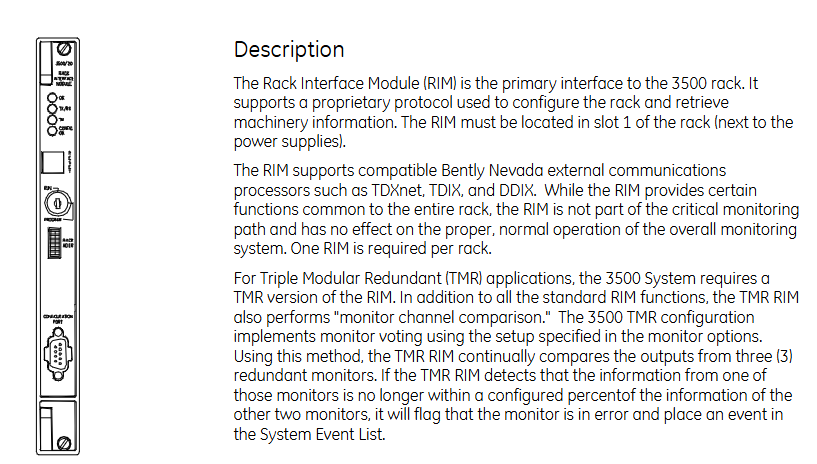
As the main interface of the 3500 rack, it supports proprietary protocols for configuring the rack and obtaining mechanical information, and must be installed in slot 1 of the rack (adjacent to the power supply).

Supports compatible Bently Nevada external communication processors (such as TDXnet, TDIX, DDIX), does not participate in critical monitoring paths, does not affect system normal operation, and requires one per rack.

TMR version: For Triple Modular Redundancy (TMR) applications, in addition to standard functions, it can also perform “monitoring channel comparison” – continuously comparing the outputs of three redundant monitors. If the data of one monitor deviates from the other two by more than the configured percentage, an error will be marked and recorded in the system event list.
Technical specifications

input parameter

Power consumption: Typical value of 4.75 watts.

Data interface:

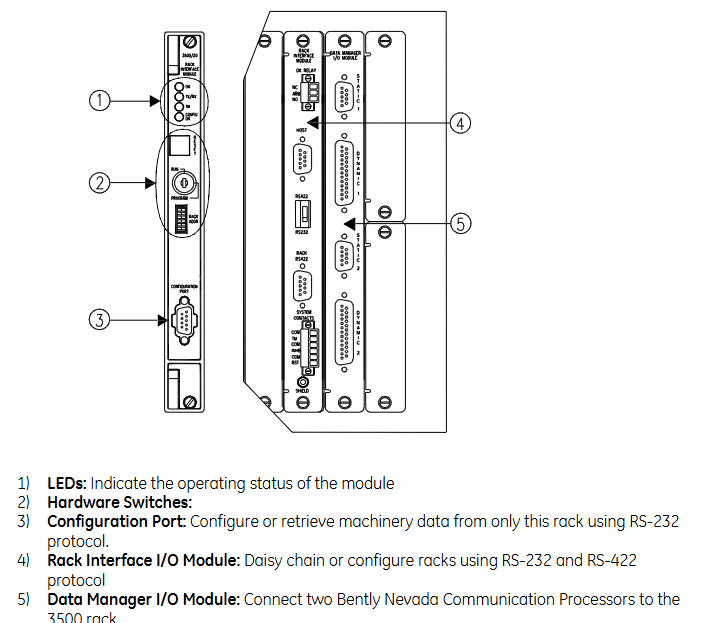
Front panel: Standard RS232 serial communication, speed of 38.4 k baud.

I/O module: Supports RS232/RS422 serial communication (up to 38.4 k baud) and internal modem communication (14.4 k baud).

Output parameters

Front panel LED:

OK LED: Indicates that the module is operating normally.

TX/RX LED: Indicates that the module is communicating with other modules inside the rack.

TM LED: Indicates that the rack is in the “Trip Multiply” state.

CONFIG OK LED: Indicates that the rack configuration is valid.

I/O module OK relay: used to indicate the normal operation or fault of the rack, with the option to select the “open” or “close” contact annunciate fault state, normally excited operation, rated value 5A @ 24Vdc/120Vac (120W/600VA), equipped with an arc extinguisher, normally closed contact.

Control components

Front panel reset button: clears the lock alarm and timed OK channel failure inside the rack, with the same function as the “Rack Reset” contact on the I/O module.

Address switch: Set the rack address to a maximum of 63 addresses.

Configure key lock: Switch the rack to “RUN” mode (normal operation, locking configuration changes) or “GRAM” mode (allowing local/remote configuration), the key can be removed from any position, RUN mode restricts unauthorized reconfiguration, and GRAM mode supports remote configuration at any time.

Communication and Interface

I/O module system contacts

Including Trip Multiply (to put the rack into Trip Multiply state), Alarm inhibit (to suppress all alarms), Rack reset (to clear lock alarms, etc.), maximum current<1mA dc (from dry contact to common terminal).
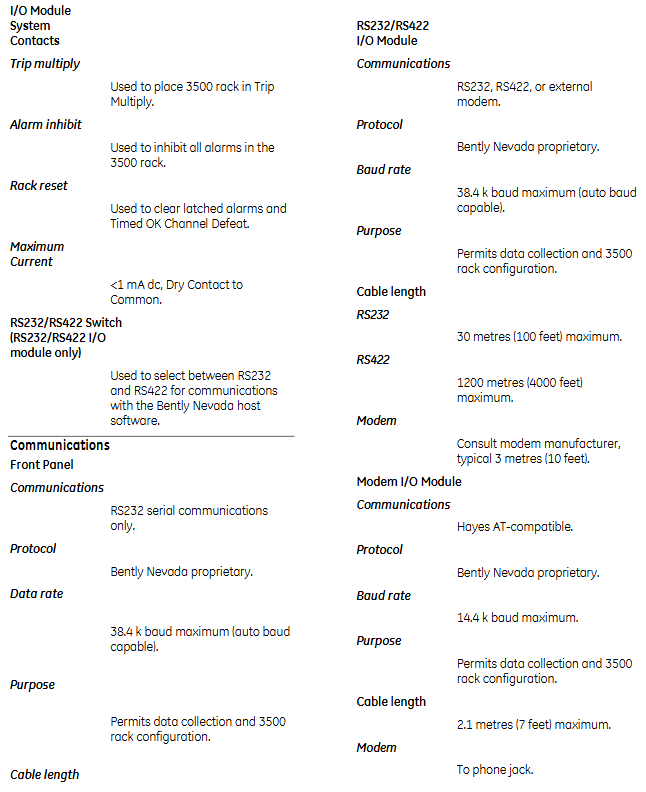
Communication interface details

Interface type, communication protocol, rate usage, maximum cable length

Front panel RS232 Bently Nevada proprietary maximum 38.4 k baud (supports automatic baud rate) data collection and rack configuration 30 meters (100 feet)

RS232/RS422 I/O module Bently Nevada proprietary communication with host software up to 38.4 k baud RS232: 30 meters; RS422: 1200 meters (4000 feet)

The I/O module of the modem is Hayes AT compatible, with a proprietary protocol of up to 14.4 k baud for data collection and rack configuration. It is 2.1 meters (7 feet, up to the telephone jack) long

Rack connector RS422 Bently Nevada proprietary maximum 38.4 k baud multi rack Daisy choked communication 1200 meters

Data Manager I/O Module (2 sets of ports) Bently Nevada proprietary fixed 9600 baud static and dynamic data collection 3 meters (10 feet)

Environmental and physical parameters

Environmental limitations

Rack interface module and RS232/RS422 I/O: operating temperature -30 ° C to+65 ° C, storage temperature -40 ° C to+85 ° C; modem I/O module: operating temperature 0 ° C to+50 ° C, storage temperature -40 ° C to+85 ° C.

Humidity: 95% non condensing.

CE certification: Complies with EMC directives (EN50081-2, EN55011, etc.) and low voltage directives (EN 61010-1).

Hazardous Area Certification: CSA/NRTL/C Class I, Div 2, Groups A, B, C, D, T4 @ Ta=-20 ° C to+65 ° C.

Physical specifications

RIM dimensions: 241.3mm x 24.4mm x 241.8mm (height x width x depth), weight 0.91kg.

RS232/RS422 I/O、 Modems I/O and Data Manager I/O modules: size 241.3mm × 24.4mm × 99.1mm, weight 0.45kg.

Rack space requirement: RIM motherboard occupies one full height front slot; The RIM I/O module and the Data Manager I/O module each occupy one full height rear slot.

Order Information

Module model: 3500/20-AXX-BXX-CXX

A (interface type): 01=standard RIM, 02=TMR RIM (only for TMR configuration).

B (I/O module type): 01=with built-in modem, 02=with RS232/RS422 interface.

C (institutional certification): 00=none.

Spare parts and cables

Spare parts include standard/TMR RIM, various I/O modules, grounding wristbands, firmware ICs, etc.

There are various types of cables, including interfaces (RS232/RS422), lengths (10 feet to 500 feet+), and insulation materials (PVC/Teflon) ®) And assembly status classification, supporting connections between hosts and racks, and between racks. Expansion cables can be used for distances exceeding 500 feet.
Bently Nevada 3500 Monitoring System Rack Installation

Receiving and Processing Instructions

Receiving inspection

Visually inspect the system for any obvious transportation damage. If there is any damage, file a claim with the carrier and submit a copy to Bently Nevada, LLC.

Handling and storage precautions

The circuit board is susceptible to static damage and requires the use of a grounding strap (such as 3M Velostat) before operation ®  No.2060) Grounding: Avoid using tools/materials that are prone to static electricity, such as ungrounded soldering irons and non-conductive plastics.

Transport and storage of circuit boards require the use of conductive bags or foil, and special attention should be paid to static electricity accumulation in dry weather (humidity<30%).

When the system loses power, it will lose its mechanical protection function; When operating correctly, the module can be plugged in and out while powered on (see Chapter 4 for details).

Basic Information

System Overview

The 3500 monitoring system is used to continuously monitor the status of rotating and reciprocating machinery (such as imbalance, misalignment, shaft cracks, bearing failures, etc.) to improve factory safety, product quality, equipment availability, and reduce operating costs.

Core advantage: Enhanced operator information (providing multi-dimensional data, Windows) ®  Basic display software, better integration of factory control computers (multi protocol communication gateway, time synchronization data), reduced installation and maintenance costs (reduced wiring, backward compatibility, easy configuration), improved reliability (redundant power supply, TMR system), intrinsic safety options, multiple output interfaces (supporting multiple display and control systems).

General characteristics

Hot swappable module: When operated correctly, any module can be plugged in and out while the system is powered on, without affecting the operation of unrelated modules (plugging in and out of the power supply does not interrupt the system when dual power is available).

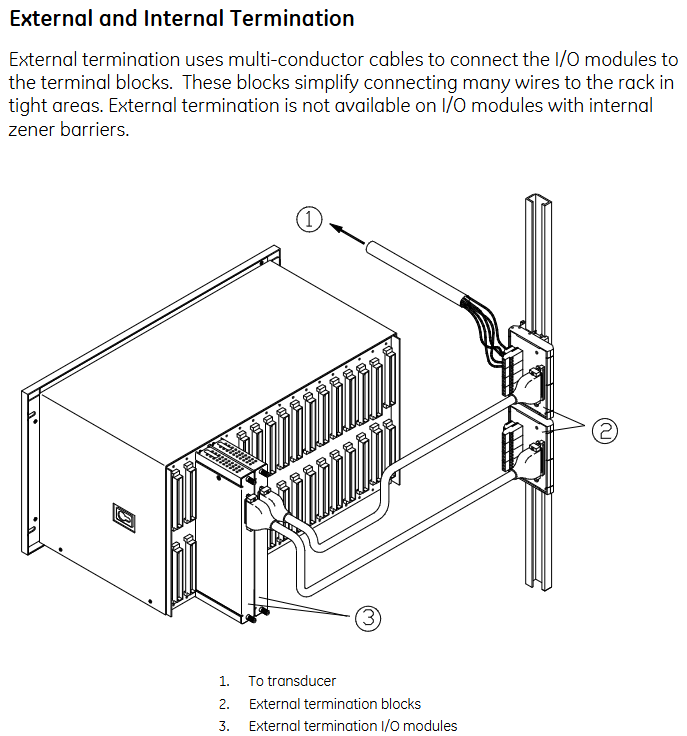
Internal and external terminals: External terminals are connected to I/O modules and terminal blocks through multi-core cables (suitable for narrow space areas); Internal terminals allow sensors to be directly connected to I/O modules (I/O modules with internal Zener barriers have no external terminals).

System components

Including a weatherproof enclosure (protecting the rack from moisture and dust), rack (full-size 19 inch/compact 12 inch Mini rack), power supply (half height module, supporting 1-2 redundant installations), Rack Interface Module (RIM, communicating with the host and other modules, maintaining event lists), communication gateway module (allowing external devices to access information), monitoring module (collecting sensor data), relay module (controlling relays based on channel status) Keyphasor ®  Modules (supplying power to sensors and processing signals), display modules (supporting multiple display devices), grounding modules (providing low impedance grounding, used in conjunction with internal barrier I/O modules), etc.

Relays and Safety Systems

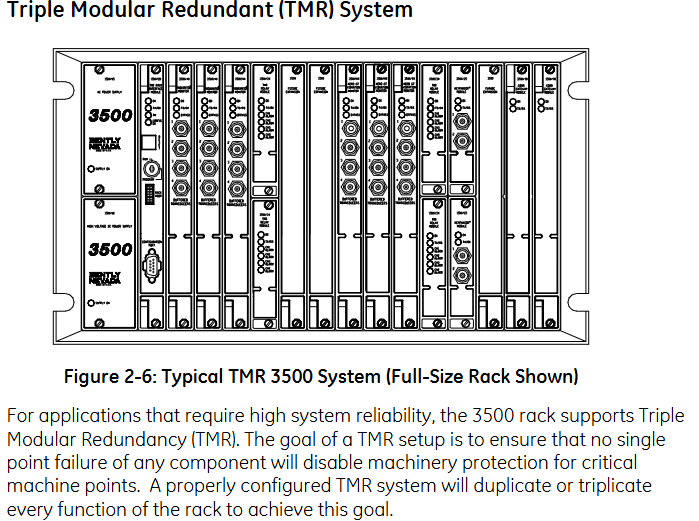
Standard rack relay options: independent relay (each monitoring module is equipped with more than one relay module), bus relay (multiple monitoring channels share a single relay), Triple Modular Redundancy (TMR) system (high reliability configuration, triple redundancy function, avoiding single point failure).

Intrinsic safety internal barrier system: suitable for hazardous environments, needs to be used in conjunction with grounding modules, has strict installation restrictions (such as prohibiting the use of bus sensors, requiring isolation of RS-232 connections, etc.), and has characteristics such as dual IS grounding and safe/hazardous area wiring separation.

Initial rack installation

General installation process

Refer to the installation checklist (confirm conditions such as power supply, space, ventilation, grounding, etc.);

Install weatherproof casing (if required);

Install the rack;

Set rack jumpers and switches;

Install external terminal blocks (if necessary);

Install modules;

Connect sensors, relays, and power wiring;

Complete the software configuration for rack installation.

Key installation details

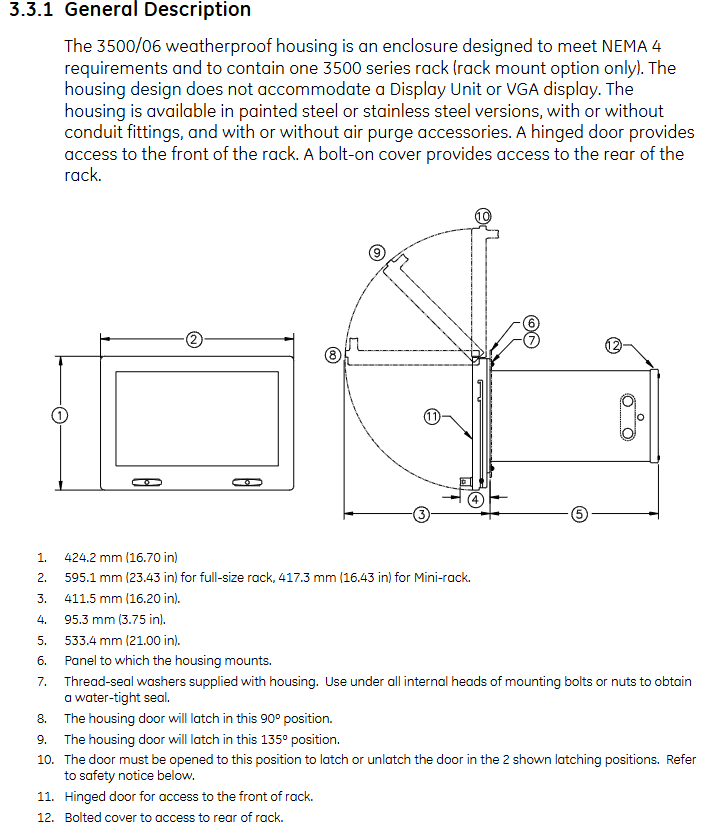
Weather resistant enclosure: Meets NEMA 4 requirements, not compatible with display units; Attention should be paid to temperature derating (due to limited ventilation), panel cut size, conduit fittings (to avoid mixing power and signal wiring), and air purification options (to meet specific pressure and flow requirements).

Rack installation: Ensure ventilation (minimum gap of 50.4mm between top and bottom), support panel installation, rack installation (19 inch EIA cabinet), Bulkhead installation, etc. Different installation types have specific size and fixing requirements.

Intrinsic safety operation: Ensure that the grounding resistance is less than 1 Ω, use 4-10mm ² cables to connect to the factory’s IS grounding, and use a single point grounding to avoid loops.

High electromagnetic noise/CE installation: The system rack, EMI shielding, and cables must be thoroughly grounded to shield all wiring out of the metal cabinet. CE installation must comply with EN61000.3.2 standard.

Module installation and removal

Installation steps

Power supply: First install the Power Input Module (PIM), configure single point grounding, connect the power cord (in a non powered state), then install the main module and tighten the screws.

Full height module: First install the I/O module (configuration options, fastening screws, connection wiring), and then install the main module (ensure that the ejectors are in place, inserted along the guide rail, and fastened).

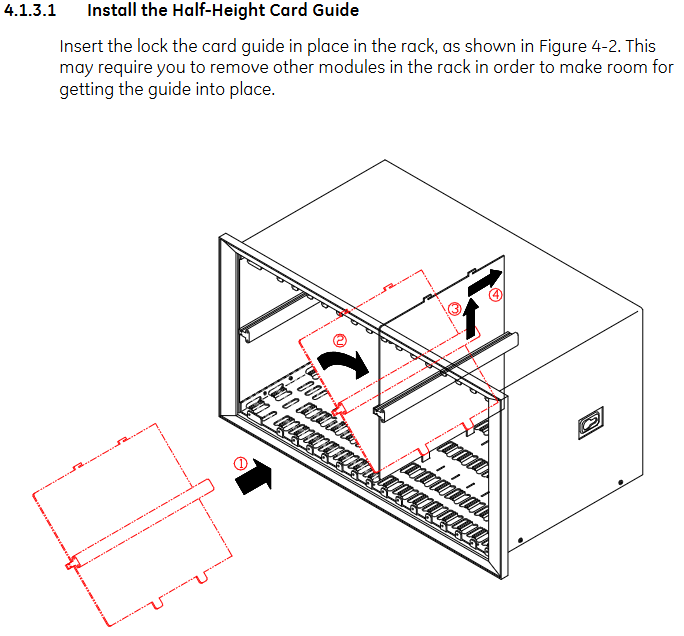
Half height module: First install the half height card guide rail, then install the I/O module and main module, similar to the steps for full height modules.

Remove steps

After power off, loosen the module screws and use ejectors (full height) or screws as handles (half height/power) to pull out the module; The I/O module needs to remove the wiring first, and then loosen the screws to remove it.

Replace module

Main module: Save the configuration before removing the old module, reconfigure and verify after installing the new module.

I/O module: The main module and wiring need to be removed first, replaced, reconnected, and verified.

Maintenance

General maintenance

The internal components of the module cannot be repaired on site, and maintenance mainly involves testing whether the channel is normal and replacing faulty modules (spare parts are required).

Support live plugging and unplugging modules (follow the steps in Chapter 4), the system does not require calibration, but the functionality needs to be verified regularly.

Maintenance interval

The initial interval is 1 year; If the monitoring machine is a critical equipment or the rack is in an extreme temperature, high humidity, or corrosive environment, the interval needs to be shortened; Adjust the interval based on the verification results and ISO 10012-1 after each maintenance.

Order Information

Rack ordering: Specify the size (19 inches/12 inches Mini rack), installation method (panel/rack/Bulkhead installation), institutional certification (CSA-NRTL/C), European compliance (CE), etc. through code.

Windproof shell ordering: optional materials (painted steel/stainless steel), conduit fittings, air purification options, etc., incompatible with display units, Mini rack requires adapter panel.

Grounding module and spare parts: The grounding module needs to occupy one rack slot; Spare parts include TMR/SIM jumpers, blank panels, adapters, etc.

Specification parameters

Dimensions: Detailed length, width, and height data for different installation types (panel/rack/Bulkhead installation, full-size/Mini rack) (such as full-size panel installation rack width 482.6mm, height 265.9mm).

Weight: The weight of different configurations (empty/full load, with internal barriers) (such as a full-size full load panel installation of approximately 31.07kg).

Environmental parameters:

Working temperature: -30 ° C to 65 ° C (0 ° C to 65 ° C with internal barrier); Storage temperature: -40 ° C to 85 ° C.

Humidity: 0% -95% without condensation.

Mechanical performance: 10g impact (11ms); 3g sine vibration (5-100Hz).

ABB medium voltage frequency converter ACS2000 4kV frame

Safety and Identification System

1. Safety instructions and standards

The safety instructions aim to highlight potential hazards when operating equipment and must be strictly followed, otherwise it may endanger personnel safety, equipment integrity, and environmental safety. The specific classification and meaning are as follows:

DANGER: Indicates the existence of direct danger, which, if not avoided, will inevitably lead to death or serious injury.

Warning: There is a potential danger that, if not prevented, may result in death or serious injury.

CAUTION: Identify hazardous situations that may cause minor or moderate injury.

NOTICE: Used to explain operational precautions unrelated to personal injury, such as equipment protection, program specifications, etc.

These safety instructions are developed in accordance with ISO 3864-2:2004 (E) “Graphic Symbols – Safety Colors and Safety Signs – Part 2: Design Principles for Product Safety Labels” and ANSI Z535.6 “American National Standard for Product Safety Information in Product Manuals, Instructions, and Other Supporting Materials”.

2. Driver identification information

To determine suitable spare parts, it is necessary to refer to the serial number nameplate of the input/control section’s inner door. The nameplate contains rich parameters, such as:

Model code (such as ACS 2040-1L-AN1-a-0R+FAME0+FDPL05)

Rated input voltage (4160V), rated auxiliary voltage (480V)

Rated input current (108A), rated auxiliary current (7.0A)

Maximum allowable short-circuit current (45kA), cooling method, and ambient temperature (FA/max104’F)

Rated output voltage (0… 4160V), protection level (TYPE1 (IP21)), etc

There are currently three frame sizes for ACS2000, with the following power coverage range:

Frame 1:300HP to 1000HP

Frame 2: 1250HP to 2000HP

Frame 3: 250HP to 3000HP

At the same time, a corresponding relationship table between rated input current, power (kW and hp), and basic model code is provided for different frame sizes, making it easy to quickly search for matching spare parts.

Classification and detailed parameters of core spare parts

Power electronic devices

(1) Semiconductor category

Phase module kit: Different frame sizes correspond to different models, such as 2UEA001345 (including disassembly tools) for Frame 1, 2UEA002570 (including disassembly tools) for Frame 2, and 2UEA003021 (including disassembly tools) for Frame 3, used to achieve power conversion and control.

Stacking components of pry bar: Frame 1 corresponds to 2UEA003051, Frame 2 corresponds to 2UE003063, and Frame 3 corresponds to 2UEA0003031, mainly used for overvoltage protection.

Diode clamp: Model 2UEA000911, suitable for all frames, providing clamp protection.

Clamp resistors: 2UEA000360 is used for Frame 1 and 2, and 2UEA001469 is used for Frame 3 to limit the peak voltage.

DC link resistance: Use 2UEA000893 for Frame 1, 2UEA001348 for Frame 2, and 2UEA001470 for Frame 3 to maintain stable DC link voltage.

(2) Capacitor class

EMC filter capacitors: 2UEA0000005 is used for Frame 1, 2UEA001404 is used for Frame 2, and 2UEA001464 is used for Frame 3 to suppress electromagnetic interference.

DC link capacitors: 2UEA000358 for Frame 1, 2UEA001406 for Frame 2, and 2UEA001466 for Frame 3, store electrical energy and stabilize DC voltage.

Bentley 60M100 Condition Monitoring System

Product Overview

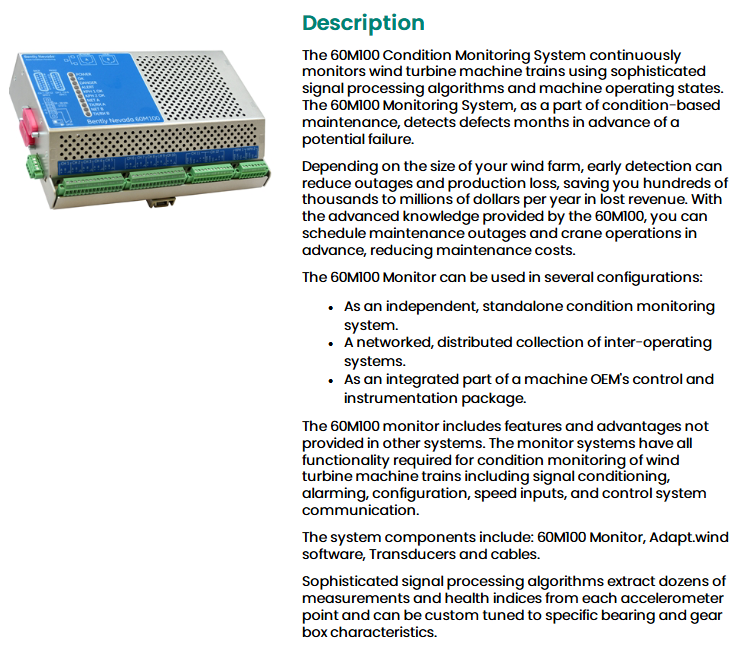
The 60M100 condition monitoring system is a continuous permanent monitoring system designed by Bently Nevada (a business under Baker Hughes) specifically for wind turbine units, suitable for equipment that requires extremely high reliability and availability. Its core function is to detect potential faults months in advance through complex signal processing algorithms and machine operation status analysis, thereby reducing downtime and production losses, and lowering maintenance costs.

The system can be configured in various ways: as an independent state monitoring system, a networked distributed interoperability system, or integrated into the control and instrumentation package of the machine’s original equipment manufacturer. The system components include a 60M100 monitor, Adaptewind software, sensors, and cables.

image.png

Monitoring scope and core functions

Monitoring object

The key components and characteristics of wind turbines include:

Tower sway

main bearing

Main Rotor

Gearbox (all internal bearings, all bearing meshing, debris monitoring)

generator bearings

Generator grounding

Core functions

Monitor 150 static variables, generate high-resolution waveform data and trend lines

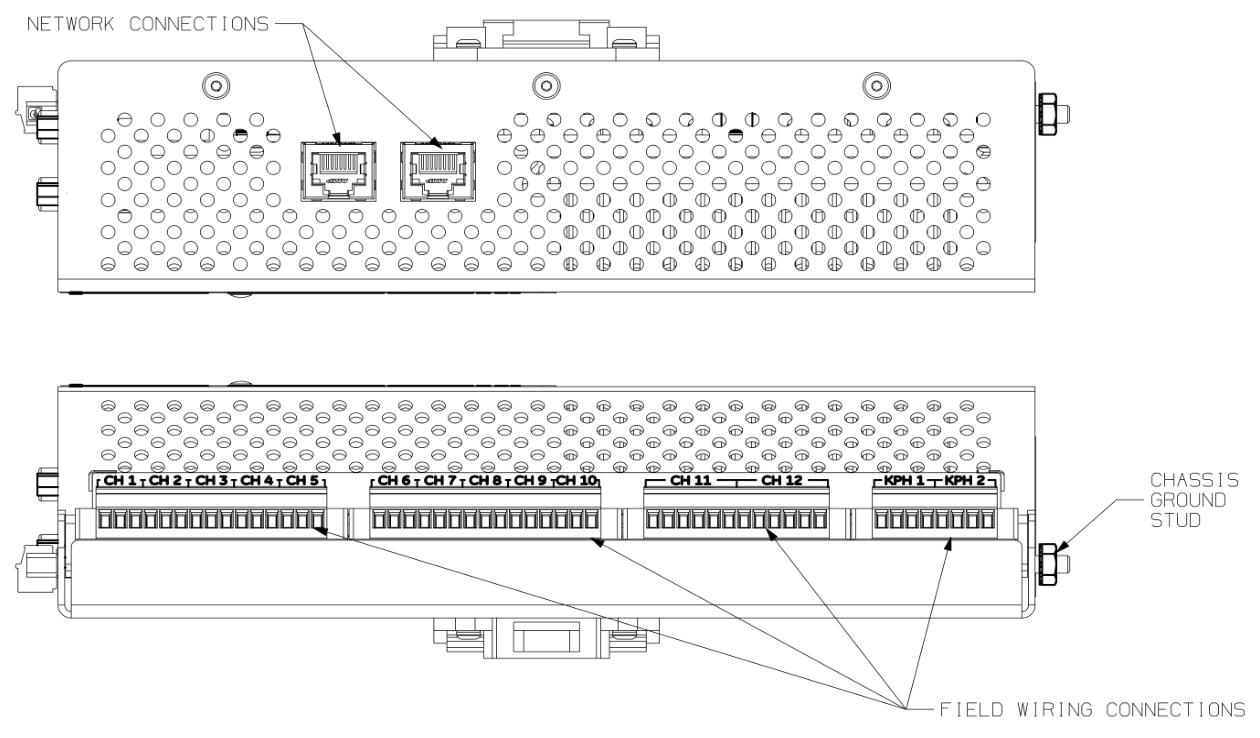
Supports up to 12 dynamic channel inputs, 2 Keyphasor signals, and digital communication

Equipped with 24 bit analog-to-digital conversion and a 40kHz bandwidth design, it enhances the mechanical and gear monitoring capabilities of rolling bearings

Provide digital communication function, support integration with ADAPT software and other automation systems through Ethernet TCP/IP, compatible with Modbus/TCP protocol (supporting server and client modes)

Technical specifications

Electrical specifications

Input power supply: 18-36Vdc

Maximum current: 1.7A

Surge current: maximum 2.7A (less than 5ms)

Module Input/Output

Input: Up to 12 dynamic signals and 2 Keyphasor signals

Dynamic range: 110dB (fs=102.4ksps)

Signal to noise ratio: 110dB (fs=102.4ksps)

Analog to digital conversion: nominal 24 bit Sigma Delta

Bandwidth: 0-40kHz

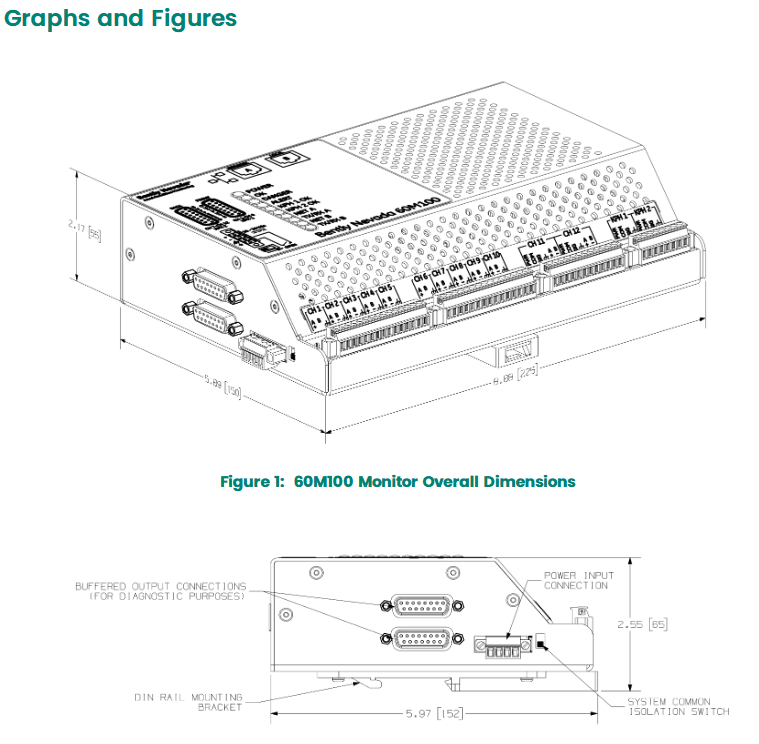
Output: 2 independent Ethernet ports (Net A is a 10/100 BaseT DHCP port, Net B is a 10/100 BaseT local static IP port); Buffer signal output of 2 15 pin DSUB connectors (output impedance 550 ohms)

precision parameter

Direct peak or effective value: Typical value is ± 0.5% of full scale, worst case ± 1.1%

Rotor, meshing, and fault frequency: typical value ± 6.7%, worst-case scenario ± 9.7%

Bearing frequency: typical value ± 6.7%, worst-case scenario ± 9.7%

Tower sway: typical value ± 0.16m/s ² (0.016g), worst-case scenario ± 0.23m/s ² (0.023g)

Alarm

Mode: Divided into 5 modes based on generator power (25% -40%,>40% -55%,>55% -70%,>70% -85%,>85%)

Setpoint: Warning and Alarm Level 2

Time delay: All measurements are fixed at 300 seconds

All alarm states are locked

Dynamic Data and Spectrum

Asynchronous waveform: 8192 samples, 320ms

Synchronous waveform: Multiple sample/conversion configurations (such as 4 to 8192 samples, 2048 samples/conversion, etc.)

Spectrum: Tower sway at 15.625Hz, 200 lines; Anti aliasing minimum -80dB; update rate of 30 seconds; The historical data storage rate is 4 hours, and it can be stored for 2 weeks under typical no alarm conditions

Environmental and Physical Specifications

Working temperature: -40 ° C to+70 ° C (-40 ° F to 158 ° F)

Storage temperature: -45 ° C to+85 ° C (-49 ° F to 185 ° F)

Relative humidity: 0% -95% (non condensing, working and storage)

Size: 8.88 x 5.89 x 2.17 inches (225 x 150 x 55mm)

Weight: 1.4kg (3lbs)

Installation method: DIN rail installation

Compliance and Certification

FCC: Compliant with Part 15 of FCC rules

EMC: Compliant with EN 61000-6-2, EN 61000-6-4, EMC Directive 2014/30/EU

Electrical safety: compliant with EN 61010-1, Low Voltage Directive 2014/35/EU

RoHS: Compliant with RoHS Directive 2011/65/EU

Order Information

Main product models

60M100-AA: Almost Nevada Wind State Monitor (monitor only), “A” in “AA” represents certification, “00” is standard

60M100_KIT-AA-BB: Almost Nevada Wind Condition Monitoring System Kit, “AAA” for configuration (applicable to different models such as GE 1. X MW, Vestas V82, etc.), “BB” for certification (“00” indicates none)

Spare parts and sensor cables

Software package: 3701 software package and options, including initial purchase, software updates, and other versions

Sensors: such as Turningpoint TP100 accelerometer, low-frequency accelerometer, etc

Cables: accelerometer cables, CAT5 cables, buffer output cables, etc

Attachment: Surge protector, power supply, grounding wristband, etc

Honeywell portable gas detection

Product Classification and Overview

This guide covers Honeywell’s various portable gas detection products, mainly divided into single gas detectors, multi gas detectors, as well as supporting docking, testing and data management equipment, calibration testing and sampling equipment, aiming to provide safe, compliant and efficient solutions for gas detection in different scenarios.

Single gas detector

BW Clip Series

Gas detection: H ₂ S, CO, O ₂, SO ₂ (2-year warranty); H ₂ S, CO (3-year warranty).

General specifications: Size 1.6 x 2.0 x 3.4 inches, weight 3.2 ounces, typical battery life of 2 years (H ₂ S, CO, SO ₂ or O ₂) or 3 years (H ₂ S or CO).

Certification and approval: Class I, Div. 1, Gr. A, B, C, D; Multiple certifications including Class I, Zone 0, Group IIC, etc.

Warranty: 2 or 3 years (under normal use) after activation, plus 1 year warranty (6 months for some models). The 2-year H ₂ S and CO detectors can be extended up to 3 years (limited to 24 months of detector operation time) when using the sleep function.

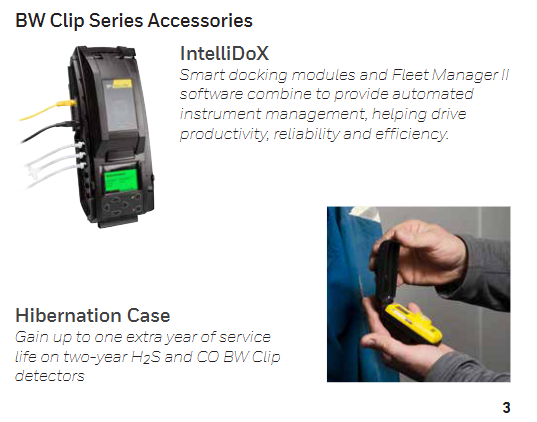
Features: Maintenance free operation for up to 3 years, no need for calibration, replacement of sensors and batteries. The 2-year H ₂ S or CO detector can extend its service life through a sleep box and is compatible with MicroDock II and IntelliDoX instrument management systems.

GasAlert Extreme

Detecting gases: H ₂ S, CO, CO-H, O ₂, SO ₂, NH ∝, PH ∝, Cl ₂, ClO ₂, NO, NO ₂, HCN, ETO, O3, etc.

General specifications: Size 1.1 x 2.0 x 3.75 inches, weight 2.9 ounces, typical battery life of 1.5 years.

Certification and approval: Class I, Div. 1, Gr. A, B, C, D; Multiple certifications including Class II, Div. 1, Gr. E, F, G, etc.

Warranty: Full 2-year warranty (including sensors, Cl ₂, NH ∝, O3, ETO, and ClO ₂ sensors for 1 year).

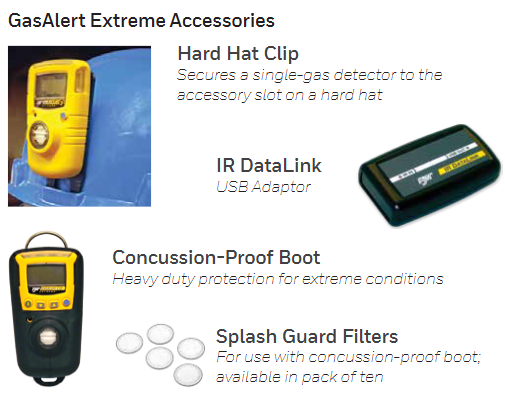
Features: Compact and affordable, capable of monitoring multiple single gas hazards, battery and sensor replaceable on site, multiple tamper proof user options and multilingual display, data recording as standard configuration, easy calibration, compatible with MicroDock II automatic testing and calibration system.

Multi gas detector

GasAlertMicroClip series

Detecting gases: H ₂ S, CO, O ₂ LEL。

General specifications: Size 4.4 x 2.4 x 1.2 inches, weight 6.7 ounces, operating temperature -4 to+122 ° F, typical battery life of 18 hours (less than 6 hours on charge).

Certification and approval: Class I, Div. 1, Gr. A, B, C, D; ATEX: X g II 1 G Ex ia IIC T4 Ga, etc.

Warranty: GasAlertMicroClip XL comes with a full 2-year warranty (including sensors and batteries); GasAlertMicroClip X3 comes with a 3-year warranty (including all sensors).

Features: Easy to wear, slim and compact, GasAlertMicroClip X3 has longer battery life in cold weather, with green IntelliFlash ™ Blinking, one click operation reduces training time, compatible with MicroDock II and Fleet Manager II software.

BW Clip4

Detecting gases: H ₂ S, CO, O ₂ LEL。

General specifications: Size 4.7 x 2.7 x 1.3 inches, weight 8.2 ounces, operating temperature -4 to+131 ° F, typical battery life of 2 years (continuous operation).

Certification and approval: Class I, Div 1, Group A, B, C, D; Class I, Zone 0, Group IIC, etc.

Warranty: Full 2-year warranty (including all sensors).

Features: Easy to operate, “always on”, no need to charge, replace batteries or sensors, low cost of ownership, backed by Honeywell’s quality commitment.

GasAlertQuattro

Detect gases: H ₂ S, CO, O ₂, LEL (1-4 gases).

General specifications: Size 5.1 x 3.2 x 1.9 inches, weight 11.15 ounces (with rechargeable battery pack) or 11.92 ounces (with alkaline battery pack), typical battery life AA alkaline battery 14 hours (+68 to 122 ° F), rechargeable battery 20 hours (+68 to 122 ° F), etc.

Certification and approval: Class I, Div. 1, Gr. A, B, C, D; ATEX: X g II 1 G Ga Ex ia IIC T4 Ga, etc.

Warranty: Full 2-year warranty (including all sensors).

Features: Sturdy and reliable, one click operation, flexible power options, graphic LCD display with easily recognizable icons, IntelliFlash provides continuous visual confirmation, suitable for various industrial applications, compatible with MicroDock II system.

image.png

GasAlertMax XT II

Detect gases: H ₂ S, CO, O ₂, LEL (1-4 gases).

General specifications: Size 5.1 x 2.8 x 2.0 inches, weight 11.5 ounces, typical battery life of 13 hours (32 ° F), 8 hours (-4 ° F), and 6 hours of charging.

Certification and approval: IECEx: Ga Ex ia IIC T4; Class I, Div. 1, Gr. A, B, C, D, etc.

Warranty: Full 2-year warranty (including all sensors).

Features: Easy to operate, equipped with SmartSample pump, IntelliFlash flashing LED compliance indicator, reliable monitoring of multiple hazards, compatible with MicroDock II automatic testing and calibration system.

GasAlertMicro 5 Series

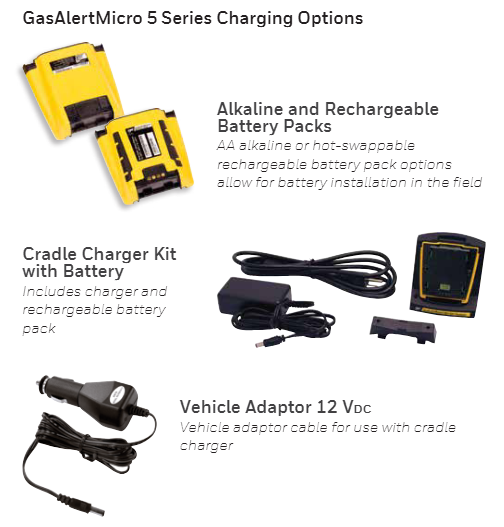
Detecting gases: VOCs, CO ₂, LEL, H ₂ S, CO, O ₂, SO ₂, PH ∝, NH ∝, NO ₂, HCN, Cl ₂, ClO ₂, O3, etc. (1-5 gases).

General specifications: Size 5.7 x 2.9 x 1.5 inches, weight 13.1 ounces, operating temperature -4 to+122 ° F (PID 14 to+104 ° F), typical battery life of 20 hours (PID/IR 15 hours).

Certification and approval: Class I, Div. 1, Gr. A, B, C, D; ATEX: X g II 1 G Ga Ex ia IIC T4 *, etc.

Warranty: Full 2-year warranty (including sensors, Cl ₂, HCN, NH ∝, O ∝, ClO ₂, and PID sensors for 1 year).

Features: Compact and lightweight, with diffusion or pump suction capabilities, capable of monitoring and displaying multiple potential atmospheric hazards simultaneously. The GasAlertMicro 5 PID model can identify VOCs that can be detected by PID, and the GasAlertMicro 5 IR uses NDIR sensors to monitor CO ₂ levels. It has multiple on-site options that users can set and is compatible with the MicroDock II system.

Docking、 Testing and data management equipment

IntelliDoX Automatic Instrument Management System

General specifications: Size 5.4 × 14.2 × 4.3 inches (each docking module), weight 4.2 pounds, power supply 12V/8.33A ITE, external interface 1 USB port, 1 Ethernet port, pump flow rate 350 ml/min (each module has an independent pump).

Certification and approval: CSA/UL 61010-1 (3rd Ed), etc.

Warranty: Full 2-year warranty.

Features: Combining intelligent docking module and Fleet Manager II software to achieve automated instrument management, automatic testing and data transmission after placing detectors, fast collision testing, and the ability to combine multiple modules to improve efficiency. It can run online or independently.

image.png

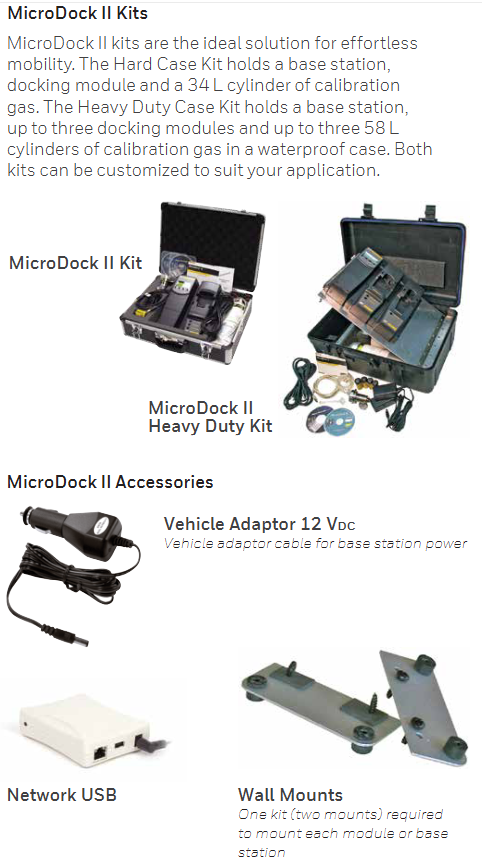
MicroDock II Automatic Testing and Calibration Station

General specifications: Size 8.3 × 10.4 × 3.2 inches (base station with one docking module), power supply 6V wall adapter or 4 C-type batteries, external interface USB 2.0 interface, pump flow rate 400 ml/min.

Certification and approval: IEC 61010/C22.2 No. 61010, etc.

Warranty: Full 2-year warranty.

Features: Economical and efficient collision testing, calibration, charging, and record management, no need for computers, portable, expandable to 6 modules, storing and updating calibration records, automatic testing of sound and light alarms, including Fleet Manager II software.

Fleet Manager II software

Function: Provides comprehensive control over detector configuration and reporting, can adjust the activity of IntelliDoX or MicroDock II docking modules, adjust detector settings and alarm points, create reports, view history, archive data, manage records, etc.

Compatible devices: BW Clip series, GasAlert Extreme, GasAlertMicroClip series and other detectors, as well as MicroDock II, IntelliDoX.

Calibration, testing, and sampling equipment

Calibration and testing equipment

Calibration gas: There are various gas types, combinations, cylinder sizes, and concentrations.

Cylinder mounting bracket: available in fixed and adjustable versions, suitable for 34L and 58L gas cylinders.

Regulators: There are various demand flow regulators and calibration gas regulators.

Sample Equipment

Manual suction pump: simplifies remote sampling.

Sampling probes and hoses: available in various styles, options, and lengths.

Sampling float: Sampling above the liquid surface.

Replace filters and parts: Keep the sampling equipment in good condition.

image.png

Honeywell System Sensor L-Series Wall Mounted Sound

Product overview

The System Sensor L-Series is a series of indoor optional output horn, strobe light, and sound light combination alarms suitable for wall mounted applications. This series of products has rich functions, modern aesthetic design, low current consumption, can shorten installation time and increase revenue. It is one of the most widely used and easy-to-use series in the industry. It has white and red plastic shells, as well as standard and compact sizes, which can almost meet various application needs.

Product Features

Design advantages: Adopting a plug-in design, minimal intrusion into the bottom box, making installation fast and simple, and almost eliminating costly and time-consuming grounding faults; The modern aesthetic design has been updated, and the horn and sound light combination alarm adopt a small-sized design.

Anti tampering structure: It can effectively prevent unauthorized operations and damage.

Voltage adaptive: It can automatically select 12V or 24V operation at 15 and 30 Candela.

Flexible Candlelight Setting: Candlelight settings for wall mounted units can be selected on-site, including 15, 30, 75, 95, 110, 135, and 185 Candela.

Horn performance: At 16 volts, the horn rated value is 88+dBA; Equipped with a rotary switch for selecting horn pitch and two volume options.

Easy installation: All standard and wall mounted units use mounting plates; The short-circuit spring on the installation board can be used to check the continuity of wiring before equipment installation, simplify installation, and protect equipment from construction damage.

Compatibility: Electrical compatibility with traditional SpectraAlert and SpectraAlert Advance devices; Compatible with MDL3A synchronization module.

Installation restrictions: The strobe light and sound light combination alarm are only listed and applicable to wall mounted devices; Horn column names are suitable for wall or ceiling installations.

Technical specifications

General specifications

Installation bottom box: Standard horn, strobe light, and sound and light combination alarm can be installed on standard 2 × 4 × 1 and 7/8 inch bottom boxes, 4 × 4 × 1.5 inch bottom boxes, 4-inch octagonal bottom boxes, or double gang bottom boxes; Compact products can be installed in a single gang 2 × 4 × 1 and 7/8 inch bottom box.

Installation board: All standard wall mounted products use universal installation boards, while compact wall mounted models use separate universal installation boards; Notify the device circuit terminals to be connected to the universal mounting board.

Power supply: with Sync Circuit ™  When used together with module accessories, the non coding notification device circuit outputs power with a rated voltage of 12 or 24 volts; When using the Sync Circuit module, the operating voltage range of the 12 volt rated notification device circuit output is 8.5-17.5 volts, and the 24 volt rated is 16.5-33 volts.

Working environment: Indoor L series products work at 32-120 degrees Fahrenheit (0-49 degrees Celsius), with a regulated DC or full wave rectified unfiltered power supply.

Frequency flash lamp: meets the requirements of visible signal equipment, flashes at a frequency of 1Hz throughout the entire operating voltage range, consists of xenon flash tubes and related lens/reflector systems, listed in ULC, approved for fire protection services.

Sound and light combination alarm: listed in ULC, approved for fire protection services, with wiring as the main signal notification device, meeting the requirements of visible signal equipment, and the specifications of the flashing lights are the same as those mentioned above; The horn has two audible options, which can be switched between temporary three mode and non temporal (continuous) mode, set through a multi position switch, and can operate on encoded or non encoded power sources.

Synchronization module: System Sensor Sync · Circuit model MDL3A is listed in ULC and approved for use in fire protection services; Synchronize the strobe light with 1Hz and the horn with temporary three. When operating the strobe light, the horn of the sound and light combination model can be silenced through a single pair of wires; Installed on a 4 and 11/16 x 4 and 11/16 x 2 and 1/8 inch bottom box; It can control two Style Y (Class B) circuits or one Style Z (Class A) circuit, synchronize multiple regions, and multiple synchronization modules connected in a daisy chain can synchronize all the regions they control. It cannot work on the encoding power supply.

Physical/Electrical Specifications

Standard operating temperature: 32 ° F to 120 ° F (0 ° C to 49 ° C).

Humidity range: 10% to 93% non condensing.

Flashing rate of strobe light: once per second.

Nominal voltage: stabilized at 12 DC or stabilized at 24 DC/full wave rectification.

Working voltage range: 8-17.5 volts when rated at 12 volts, 16-33 volts when rated at 24 volts; The 12 volt nominal operating voltage range of the MDL3 synchronization module is 8.5-17.5 volts, and the 24 volt nominal range is 16.5-33 volts.

Input terminal wire gauge: 12 to 18 AWG.

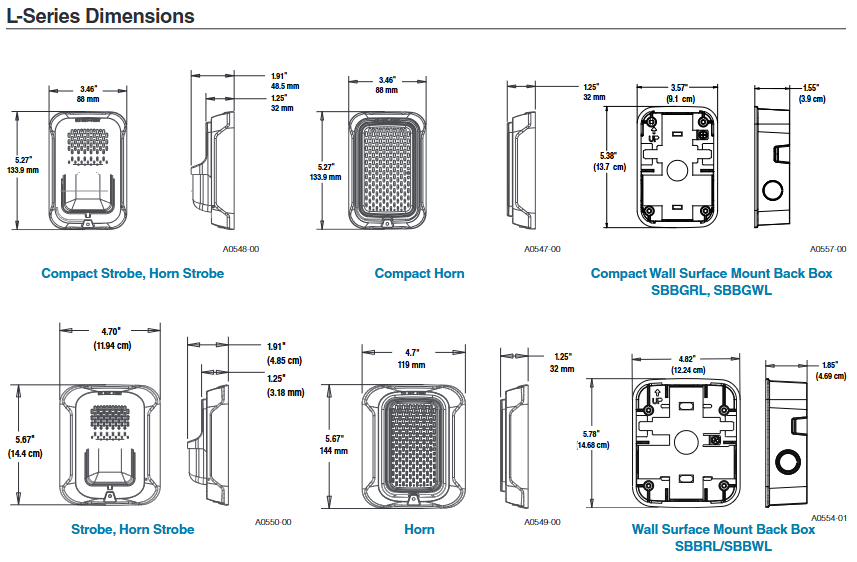
Wall mounted dimensions (including lens): The standard size is 5.6 inches long x 4.7 inches wide x 1.25 inches deep (143mm x 119mm x 32mm); The compact model measures 5.26 inches in length, 3.46 inches in width, and 1.93 inches in depth (133mm x 88mm x 49mm).

Horn size: The standard size is 5.6 inches long x 4.7 inches wide x 1.25 inches deep (143mm x 119mm x 32mm); The compact model measures 5.25 inches in length, 3.45 inches in width, and 1.25 inches in depth (133mm x 88mm x 32mm).

Current consumption and sound output data

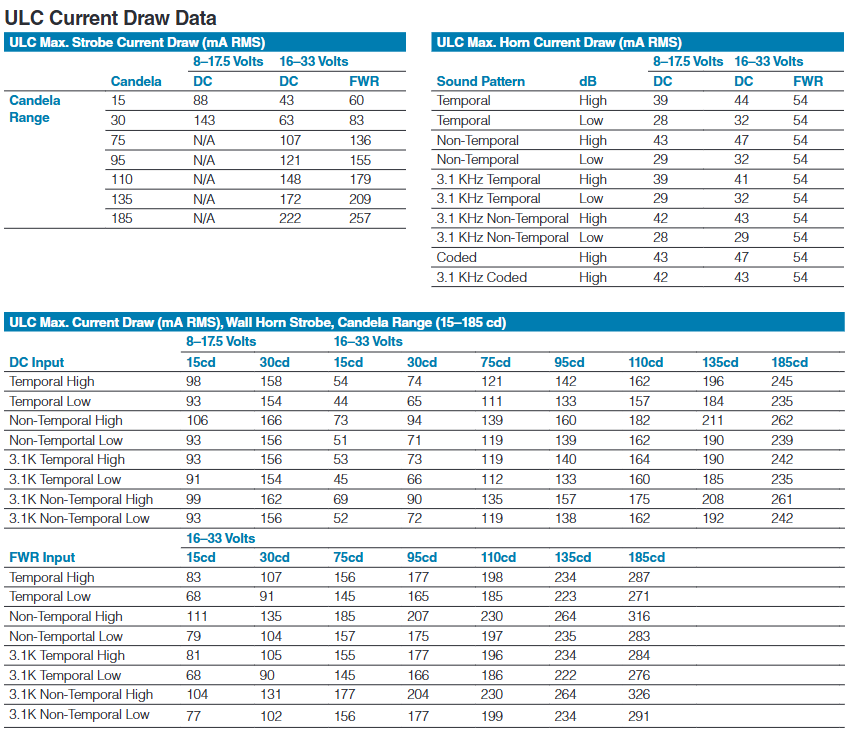
Provides maximum current consumption data for strobe lights, horns, and sound light combination alarms under different conditions (such as voltage, candle range, sound mode, etc.), as well as sound output (dBA) data for horns and sound light combination alarms under different settings.

Ordering information

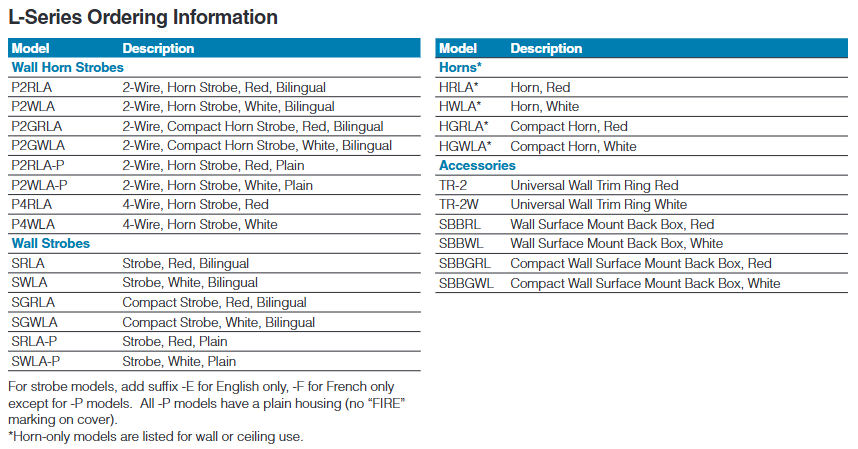
List the models and descriptions of wall mounted sound and light combination alarm, wall mounted strobe light, horn, and accessories, such as 2-wire red bilingual sound and light combination alarm (P2RLA), white wall mounted strobe light (SWLA), red horn (HRLA), universal wall mounted decorative ring (TR-2 red, TR-2W white), etc., and explain that for strobe light models, except for the – P model, the suffix – E can be added to indicate English only and – F to indicate French only. All – P model shells are plain (with no “FIRE” mark on the cover), and only horn model names are applicable for wall mounted or ceiling installation.

Honeywell SPM Flex Chemical Box Gas Detector

Product overview

Honeywell SPM Flex is a Chemcassette based software ®  The gas detector of tape technology is the most flexible and user-friendly low concentration toxic gas tape type gas detector, aimed at improving safety and productivity. It can play a role in critical operations, cope with harsh environments, reduce costly shutdowns caused by false alarms, and is easy for workers to operate. It has unparalleled accuracy, flexibility, and ease of use, ensuring personnel safety and operation.

Product features and advantages

Durable and reliable: able to work under harsh conditions such as sunlight, rain, steam environment, etc., without being affected by temperature and humidity changes, ensuring accuracy; Because its PTFE coating does not absorb dust, it is also suitable for clean rooms; If in contact with toxic gases or corrosive liquids, rinse directly or clean with a cleaning cloth.

New enhanced features: including additional gas formula, flip screen, reduced work cycle of chemical box usage, and K-factor multiplier.

Clear and Visible: The display screen is clear, with a color coded LED strip at the top, making it easy to view alarm status, gas concentration, and other data from a distance; With the help of network functions, remote viewing can be achieved by simply inserting an Ethernet cable and viewing device status through an easy to read web interface.

Flexible application: Designed to be sturdy and intuitive to operate, it can be used in various scenarios in factories.

Emergency response: Rapid start-up, easy to operate when wearing dangerous goods equipment, sturdy design, able to meet the needs of emergency response teams for quick action.

Life safety: Can be used as a fixed and portable device, is an important supplement to toxic gas monitoring systems, can be used to investigate suspected leaks, or replace faulty monitoring points, can choose to plug in or use long-lasting batteries.

Tool maintenance: When performing process tool maintenance, staff can carry it with them to ensure work safety, complete data recording, and rich gas detection options.

Advanced features and easy to operate: highly automated, intuitive and user-friendly, suitable for different operational needs.

Easy selection of target gas: Open the device and load the appropriate Chemcassette ®  Tape, select gas from the list through the intuitive LCD menu; When monitoring different types of gases, simply replace the tape and select a new gas without the need for ChemKeys ™。

Quick start of emergency response: It can be activated in less than two minutes, making it easy for emergency teams to act quickly.

Easy to use when wearing protective equipment: Designed with user experience in mind, it is easy to carry, operate, and read, even when wearing protective clothing or other protective equipment. The buttons are large and thick, and the display screen faces up for easy reading when carrying.

High precision detection: As the next generation product of SPM and TLD gas detectors, it adopts chemical box tape technology and can be used as a fixed and portable device. It can detect inherent ultra sensitive gases in operation, such as hydrides, inorganic acids, oxidants, amines, etc., and this technology can quickly and clearly display the presence of gases and provide physical records to prevent downtime caused by false alarms.

Data recording and information management: It can record data at each monitoring moment for easy analysis at any time, and can save historical data such as gas concentration, alarms, tape replacement, etc. for up to three months. It can be viewed through a web server or downloaded to a USB drive; Easily adjust configurations through intuitive menus, such as gas detection limits, locking alarm parameters, etc., and can be downloaded and transferred to other devices through USB ports, making it easy for multiple detectors to maintain consistent configurations.

High reliability design: components are easy to maintain, batteries are reliable, convenient for long-term portable use, and have an economical cost of ownership; If the device loses power when plugged in, the internal battery will be used as a backup to ensure continuous monitoring.

Brand Guarantee: Produced by Honeywell, adhering to its high standards of engineering design in terms of safety and reliability, supporting customers’ investments, and providing customers with confidence in facility gas safety, compliance, and normal operating time.

Honeywell Gas Detection Product Series

Honeywell gas detectors protect personnel, assets, and the environment from toxic and flammable gas hazards. Their advantage stems from their leading position in sensor technology, with four sensor manufacturing plants providing core detection components for the entire industry.

Business field: From independent units to fully engineered multi-point systems, cost-effective regulatory compliance solutions can be provided, applied in various places such as parking lots, chillers, machinery rooms, office buildings, etc.

In the industrial field, the well-known Sieger and Manning gas detection systems use advanced electrochemical, infrared, and open path sensing technologies and are applied in fields such as oil and gas, refrigeration, and water treatment.

Portable devices: from compact and lightweight personal protective single gas or multi gas detectors to system based, networked industrial hygiene instruments, applied in underground public facilities, boiler rooms, industrial plants and other scenarios.

High tech/government field: Reliable gas and chemical detection, including cross interference free infrared spectroscopy (MST) and chemical box based paper solutions (MDA Scientific) that can detect concentrations up to one billionth, applied in semiconductor manufacturing, aerospace propulsion, and other fields.

Honeywell Midas ®- M gas monitoring system

Product overview

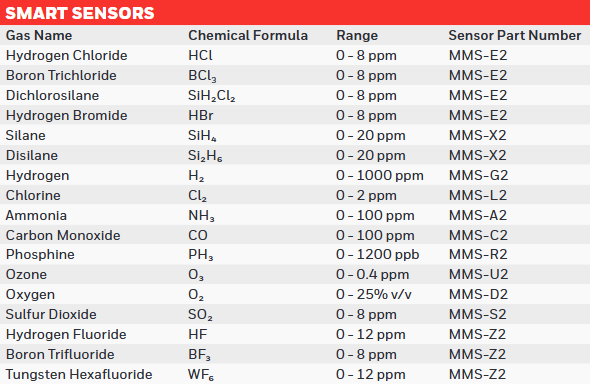
Honeywell Midas ®- The M gas monitoring system is an easy-to-use and cost-effective device in Honeywell’s gas detection product portfolio, utilizing reliable sensor technology to easily, quickly, and error free detect over 35 key toxic, environmental, and flammable gases. This device is capable of monitoring detection points up to 30 meters (100 feet) away, while using patented technology to regulate flow to ensure error free gas detection.

Its standard power and communication functions include three onboard relays (Form C), 0mA to 21mA analog outputs, and Modbus ®/ TCP Ethernet digital output facilitates connection to ports of control and alarm systems for optimal connectivity and service interaction.

The Midas-M gas detector has flexible features and options, can be used out of the box, and is easy to configure to meet your needs. Each plug and play sensor box is pre calibrated to extend sensor life, facilitate quick and easy replacement, and prevent operator errors due to incorrect or depleted sensors. In addition, the device also has an extended sensor calibration cycle and patented diagnostic function, which can reduce the cost of ownership.

Application scenarios

Suitable for various scenarios, including semiconductor processing, light industry manufacturing, university laboratories, aerospace, wastewater treatment, etc.

Features and advantages

Clear visibility: Equipped with bright LED and intuitive interface, it can instantly display gas readings or alarm levels.

Calibration completed: Factory calibrated sensors reduce the need for frequent gas testing.

Easy to install: Compact in size, suitable for crowded and complex process environments with limited space, with plug and play functionality and simple installation.

PoE protocol: includes the innovative Power over Ethernet (PoE) protocol, which meets all power, control, and communication needs through a single Ethernet connection.

Integrated security: The interface includes a password protected menu to maintain system integrity.

Technical specifications

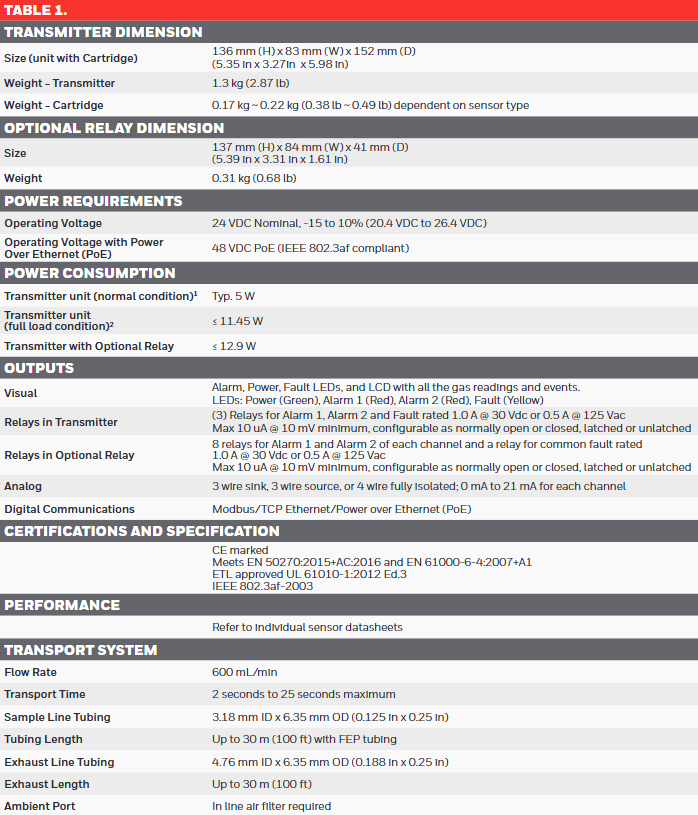
Transmitter size

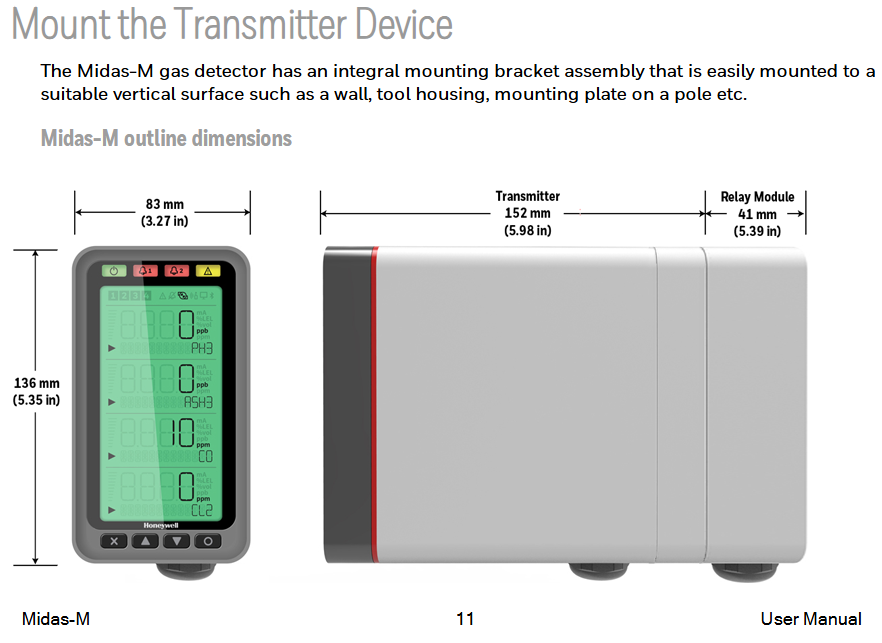
Equipment size with sensor box: 136mm (height) x 83mm (width) x 152mm (depth) (5.35 inches x 3.27 inches x 5.98 inches)

Weight of transmitter: 1.3kg (2.87 pounds)

Sensor box weight: 0.17kg~0.22kg (0.38 pounds~0.49 pounds), depending on the sensor type

Optional relay size

Dimensions: 137mm (height) x 84mm (width) x 41mm (depth) (5.39 inches x 3.31 inches x 1.61 inches)

Weight: 0.31kg (0.68 pounds)

Power requirements

Working voltage: nominal 24VDC, -15% to+10% (20.4VDC to 26.4VDC)

Working voltage with Power over Ethernet (PoE): 48VDC PoE (compliant with IEEE 802.3af standard)

Power consumption

Transmitter unit (normal conditions): typical value 5W

Transmitter unit (full load condition): ≤ 11.45W

Transmitter with optional relay: ≤ 12.9W

Output

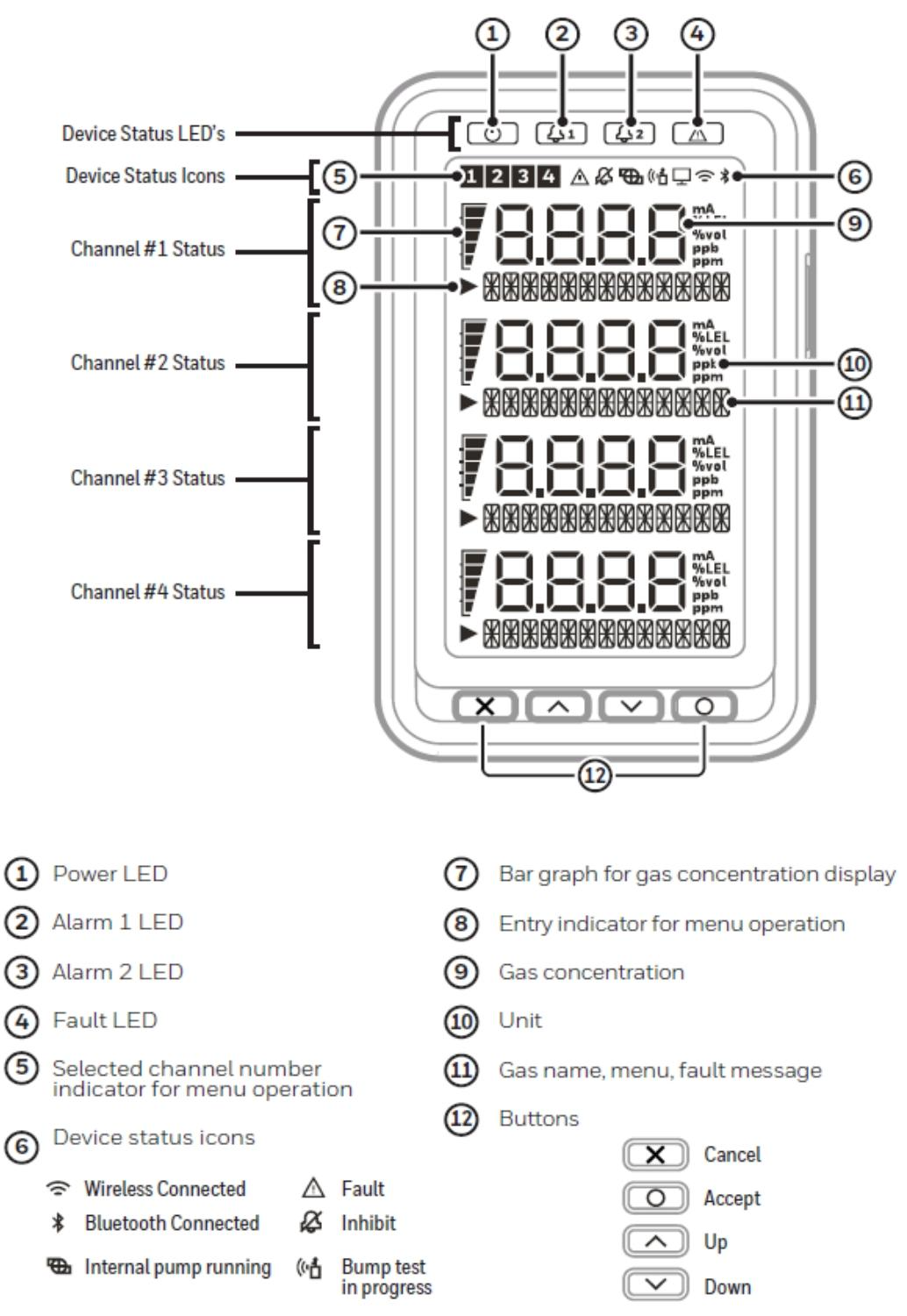
Visual output: alarm, power, fault LED and LCD, displaying all gas readings and events. LED includes power (green), alarm 1 (red), alarm 2 (red), and fault (yellow).

Relays in the transmitter: 3 relays, used for alarm 1, alarm 2, and fault respectively, with a rated value of 1.0A@30Vdc perhaps 0.5A@125Vac , the smallest 10uA@10mV , can be configured as normally open or normally closed, locked or unlocked.

Optional relays: 8 relays for each channel’s alarm 1 and alarm 2, as well as 1 common fault relay with a rated value of 1.0A@30Vdc perhaps 0.5A@125Vac , the smallest 10uA@10mV , can be configured as normally open or normally closed, locked or unlocked.

Analog output: 3-wire drain, 3-wire source, or 4-wire completely isolated; Each channel ranges from 0mA to 21mA.

Digital communication: Modbus/TCP Ethernet/Power over Ethernet (PoE)

Certification and specifications

Has CE mark and complies with EN 50270:2015+AC: 2016 and EN 61000-6-4:2007+A1 standards.

Obtained ETL certification and complies with UL 61010-1:2012 Ed.3 standard.

Compliant with IEEE 802.3af-2003 standard.

Performance

Refer to the data sheets of each sensor.

Transmission system

Flow rate: 600mL/min

Transmission time: maximum 2 seconds to 25 seconds

Sampling pipeline: 3.18mm inner diameter x 6.35mm outer diameter (0.125 inches x 0.25 inches)

Pipeline length: up to 30m (100 feet) using FEP pipe

Exhaust pipeline: 4.76mm inner diameter x 6.35mm outer diameter (0.188 inches x 0.25 inches)

Exhaust length: up to 30m (100 feet)

Environmental port: requires online air filter

operation temperature

0 ° C to 40 ° C (32 ° F to 104 ° F)

Wiring requirements

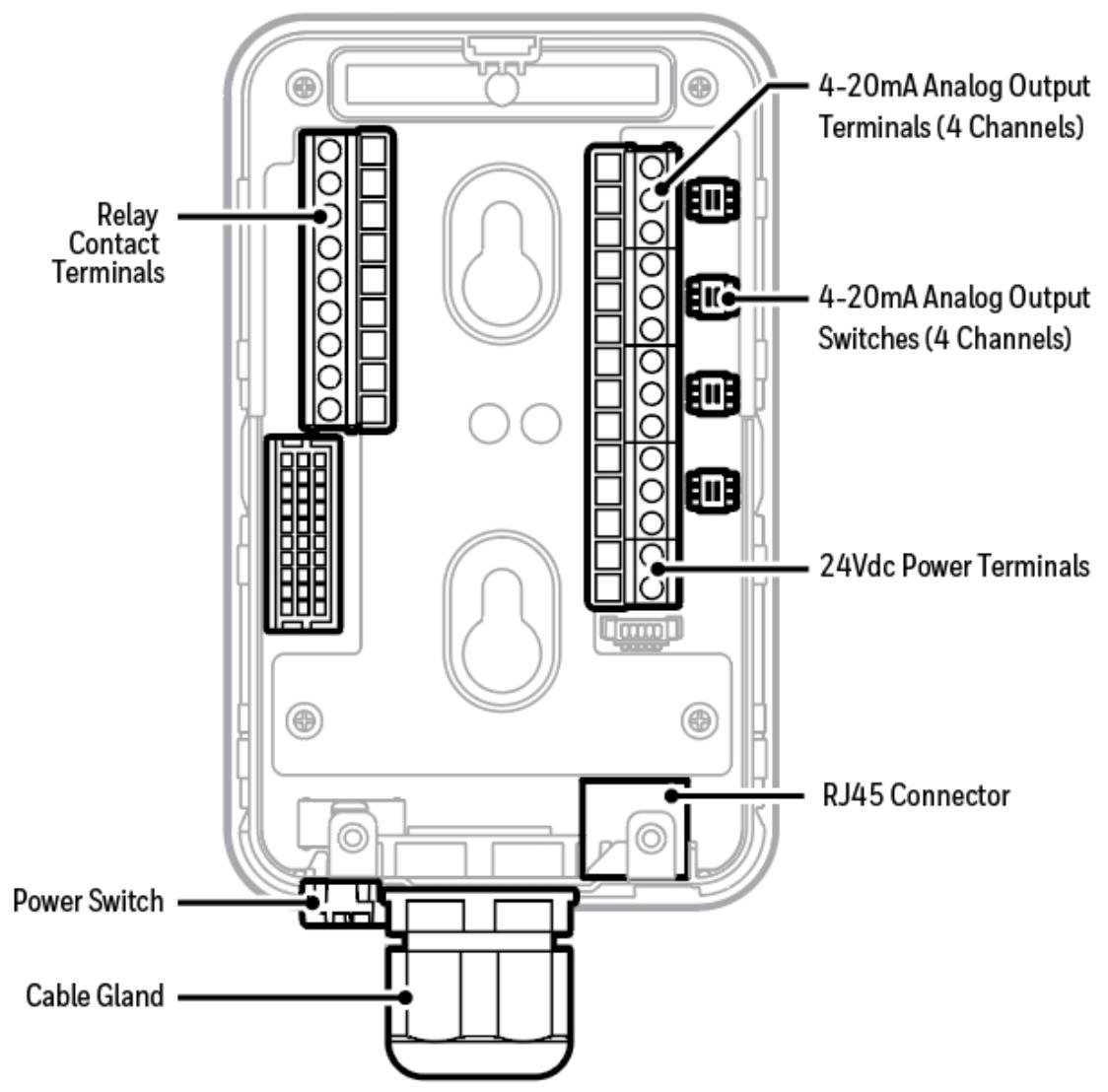
4-20mA: 2-wire, maximum 14AWG

Number: CAT5 cable or equivalent product: RJ45 connector

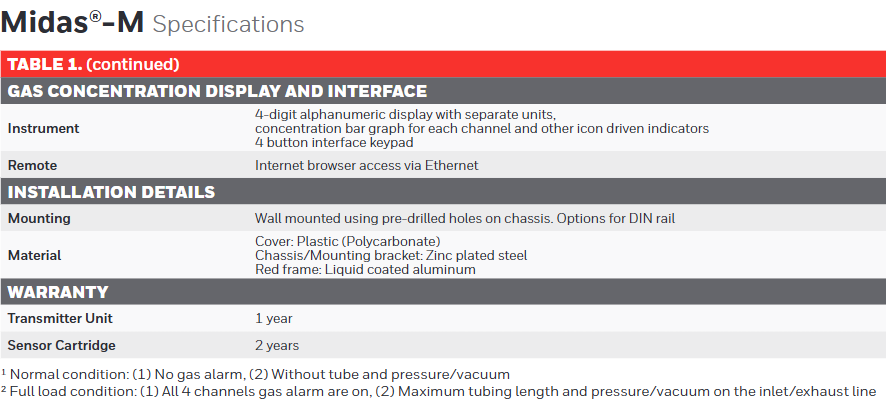
Gas concentration display and interface

Instrument: 4-digit alphanumeric display with separate units, concentration bar charts for each channel, and other icon driven indicators, with a 4-point interface keyboard.

Remote: accessed through an Internet browser over Ethernet.

Installation Details

Installation method: Use pre drilled holes on the chassis for wall mounting. Optional DIN rail installation.

Material: The lid is made of plastic (polycarbonate), the chassis/mounting bracket is made of galvanized steel, and the red frame is liquid coated aluminum.

Honeywell Midas-M Multi Gas Transmitter

Product core positioning and design architecture

As a fixed single point extraction multi gas transmitter, Honeywell Midas-M adopts an innovative 4-in-1 multi gas detection design. Its core function is to extract gas samples from local or remote sampling points to the sensor box inside the chassis for analysis. Its design goal is to meet the detection requirements of toxic, flammable gases and oxygen in the semiconductor and other manufacturing industries, suitable for non explosive environments in indoor safe areas.

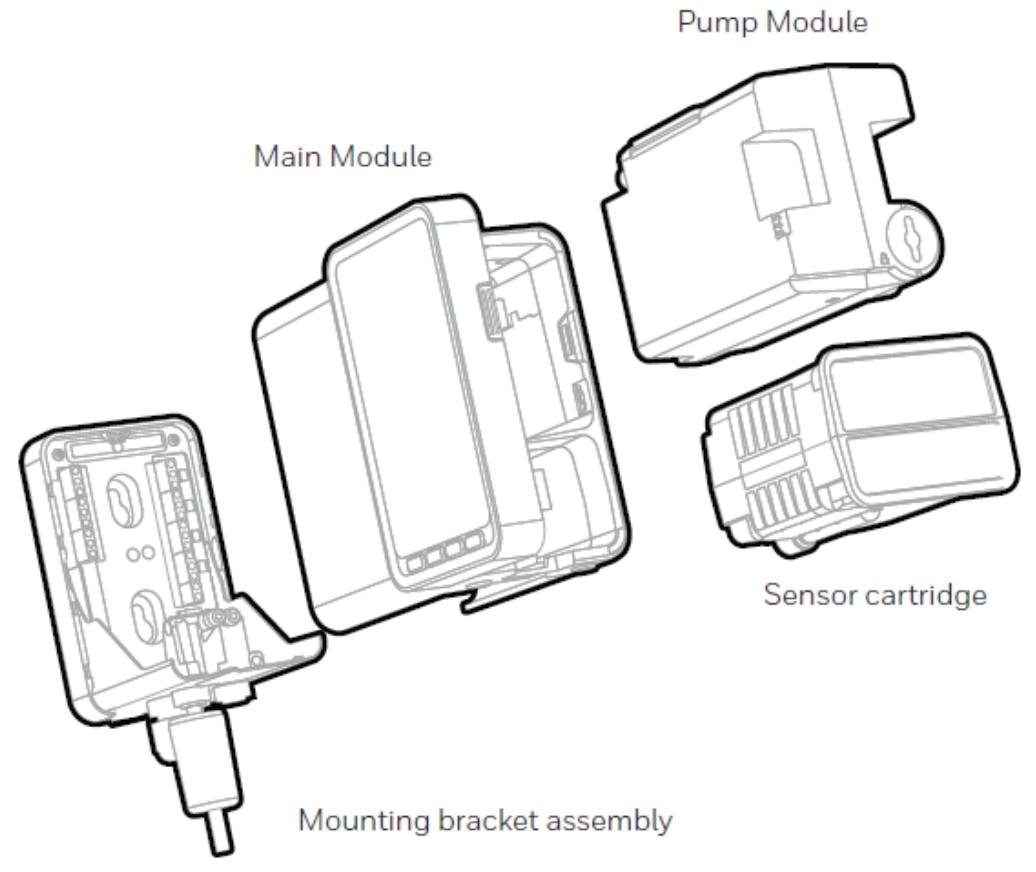
The overall architecture of the equipment consists of four core components: the main module, installation bracket assembly, sensor box, and pump module. This modular design not only facilitates installation and maintenance, but also allows for flexible configuration according to different detection requirements. The user interface includes a backlit LCD display screen, LED indicator lights, and a four key operation keyboard, which can intuitively display information such as gas concentration and alarm status, and support parameter settings and functional operations.

In terms of communication and power supply, Midas-M has high flexibility, supporting 3 onboard relays, 0-21mA analog output, Modbus/TCP digital communication, and Power over Ethernet (PoE). It can achieve the integration of power, control, and data transmission through a single Ethernet connection, greatly simplifying system wiring.

Installation process and technical specifications

(1) Mechanical installation details

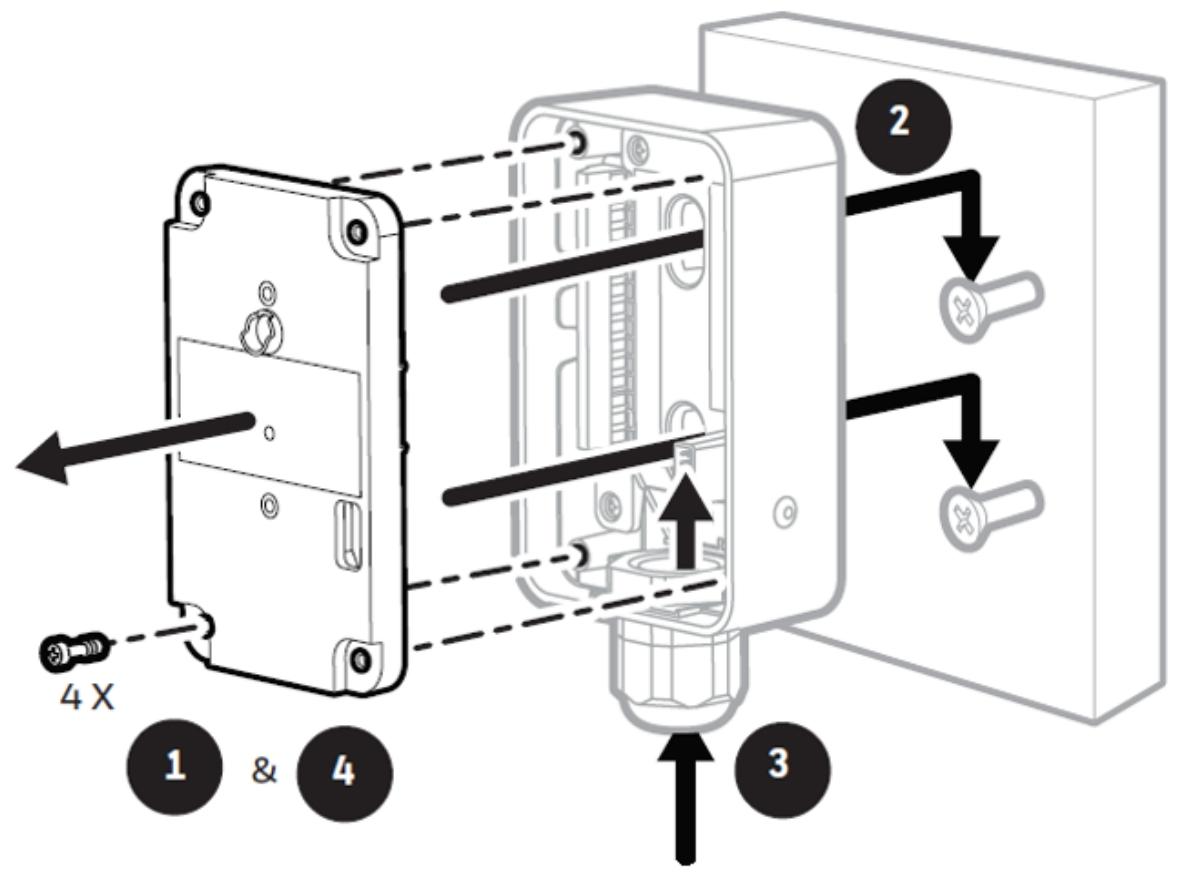
Transmitter installation: Adopting a step-by-step installation strategy, first fix the installation bracket, and then install the main module. The specific steps are: remove the equipment door → loosen the fixing screws → pull out the main module → drill holes according to the template (hole spacing 55.9mm) → fix the bracket with M4 screws → align the main module with the bracket’s rounded corner positioning → horizontally push in the main module to fully connect the connector and pipeline → tighten the bottom fixing screws. Special attention should be paid to removing the internal packaging card of the fixed pump, otherwise it may cause equipment damage.

Relay module installation: independent of the main module installation, the steps include: removing 4 screws and cover plate → positioning the module on the pre installed screws and tightening it → threading and connecting to the terminal block → resetting the cover plate and screws → docking the module connector → fixing the bracket and module with special screws.

(2) Fluid system configuration

Sampling and exhaust pipeline parameters:

Inlet sampling: the maximum length is 30m (100ft), the vacuum degree at the sampling point is ≤ -25.4cm H ₂ O. It is recommended to use a 1/8-inch ID thick wall Teflon FEP tube, the flow is stable at 600cc/min, and different pipe diameters correspond to different transmission times (25 seconds for 1/8-inch ID, 53 seconds for 3/16 inch ID).

Export exhaust: maximum length 30m (100ft), back pressure ≤ 20.3cm H ₂ O, pipeline specification 4.76mm ID × 6.35mm OD.

Pipeline preparation and filtration: The pipeline needs to be vertically cut and deburred, and the depth of insertion into the equipment port should be 15.5mm (marked for confirmation). External filters must be used: 780248 for ordinary gases and 1830-0055 or 1991-0147 for corrosive gases. It is recommended to replace them every 3 months.

(3) Electrical Connection Specification

Power requirements: Supports 24VDC discrete power supply or 48VDC PoE power supply (IEEE 802.3af standard), both cannot be connected simultaneously. Maximum power consumption: Under normal operating conditions, it is about 5W, and at full load (4-channel alarm+maximum pipeline load), it is ≤ 11.45W.

Terminal definition and wiring: The terminal supports 24-14 AWG wires (recommended 16 AWG), including interfaces for power supply, 4-20mA output, relays, etc. Among them, the 4-20mA output can be configured as a 3-wire source type, 3-wire drain type, or 4-wire isolation type. When wiring, attention should be paid to the switch settings (INT/NEXT).

Grounding requirements: If the metal casing of the equipment is not directly connected to the grounded metal surface, a dedicated grounding terminal must be connected to the external grounding electrode through PG16 glass; When using PoE, shielded CAT5 cables should be used to avoid interference from grounding loops.

(4) Installation of sensor box

The sensor box supports plug and play, and it is necessary to confirm that the model matches the detected gas before installation. The steps are: power off → open the door → remove the BiAS battery module and plug cap → align the sensor box pins and slots → gently push until fully engaged → close the door → press the “O” key to clear the “Detect New Cartridge” prompt → confirm that the green light is flashing, the yellow/red light is off, and the displayed concentration is zero.

Operational functions and system configuration

(1) Core working mode

Monitoring mode: The default operating mode of the device displays real-time gas concentration (with units and bar charts), channel status, and system icons (pump running, wireless connection, etc.). The output performance under different states is as follows:

Alarm 1: Relay 1 is activated, 4-20mA varies with concentration, corresponding to a constant red light on the channel and a red backlight.

Fault: Yellow light on, 4-20mA output 1mA, fault relay activated.

Suppression: Output 2mA, green light flashes, alarm output is suppressed.

Setting mode: Enter by long pressing the up and down keys to configure key parameters:

Alarm settings: Each channel can define 2 levels of alarm thresholds, hysteresis, delay time, and lock/unlock modes.

4-20mA output: Map 0-100% range to 4-20mA, supporting special state outputs such as fault (1mA) and suppression (2mA).

Network configuration: Supports static IP or DHCP, default IP is 169.254.60.47, subnet mask is 255.255.255.0.

(2) Calibration and maintenance functions

Calibration process:

Zero point calibration: It needs to be performed in an environment without target gas, and confirmed after the reading stabilizes. It is suitable for sensors other than O ₂.

Range calibration: Introduce a known concentration standard gas and confirm after the reading stabilizes. The O ₂ sensor is calibrated with 20.9% air as the calibration point.

Flow calibration: Adjust the pump speed to stabilize the flow at 600cc/min, and recalibrate after replacing the pump or filter.

Bump Test: A functional test to verify the responsiveness of sensors. The steps are: enter test mode → enable collision testing → introduce test gas → confirm alarm triggering → reset ventilation. It is recommended to use target gas or cross sensitive gas (such as O3 can be replaced by NO ₂) every 6 months.

(3) Network and Remote Management

The device is equipped with a built-in web server that supports access through browsers such as IE and Chrome. Its features include:

Status monitoring: Real time display of concentration, flow rate, temperature and other data for each channel.

Configuration management: remotely modify alarm thresholds, network parameters, and other settings.

Log query: View event records such as alarms, faults, calibration, etc., and support graphical display.

Certificate Management: When enabling HTTPS secure access, device certificates need to be installed (detailed steps apply to Chrome and IE browsers).

Maintenance strategy and fault diagnosis

(1) Preventive Maintenance Plan

Component maintenance project frequency note

External filter replacement takes 3-6 months. Corrosive environments require a shortened cycle

Internal filter replacement 2-year model 780248

Pump module replacement 2-year model MM-PM

Leakage inspection, pressure testing for 6 months, sealing of inlet/outlet after component replacement, verification of flow failure alarm

Adjust the pump speed through flow calibration and replace the pump or filter to ensure a stable flow rate of 600cc/min

(2) Common fault handling

Flow failure (F41): manifested as a flow rate<70% of the nominal value for 24 seconds. Troubleshooting steps: check if the filter is clogged → confirm that the pipeline connection is tight and leak free → check the pump operating status → replace the pump module.

Sensor malfunction (F50): REFLEX ®  Test failed, possible reasons: sensor aging → exposure to interfering gases → physical damage, the solution is to replace the sensor box.

Communication failure: Web access failed, check network connection → verify IP configuration → restart device → update firmware.

Technical parameters

Dimensions: transmitter 136mm × 83mm × 152mm, relay module 137mm × 84mm × 41mm

Weight: transmitter 1.3kg, sensor box 0.17-0.22kg

Working environment: temperature 0-40 ℃, humidity 20-90% RH (non condensing), pressure 700-1300hPa

Certification: CE (EN 50270), ETL (UL 61010-1), PoE (IEEE 802.3af)

Application scenarios and selection suggestions

Midas-M is suitable for scenarios that require simultaneous monitoring of multiple gases, such as:

Semiconductor cleanroom: detecting special gases such as SiH ₄ and HCl

Chemical storage tank area: monitoring toxic gases such as NH3 and H2S

Laboratory ventilation system: monitoring O ₂ content and VOC leakage

Pharmaceutical production workshop: detecting process gases such as CO and Cl ₂

Honeywell Satellite XT gas detection transmitter

Product overview

Satellite XT is an intelligent gas detection transmitter that uses a unique electrochemical sensor to detect toxic, corrosive, and flammable gases, making it a simple solution to meet all gas detection needs at any point of use. Based on the smallest and most reliable electrochemical cell technology on the market, it has the characteristics of flexibility, simplicity, and ease of application. It has two configurations to choose from, analog and digital, and can be integrated with new or existing facility control technologies. Among them, the digital version of Satellite XT is based on LonWorks ®  Technology, based on LonWorks ®  The life safety system built on the network platform allows users to utilize the cost-effectiveness of distributed control while maintaining the integrity and reliability required for compliant security applications.

Application scenarios

Suitable for gas detection in various scenarios, including:

Gas cabinet

Valve manifold box

Equipment casing

Environmental breathing zone

Gas storage room

Original Equipment Manufacturer (OEM) equipment

Typical installation scenarios include gas cabinet exhaust pipes, valve manifold boxes, equipment enclosures, and environmental breathing zones. On site attachments provide sampling options for various environments, including in-situ pipeline testing and extractive design for harsh or remote areas.

Product advantages

Fast, reliable, and specific gas detection

Continuous real-time monitoring

Interchangeable intelligent sensor units

No need for dynamic gas calibration

General sensor head electronic device

LOW COST OF OWNERSHIP

No easily worn or replaceable moving parts

Modular settings to meet current and future needs

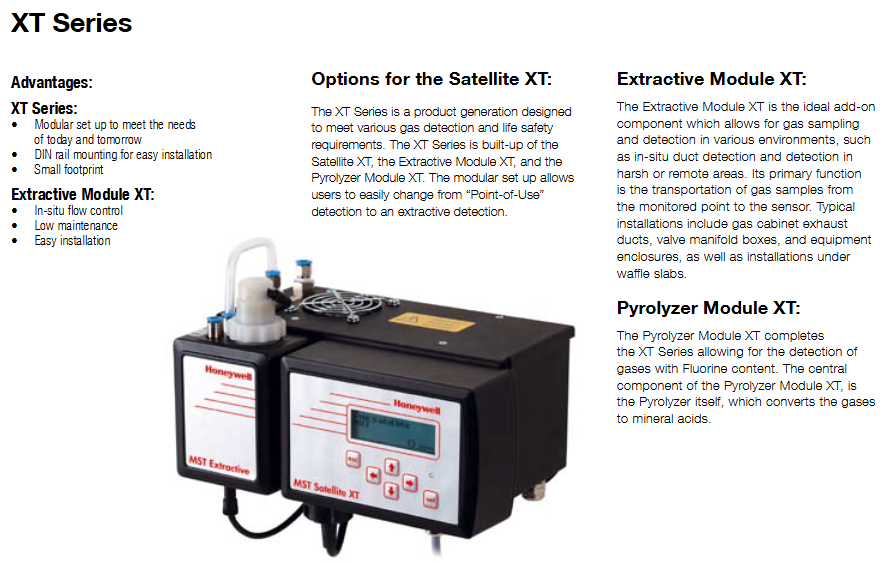
DIN rail installation, easy to install (advantages of XT series)

The extraction module XT has the advantages of in-situ flow control, low maintenance, and easy installation

Series composition and options

The XT series is a product line designed to meet various gas detection and life safety requirements, consisting of Satellite XT, Extraction Module XT, and Pyrolysis Module XT. Modular settings allow users to easily switch from “point of use” detection to extractive detection.

Extraction module XT: an ideal add-on component that allows gas sampling and detection in various environments, such as in-situ pipeline testing and detection in harsh or remote areas. Its main function is to transfer gas samples from monitoring points to sensors.

Pyrolysis module XT: The XT series has been improved to allow for the detection of fluorine-containing gases. Its core component is the pyrolyzer, which can convert gases into inorganic acids.

Sensor Expansion: Available in three lengths: 1 meter, 2 meters, and 3 meters.

Sensor related

Electrochemical cell gas detection sensor

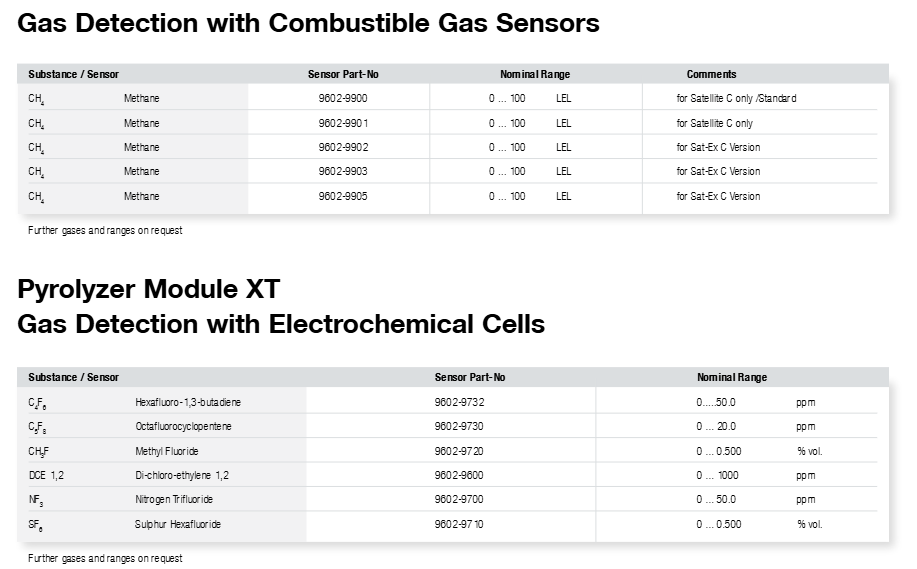
It covers various substances, such as arsine (AsH ∝), diborane (B ₂ H ₆), bromine (Br ₂), chlorine (Cl ₂), etc. Each substance corresponds to different sensor models, nominal ranges, and related descriptions, and more gases and ranges can be provided upon request.

Combustible gas sensor

For methane (CH ₄), there are various sensor models with nominal ranges of 0… 100 LEL, suitable for different versions of equipment.

Pyrolysis module XT electrochemical cell gas detection sensor

Including hexafluoro-1,3-butadiene (C ₄ F ₆), octafluorocyclopentene (C ₅ F ₈), etc., each substance corresponds to a specific sensor model and nominal range.

Working principle of sensors

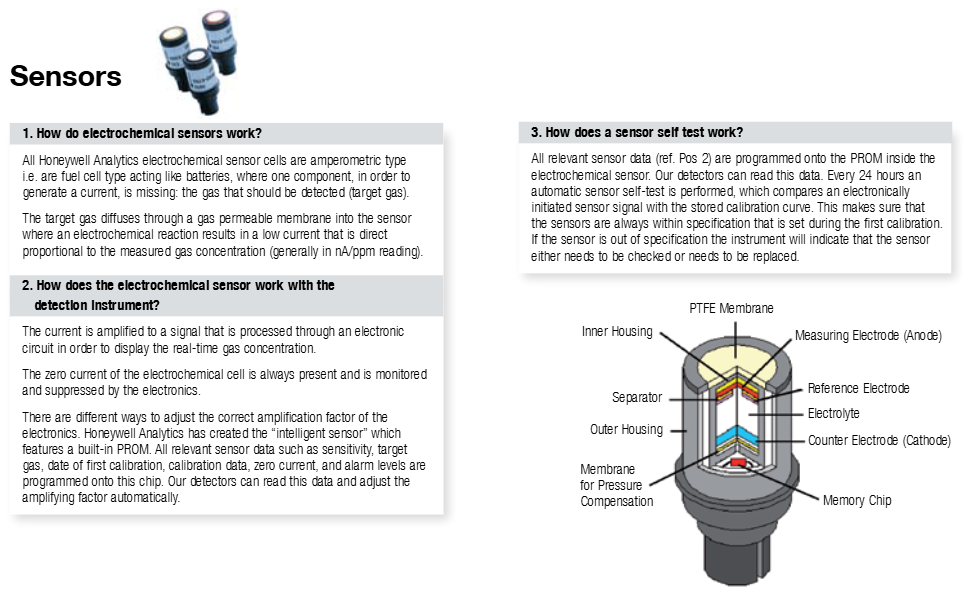
Electrochemical sensors are all ampere type, similar to fuel cells. In order to generate current, they lack a component, which is the gas (target gas) that should be detected. The target gas diffuses through the breathable membrane into the sensor, where an electrochemical reaction occurs, producing a low current proportional to the measured gas concentration (usually read in nA/ppm).

The current is amplified into a signal and processed by electronic circuits to display real-time gas concentration. The zero current of electrochemical cells always exists and is monitored and suppressed by electronic devices.

Honeywell Analytical Instruments has created an “intelligent sensor” with a built-in PROM that programs all relevant sensor data (such as sensitivity, target gas, first calibration date, calibration data, zero current, and alarm level) onto the chip. The detector can read this data and automatically adjust the amplification factor.

Sensor self-test

All relevant sensor data is programmed into the PROM inside the electrochemical sensor, and the detector can read this data. Perform an automatic sensor self-test every 24 hours, comparing the electronically activated sensor signal with the stored calibration curve to ensure that the sensor remains within the specifications set during the initial calibration. If the sensor exceeds the specifications, the instrument will indicate that the sensor needs to be checked or replaced.

Technical specifications

Digital version (such as Satellite XT FTT, etc.)

Power requirements: Voltage ranging from 12 to 24 VDC, maximum power consumption varies for different models, such as FTT maximum 0.6W, FTT/R maximum 1.4W, etc.

Network data transmission: 78Kb/s.

Wiring topology: Free, such as bus, star, ring, or hybrid.

Wiring: The network uses 4-wire shielded cables, and relay contacts use 6-wire shielded cables.

Relay output: 3 single pole single throw (SPST) contacts, maximum rated 250 VAC/30 VDC, 2A.

Graphic display: 122 x 32 dots with backlight.

Status LED: Green.

Keyboard: 6 touch sensitive film function keys.

Physical dimensions: 145 x 95 x 50mm (length x width x height).

Weight: Different models have different weights, such as FTT at 480g (17oz) and FTT/R at 650g (23oz).

Installation: Special installation board (provided with the instrument).

Shell protection level: IP 52 (optional IP 65).

RF interference/electromagnetic compatibility: Complies with EN 55022 and EN 50082-2 standards.

Working conditions: temperature from -20 ° C to+40 ° C, pressure from 700 to 1300hPa, humidity from 20 to 90% relative humidity.

Part number: Different models correspond to different numbers, such as FTT 9602-0400, FTT/R 9602-0405, etc.

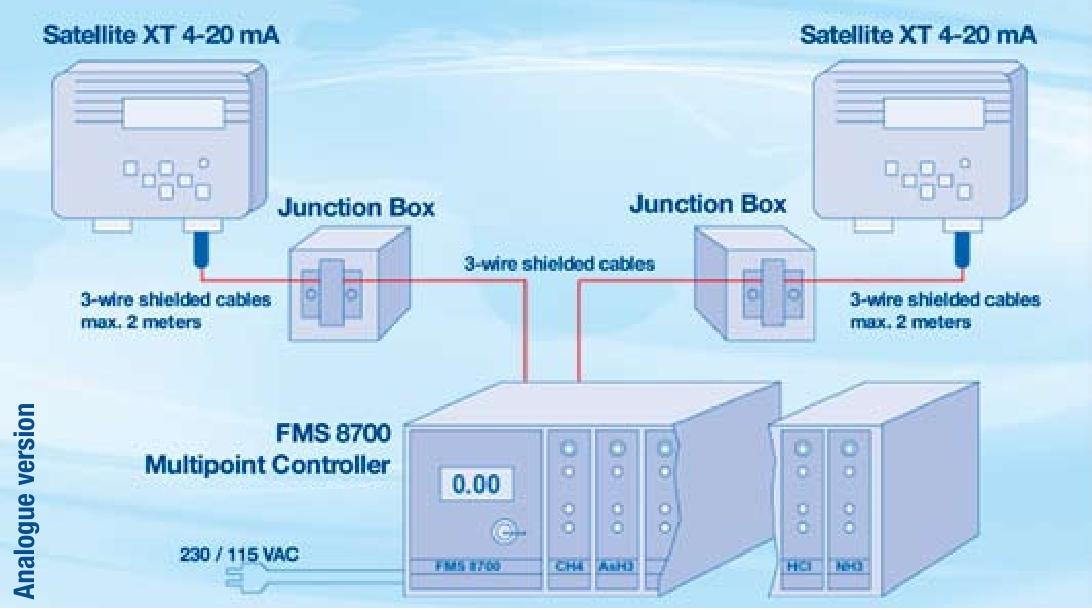
Simulated version (Satellite XT 4-20 mA, etc.)

Power requirements: Voltage 12 to 24 VDC, maximum power consumption varies for different models, such as 4-20 mA with a maximum of 1W, 4-20 mA/R with a maximum of 1.8W, etc.

Analog signal output: The monitoring mode is 2-20mA or 4-20mA, the warning state is 2.8-4 mA 0.1Hz, the maintenance mode is 2.4-4 mA 1Hz, and the fault range is 0-2mA.

Wiring: The analog interface uses 3-wire shielded cables, and the relay contacts use 6-wire shielded cables.

Relay output: 3 single pole single throw (SPST) contacts, maximum rated 250 VAC/30 VDC, 2A.

Graphic display: 122 x 32 dots with backlight.

Status LED: Green.

Keyboard: 6 touch sensitive film function keys.

Physical dimensions: 145 x 95 x 50mm (length x width x height).

Weight: Different models have different weights, such as 480g (17oz) for 4-20 mA and 650g (23oz) for 4-20 mA/R.

Installation: Special installation board (provided with the instrument).

Shell protection level: IP 52 (optional IP 65).

Radio frequency interference/electromagnetic compatibility: Complies with standards such as EN 55011 and EN 50082-2.

Working conditions: temperature from -20 ° C to+40 ° C, pressure from 700 to 1300hPa, humidity from 20 to 90% relative humidity.

Part number: Different models correspond to different numbers, for example, 4-20 mA is 9602-0200, 4-20 mA/R is 9602-0205, etc.

Honeywell related products and services

Range

Fixed gas monitoring: Honeywell Analytical Instruments provides a wide range of fixed gas detection solutions, suitable for various industries and applications, including commercial properties, industrial applications, semiconductor manufacturers, energy plants, and petrochemical plants. It can detect flammable, oxygen, and toxic gases (including foreign gases), with four core sensing technologies (paper tape, electrochemical cells, catalytic beads, and infrared), capable of detecting gases as low as one billionth (ppb) or volume percentage (% v/v), providing cost-effective solutions that comply with regulations, as well as customized preventive/corrective maintenance plans and extended product warranties.

Portable gas monitoring: Honeywell analytical instruments have a wide range of reliable solutions for personal protection against gas hazards, making them ideal for use in enclosed or confined spaces, including detecting flammable, oxygen, and toxic gases, single gas personal monitoring devices (worn by individuals), multi gas portable gas monitoring devices (for confined space entry and regulatory compliance), and multi gas transportable monitoring devices (for temporary protection of areas during on-site construction and maintenance activities).

Technical service

Honeywell Analytical Instruments values high-quality service and customer care, committed to providing complete and thorough customer satisfaction. The services provided include comprehensive technical support, well-equipped workshops to ensure quick repair turnover, a comprehensive network of service engineers, product usage and maintenance training, mobile calibration services, and more.

Search for products

Back to Top
Product has been added to your cart